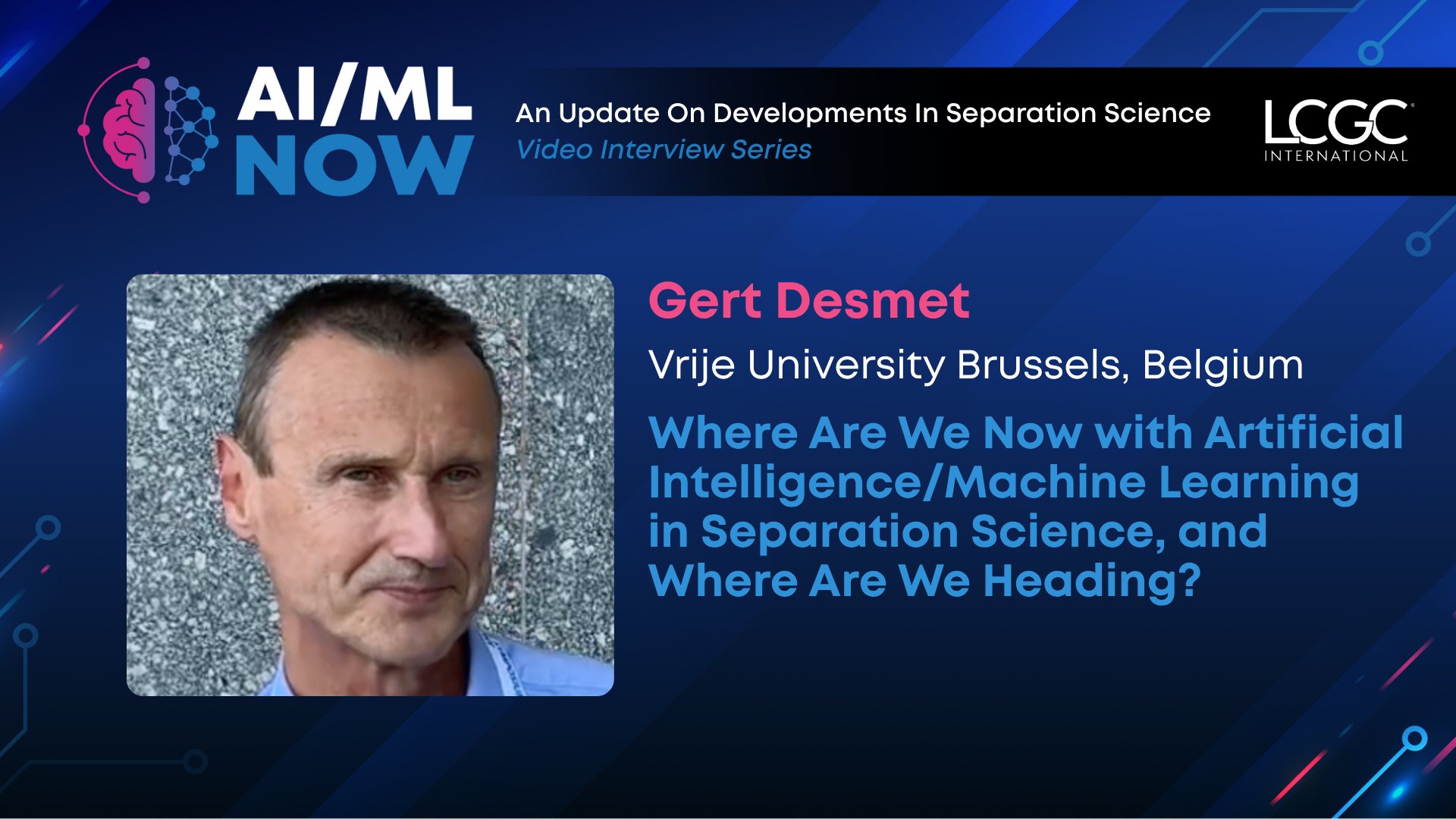
Gert Desmet explores the current role of AI/ML in separation science.
Introduction to the AI ML Now Series and Initial Interview Focus The 'AI ML Now' is a newly launched video interview series by LCGC International, designed to delve into the transformative impact of artificial intelligence (AI) and machine learning (ML) across various facets of separation science. This series aims to feature interviews with leading researchers who are actively contributing to the advancement of this rapidly evolving field. The inaugural episode presents an insightful discussion with Gert Desmet, a distinguished professor from the Vrije Universiteit Brussel in Belgium. In this first segment, Professor Desmet provides a comprehensive overview of the current standing and practical applications of AI and ML within separation science. The interview was conducted live at the ISC 2026 conference, an international scientific gathering that took place in Prague from September 6th to 10th, 2026. Detailed Discussion Points from Part One of the Interview with Gert Desmet During the initial segment of his interview, Gert Desmet embarked on a thorough assessment of the contemporary status of AI and ML in separation science. A key objective of this part was to clarify and debunk prevalent misconceptions regarding what AI and ML are genuinely capable of achieving, and conversely, what their limitations are, especially in the context of chromatographic applications. Following this, Desmet meticulously evaluated the inherent suitability or unsuitability of separation science disciplines for the adoption of these data-driven AI/ML methodologies. The dialogue then advanced into a critical exploration of the potential for future research to transition beyond current 'black-box' AI models. This envisioned shift would embrace physics-informed and chemically-informed machine learning paradigms, which integrate and build upon established scientific theories and principles directly into their models, aiming for greater transparency and interpretability. The specific core questions addressed in Part One of the interview included: 'Where are we now with artificial intelligence and machine learning in separation science?' and 'Are there any popular misconceptions about AI/ML in separation science?' The article also indicates the availability of the full video for this segment and provides a link to Part 2 of the interview, which will focus on the future trajectory of AI/ML in separation science. Professional Background and Research Focus of Gert Desmet Gert Desmet is a highly accomplished academic, holding both a master’s degree and a PhD in chemical engineering, with his doctoral research specifically centered on fermentation technology, all obtained from the Vrije Universiteit Brussel (VUB) in Brussels, Belgium. Presently, he holds the esteemed position of a full professor in chemical engineering at VUB. His leadership roles at the university include serving as the head of the Department of Chemical Engineering from 2008 to 2020, and as the vice-dean of the Faculty of Sciences and Bioengineering from 2012 to 2015. Professor Desmet's primary research interests are deeply rooted in the miniaturization of separation methods and an in-depth investigation and sophisticated modeling of flow effects that occur within chromatographic systems. His contributions to the field extend to guest-editing a prominent LCGC International supplement focused on 'Advances in (U)HPLC,' underscoring his expertise. Furthermore, he is an active and influential member of the LCGC International editorial advisory board (EAB), contributing to the strategic direction and quality of the publication's content.
Introduction to the AI ML Now Series and Initial Interview Focus
The 'AI ML Now' is a newly launched video interview series by LCGC International, designed to delve into the transformative impact of artificial intelligence (AI) and machine learning (ML) across various facets of separation science. This series aims to feature interviews with leading researchers who are actively contributing to the advancement of this rapidly evolving field. The inaugural episode presents an insightful discussion with Gert Desmet, a distinguished professor from the Vrije Universiteit Brussel in Belgium. In this first segment, Professor Desmet provides a comprehensive overview of the current standing and practical applications of AI and ML within separation science. The interview was conducted live at the ISC 2026 conference, an international scientific gathering that took place in Prague from September 6th to 10th, 2026.
Detailed Discussion Points from Part One of the Interview with Gert Desmet
During the initial segment of his interview, Gert Desmet embarked on a thorough assessment of the contemporary status of AI and ML in separation science. A key objective of this part was to clarify and debunk prevalent misconceptions regarding what AI and ML are genuinely capable of achieving, and conversely, what their limitations are, especially in the context of chromatographic applications. Following this, Desmet meticulously evaluated the inherent suitability or unsuitability of separation science disciplines for the adoption of these data-driven AI/ML methodologies. The dialogue then advanced into a critical exploration of the potential for future research to transition beyond current 'black-box' AI models. This envisioned shift would embrace physics-informed and chemically-informed machine learning paradigms, which integrate and build upon established scientific theories and principles directly into their models, aiming for greater transparency and interpretability. The specific core questions addressed in Part One of the interview included: 'Where are we now with artificial intelligence and machine learning in separation science?' and 'Are there any popular misconceptions about AI/ML in separation science?' The article also indicates the availability of the full video for this segment and provides a link to Part 2 of the interview, which will focus on the future trajectory of AI/ML in separation science.
Professional Background and Research Focus of Gert Desmet
Gert Desmet is a highly accomplished academic, holding both a master’s degree and a PhD in chemical engineering, with his doctoral research specifically centered on fermentation technology, all obtained from the Vrije Universiteit Brussel (VUB) in Brussels, Belgium. Presently, he holds the esteemed position of a full professor in chemical engineering at VUB. His leadership roles at the university include serving as the head of the Department of Chemical Engineering from 2008 to 2020, and as the vice-dean of the Faculty of Sciences and Bioengineering from 2012 to 2015. Professor Desmet's primary research interests are deeply rooted in the miniaturization of separation methods and an in-depth investigation and sophisticated modeling of flow effects that occur within chromatographic systems. His contributions to the field extend to guest-editing a prominent LCGC International supplement focused on 'Advances in (U)HPLC,' underscoring his expertise. Furthermore, he is an active and influential member of the LCGC International editorial advisory board (EAB), contributing to the strategic direction and quality of the publication's content.