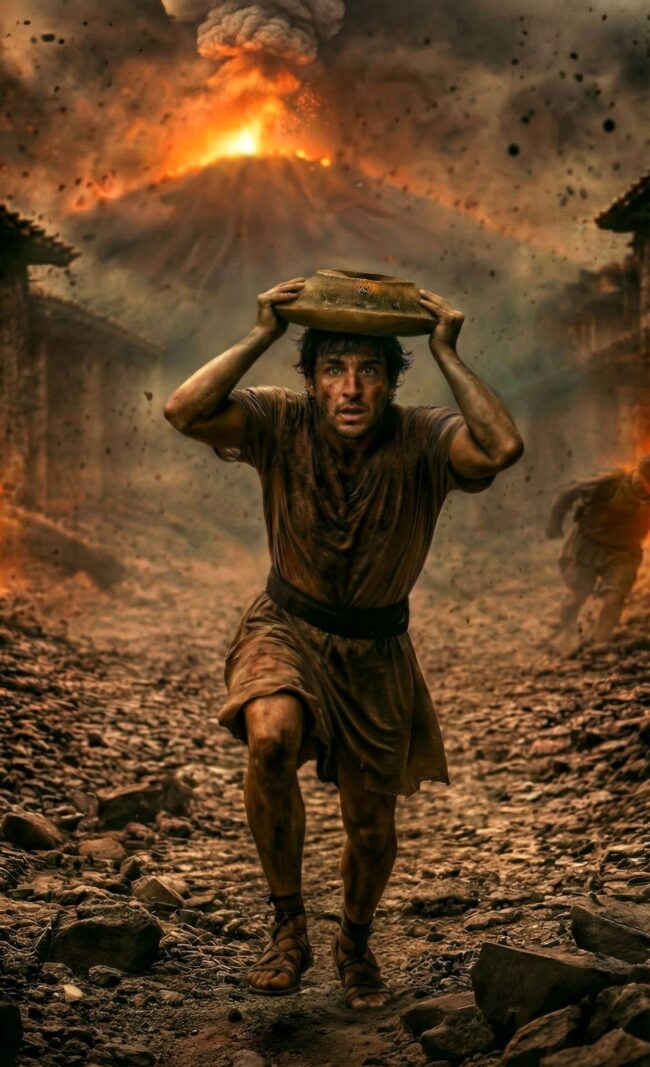
Archaeologists have embarked on a groundbreaking project, utilizing advanced Artificial Intelligence (AI) technology to meticulously recreate the likeness and final moments of a victim from the catastrophic 79 CE eruption of Mount Vesuvius that buried the ancient Roman city of Pompeii. This unprecedented application of digital reconstruction brings a poignant human dimension back to historical research, allowing a clearer visualization of a man whose remains were discovered in a posture suggesting a desperate attempt to protect himself from the volcanic onslaught.
Archaeologists recreate Pompeii victim using AI technology
The article details the harrowing discovery of a man's skeleton in 2024, found in the Porta Stabia neighborhood of Pompeii, frozen in time as he tried to escape the volcanic eruption. He was found curled up, with a fractured terracotta bowl held above his head as a makeshift shield against the heavy shower of volcanic ash and rocks. Besides the bowl, archaeologists also unearthed a ceramic lamp, indicating his attempt to navigate through the ash-darkened streets, along with a small iron ring on his left little finger and ten bronze coins, offering glimpses into his personal belongings and the immediate chaos he faced. On April 27, 2026, the Pompeii Archaeological Park officially announced this pioneering reconstruction, emphasizing its goal to present a scientifically accurate yet publicly accessible image of this historical tragedy.
Archaeology and AI
This significant project is a collaborative effort between the Pompeii Archaeological Park, the University of Padua’s Digital Cultural Heritage Laboratory, and the Ministry of Culture. Alessandro Giuli, Italy's Minister of Culture, highlighted the transformative potential of innovative methodologies like AI, stating that such rigorous applications can unveil new historical perspectives. Gabriel Zuchtriegel, Pompeii's director, further elaborated on AI's crucial role in safeguarding and enhancing the vast archaeological data from Pompeii, suggesting it can revolutionize classical studies by making the ancient world more 'immersive.' Jacopo Bonetto from the University of Padua echoed these sentiments, emphasizing that while AI is invaluable for generating interpretative models and improving communication, its deployment must be rigorously controlled, methodologically sound, and always integrated with the specialized work of human archaeologists.
Reconstructing the last moments
Luciano Floridi, founding director of Yale's Digital Ethics Center, provided a poignant reflection on the human element, noting that the Pompeii victim carried items he deemed essential for survival in the darkness—a mortar for protection, a lamp for vision, and coins. Floridi underscored AI's capability to help reconstruct these 'last moments' but cautioned against delegating scientific responsibility. He clarified that AI generates 'hypotheses, not truths,' which must be meticulously reviewed, discussed, corrected, and approved by human experts. The humanities, he argued, are vital in teaching us to differentiate reconstruction from mere fantasy, positioning Pompeii as a 'great laboratory' for these ethical and methodological considerations. This narrative powerfully resonates with historical eyewitness accounts, such as those by Pliny the Younger, who described people attempting to protect their heads with various objects, including pillows, during the devastating eruption.
Photos from the excavation
The article includes crucial photographic evidence from the excavation site, visually supporting the narrative of the Pompeii victim. One image displays the skeleton of the man, found in a tightly curled position, with the fractured terracotta bowl resting prominently near his head—a stark testament to his final, desperate act. Another photograph shows a small, brown ceramic lamp recovered from the gravel surface nearby, emphasizing the man’s attempt to find his way in the ash-laden darkness. Furthermore, a poignant image reveals a second victim discovered close to the first man. This individual, appearing younger and likely succumbing some hours later, is depicted lying on their side in a running posture, suggesting they were overtaken by a pyroclastic flow—a rapid, incandescent sweep of gas and ash, known to cause death through incineration and asphyxiation.