Quick Buzz Feed

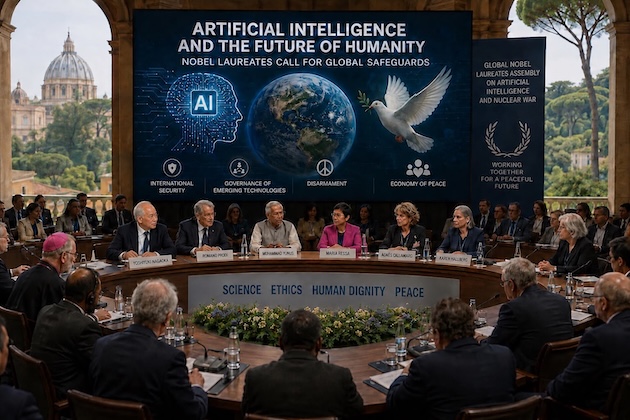
Organised by the Global Nobel Laureates Assembly on Artificial Intelligence and Nuclear War, the conference set out to reflect on its impact.
The article initiates by drawing a parallel to Stanley Kubrick's "2001: A Space Odyssey" and its sentient supercomputer HAL 9000, underscoring the enduring human fear of artificial intelligence transcending human control. Fifty-eight years after the film, this concern prompted the Global Nobel Laureates Assembly on Artificial Intelligence and Nuclear War to convene over 200 influential international figures for a three-day conference. Held in the historic setting of Borgo Laudato Si’ at the papal summer residence in Castel Gandolfo, the assembly aimed to critically examine the future of international security, the governance frameworks for emerging technologies, the path towards disarmament, and strategies for building a global economy rooted in peace. Monsignor Fabio Baggio, in his opening remarks, set the foundational tone for the discussions, emphasizing that true peace extends beyond the mere absence of conflict, embodying an established order built on justice, mutual trust, adherence to the rule of law, and an unwavering respect for the inherent dignity of every individual. This collective agreement highlighted the urgent necessity for robust AI regulation to safeguard both global peace and the very survival of humanity.
Karen Hallberg, a distinguished Argentine physicist specializing in condensed matter and serving as president of the Pugwash Conferences on Science and World Affairs, articulated a significant concern regarding the nature of artificial intelligence. She categorized AI as a "dual-use" technology, likening its potential for both profound benefit and grave destruction to that of nuclear energy. While nuclear fission has brought about remarkable advancements in power generation and medical treatments, it simultaneously paved the way for atomic weaponry. Hallberg warned that AI possesses a similar inherent ambivalence; it can contribute immensely to scientific research, medicine, and the monitoring of international treaties, yet its unchecked integration into nuclear weapons systems introduces a perilous era of uncertainty. Her primary apprehension lies in the prospect of algorithms making critical decisions within nuclear command and control processes, such as analyzing satellite imagery, interpreting complex military scenarios, or contributing to choices that could have irreversible global ramifications. Expressing concern rather than fear, Hallberg urged governments worldwide to adopt a stringent precautionary principle, emphasizing the critical need for political regulation to keep pace with technological advancement before potential abuses lead to an uncontrollable, irreversible drift.
Yoshiyuki Nagaoka, Executive Director of the Office of External Relations at Soka Gakkai and President of the Ikeda Center for Peace, Learning, and Dialogue, offered a nuanced perspective on AI. He posited that artificial intelligence is not intrinsically dangerous; its impact is entirely contingent on how humanity chooses to wield it. Nagaoka framed this choice as a fundamental ethical dilemma for humanity—whether to become more self-centered or more compassionate in its application of AI. He placed particular emphasis on the crucial responsibility of younger generations, who are growing up immersed in digital tools, highlighting the increasing risk of social isolation in such an environment. According to Nagaoka, humanity's paramount challenge is not to outright reject AI but to cultivate the wisdom to use it judiciously without relinquishing the unique human capacity for judgment. He strongly advocated for the preservation of human conscience and critical thinking in decision-making processes, reiterating that education and the ability to think critically remain the most effective safeguards against a technology that can profoundly influence both individual and collective choices. He illustrated this point with a poignant anecdote about an 86-year-old Japanese woman who sought advice from ChatGPT rather than her family when faced with the agonizing decision of ending her seriously ill husband's life support, prompting reflection on the evolving nature of human dialogue and reliance on machines.
Maria Ressa, the Filipino journalist and recipient of the 2021 Nobel Peace Prize, known for her steadfast defense of freedom of expression and her relentless fight against disinformation, brought forth critical concerns regarding AI's profound implications for the democratic fabric of societies. Throughout the conference discussions, Ressa consistently highlighted the inherent risks that artificial intelligence poses, including the accelerated dissemination of false information, the potential for large-scale manipulation of public opinion, and the worrying trend of power concentration in the hands of a limited number of powerful technology corporations. She emphatically stated that "AI is not simply an issue of innovation. It concerns the very functioning of democratic societies." Her warnings underscored the urgent need for robust regulatory frameworks and ethical considerations to prevent AI from undermining foundational democratic principles and institutions, emphasizing that the integrity of information and the autonomy of public discourse are at stake.
Muhammad Yunus, the Bangladeshi economist celebrated for founding the Grameen Bank and a recipient of the 2006 Nobel Peace Prize, offered a far-reaching and deeply humanist critique by steering the conference debate towards the economic ramifications of AI. He challenged the very underpinnings of AI's integration into contemporary capitalist models. Yunus posited that the primary concern is not merely the potential displacement of certain jobs but rather the alarming and accelerating concentration of global wealth. He issued a stark warning that artificial intelligence could intensify an economic paradigm where a select few corporations exert control over advanced technologies, vast amounts of data, and the lion's share of income, concurrently marginalizing an ever-growing segment of the global population from meaningful economic participation. Yunus argued passionately that such a trajectory could strip individuals of their livelihoods, erode their dignity, and severely compromise their ability to maintain independence. His vision for the future unequivocally rejects an economy where AI replaces human beings entirely. Instead, he advocated for a model built on broad-based participation, entrepreneurial spirit, and an equitable sharing of opportunities. His powerful message to political leaders globally was unequivocal: AI must be conscientiously developed and deployed not as an instrument for centralizing power, but as a tool genuinely placed at the service of all humanity.
As the conference concluded, a singular, undeniable truth emerged: artificial intelligence has irrevocably become an intrinsic part of our world, and there is no feasible path to revert this technological integration. The consensus among the Nobel Laureates and experts was that humanity should neither succumb to blind fear of AI nor automatically categorize it as the ultimate adversary. However, the discussions left several fundamental and critical questions unresolved: Who will ultimately control this transformative technology? What ethical frameworks and regulatory guidelines will govern its operation and evolution? And, crucially, in the service of what kind of society—one that is equitable, just, and peaceful, or one marked by greater divides—will AI be deployed? More than half a century after the ominous portrayal of HAL 9000, the article suggests that the most profound and perhaps terrifying threat is not the prospect of a machine gaining human-like consciousness. Instead, the real danger lies in human beings gradually relinquishing the very attributes that define their existence: their inherent capacity to make independent decisions, to exercise discerning judgment, and to embrace full responsibility for the consequences of their own choices in an increasingly AI-driven world.