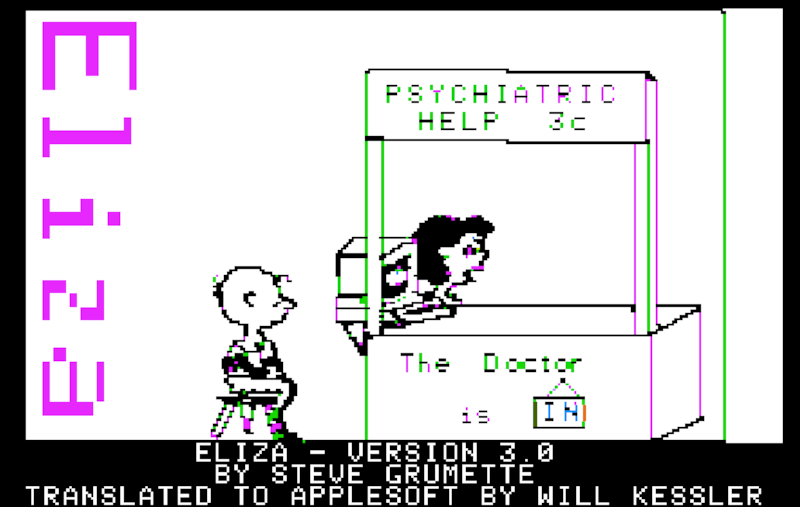
This article from Hackaday offers a retrospective on the early days of Artificial Intelligence, humorously noting how contemporary chatbots make previous AI iterations seem almost laughable. It introduces a significant new online collection from the Internet Archive called “Vintage Artificial Intelligence.” This collection provides a unique opportunity to explore historical AI software, predominantly from the 1970s and 1990s, by running it in emulated environments directly within a web browser. The author emphasizes the swift evolution of AI, where the definition of "intelligence" in machines is constantly being reshaped, and invites readers to appreciate the foundational, albeit simpler, programs that laid the groundwork for today's advanced AI systems. This initiative by the Internet Archive allows for a tangible connection to the technological past, offering insights into the dreams and limitations of early AI researchers and developers.
Exploring the Vintage AI Collection
The centerpiece of this article is the Internet Archive's recently launched "Vintage Artificial Intelligence" collection, a fascinating repository of early AI software. This collection serves as an interactive historical exhibit, enabling users to engage with programs from the 1970s through the 1990s via in-browser emulation. A highlight of the collection is the inclusion of several versions of Eliza, the groundbreaking chatbot program. Eliza, despite its relatively simple script-based approach, famously simulated a Rogerian psychotherapist, demonstrating an early form of natural language processing and eliciting surprisingly profound human responses. Its presence in the collection underscores its historical significance in AI development.
Beyond Eliza, the archive features a diverse array of programs that illustrate the varied directions of early AI research. This includes early adventure games that pushed the boundaries of conversational interfaces and interactive narratives. Also present are influential programming languages crucial to AI, such as Lisp and Prolog. Prolog, in particular, was central to the development of "expert systems," which aimed to codify human knowledge and decision-making for automated reasoning, once sparking hopes of widespread automation across various professions. The collection also showcases Racter, an experimental program designed to generate creative fiction, offering a glimpse into early attempts at machine creativity.
The article further notes the inclusion of titles like Alter Ego, a life-simulation program intended to help users explore different life choices, representing an early foray into AI for guidance and personal reflection. Conway’s Game of Life, a cellular automaton, is also featured, prompting the author to ponder its classification as AI, depending on one's definition of artificial intelligence and emergent complexity. Chess programs, exemplified by Sargon, highlight the historical pursuit of AI in strategic game-playing, a benchmark for machine intelligence. While appreciating the collection, the author also points out some omissions, such as Hexapawn, Parry (Eliza's more adversarial counterpart), and a word-chaining program named George, which are fondly remembered examples of early AI experiments. This collection provides valuable context, allowing modern audiences to understand the technological lineage of AI and appreciate how far the field has advanced from its ingenious, yet computationally limited, beginnings. The article cleverly ties these historical programs to current discussions about AI's rapid growth, making a clear case for understanding the past to contextualize the present and future of artificial intelligence.