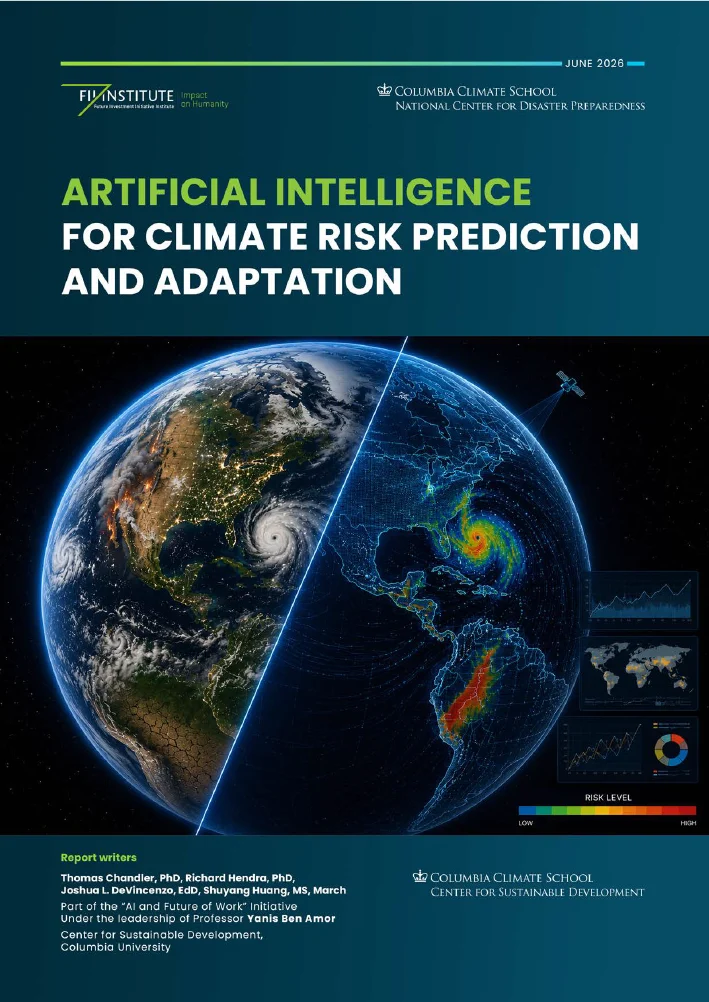
The FII Institute, in partnership with the prestigious Columbia Climate School, has unveiled a groundbreaking report titled 'Artificial Intelligence for Climate Risk Prediction and Adaptation.' This timely publication delves into the transformative potential of artificial intelligence (AI) in revolutionizing how societies worldwide anticipate, prepare for, and ultimately respond to the escalating severity and frequency of climate-related events. Authored by experts Thomas Chandler and Joshua L. Devincenzo, the report signals a critical paradigm shift from traditional, often reactive, disaster management strategies to more sophisticated, proactive, and AI-driven approaches to building resilience. It explores how leveraging advanced AI capabilities can lead to more effective mitigation and adaptation strategies, enabling communities and nations to better safeguard against the multifaceted threats posed by a changing climate. The report emphasizes the urgency of integrating cutting-edge technology with environmental science to foster a more secure and sustainable future for humanity, offering a comprehensive overview of the challenges and opportunities at this crucial intersection.
The Transformative Power of AI in Climate Resilience
The report, a collaborative effort between the FII Institute and Columbia Climate School, underscores a fundamental evolution in our approach to climate change. Traditionally, humanity has largely reacted to climate disasters after they occur, leading to significant loss of life, economic damage, and ecological devastation. This report, however, champions a proactive stance, powered by Artificial Intelligence. It argues that AI is not merely a supplementary tool but a core enabler for a profound shift towards predictive and adaptive strategies. By harnessing AI's capabilities, societies can move beyond post-event recovery to implementing preventative measures that anticipate future risks. This includes everything from forecasting extreme weather phenomena with greater accuracy to designing resilient infrastructure and developing robust early warning systems. The core message is clear: AI offers an unprecedented opportunity to fundamentally rethink and enhance our global climate resilience frameworks, ensuring a more prepared and less vulnerable world in the face of escalating climate challenges.
Enhancing Prediction and Early Warning Systems
A significant portion of the report focuses on how AI can dramatically improve our ability to predict climate risks. For instance, AI algorithms, fed with vast datasets encompassing historical weather patterns, real-time satellite imagery, sensor network data, and environmental models, can develop sophisticated predictive models for events like floods, droughts, heatwaves, and wildfires. Beyond mere prediction, AI can facilitate the creation of highly effective early warning systems. These systems can process complex environmental data at speeds impossible for human analysis, identifying nascent threats and issuing timely alerts to at-risk populations. This early notification allows for crucial preparation time, enabling evacuations, resource mobilization, and the implementation of protective measures, thereby minimizing potential damage and saving lives. The report envisions a future where AI-driven insights provide actionable intelligence, empowering decision-makers to intervene before a crisis fully unfolds, thereby transitioning from a reactive posture to one of predictive defense against climate impacts.
AI's Role in Adaptive Measures and Humanitarian Response
Beyond prediction, the report highlights AI's critical contribution to adaptation and humanitarian efforts. In scenarios like floods, AI can optimize water management systems, predict overflow points, and even guide drone deployment for damage assessment and rescue operations. For wildfires, AI models can identify ignition risks, simulate fire spread paths in real-time, and assist in strategic firefighting resource allocation, including autonomous systems for monitoring. Furthermore, in humanitarian crises exacerbated by climate events, AI can accelerate response times by optimizing logistics, identifying vulnerable populations, and facilitating the distribution of aid. Machine learning algorithms can analyze social media data and satellite imagery to rapidly assess post-disaster needs and direct resources where they are most critically required. This enhanced adaptive capacity, driven by intelligent systems, ensures that responses are not only faster but also more targeted and efficient, significantly improving the efficacy of disaster relief and long-term recovery efforts.
The Imperative of Robust Data Infrastructure and Ethical Oversight
The report emphasizes that the full potential of AI in climate resilience cannot be realized without a foundational commitment to robust data infrastructure and diligent human oversight. Effective AI models rely on vast quantities of high-quality, diverse, and accessible data, ranging from meteorological readings to socio-economic indicators and geographical information. Building and maintaining such an infrastructure requires significant investment, international collaboration, and standardized data collection protocols. Equally crucial is the aspect of human oversight. The report advocates for ethical frameworks and governance mechanisms to ensure that AI applications are developed and deployed equitably, transparently, and without exacerbating existing inequalities or creating new biases. Human experts must remain in the loop to interpret AI outputs, make critical decisions, and ensure that technology serves human well-being and environmental justice. Without this dual focus on data integrity and ethical human guidance, AI's promise risks being undermined by systemic flaws or unintended consequences.
Strategic Implications for Global Stakeholders
Artificial Intelligence for Climate Risk Prediction and Adaptation is presented as an essential resource for a broad spectrum of global stakeholders. For governments, it offers a blueprint for integrating AI into national climate action plans, informing policy development, and optimizing resource allocation for disaster preparedness and response. Investors are encouraged to recognize the emerging opportunities in sustainable finance and green technology, channeling capital into innovative AI solutions that address climate challenges. Business leaders can leverage the report's insights to build more resilient supply chains, assess climate-related financial risks, and develop innovative products and services that cater to an adapting world. Policymakers, at both national and international levels, can use the findings to foster cross-sectoral collaboration, establish regulatory frameworks that promote responsible AI development, and drive international cooperation on climate adaptation initiatives. The report serves as a call to action, urging leaders across all sectors to actively engage with AI's potential to shape a more secure and sustainable global future.