Quick Buzz Feed

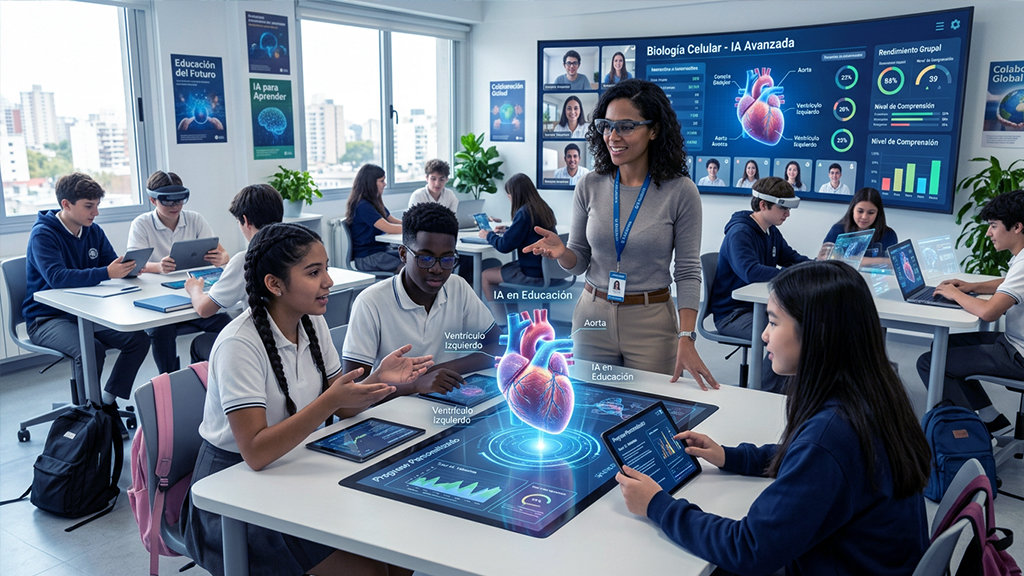
Artificial intelligence in education is transforming the way students and teachers learn and teach at an unprecedented pace. Its adoption is already widespread, but the real challenge is not technological, but pedagogical: how to use AI judiciously to enhance learning without creating risks such as cognitive debt. In this context, training in artificial intelligence and access to the technology are becoming key factors for the future of education and careers.
AI is now an everyday classroom tool, with university student usage jumping from 66% in 2024 to 92% in 2025. Despite 70% of teachers using AI, only half of institutions offer specific training, and 88% of faculty use it basically without a clear pedagogical approach. This highlights a training crisis, not a technological one, emphasizing the divide between judicious and unthinking AI use.
The use of AI in education varies significantly by educational level: secondary education uses it for personalized activities and visual resources, sixth form for summaries and exam simulations, and universities for comprehensive guides, interactive resources, and advanced research tools. Effective AI integration focuses on pedagogical objectives, transforming technology into a facilitator rather than a barrier.
Students widely use AI, often for quick work generation, content summarization without deep understanding, and direct answers, which impacts learning negatively. However, valuable applications include 24/7 personalized tutoring, language learning, study organization, and original content creation. Mastering effective AI use is a crucial 21st-century skill.
The primary risk is cognitive debt, where students fail to learn by over-delegating tasks to AI. An MIT study found heavy AI users show reduced deep thinking activity, leading to an 'illusion of knowledge' where students believe they understand but lack true retention. The issue is not AI use itself, but using it without critical thought.
Effective AI use requires students to 'think first, then use AI.' This means generating original ideas, understanding problems, and formulating criteria before using the tool. AI should be a partner, fostering a shift from copying to comparing, delegating to collaborating, and consuming to thinking, thereby enhancing rather than undermining learning.
Practical AI applications in education include generating personalized content, simulating exams, providing smart tutoring, creating teaching materials, and organizing knowledge. These solutions aim to adapt learning experiences to individual student paces and needs effectively.
Companies are rapidly adopting AI in their training, following a pattern of initial resistance, real-world application, and swift integration. The barrier to adoption is more mental than technological, disappearing once employees see AI solving specific day-to-day problems effectively.
Telefónica actively promotes AI access and digitalization by providing advanced connectivity, innovative digital services, and robust training and talent development programs. This strategy aims to help individuals and businesses integrate AI effectively, bridging the digital divide, and enhancing digital literacy.
The future of education will involve teachers evolving into designers of learning experiences and students mastering critical AI use. Education's enduring value will lie in uniquely human attributes like thinking, creativity, and adaptability, as automating tasks machines do better becomes obsolete.
AI compels education to evolve rather than replace it. Continuous learning (learnability) is now paramount, shifting the challenge from accessing information to effectively utilizing it. AI can either elevate learning or undermine it, depending on the criteria and thoughtfulness of its application.
AI in education involves using technology to personalize learning and automate various educational processes.
The primary risks include cognitive debt (failure to learn due to over-reliance on AI) and the erosion of critical thinking skills.
To use AI effectively in learning, one should prioritize thinking and understanding first, then employ AI as a supportive tool to enhance comprehension.