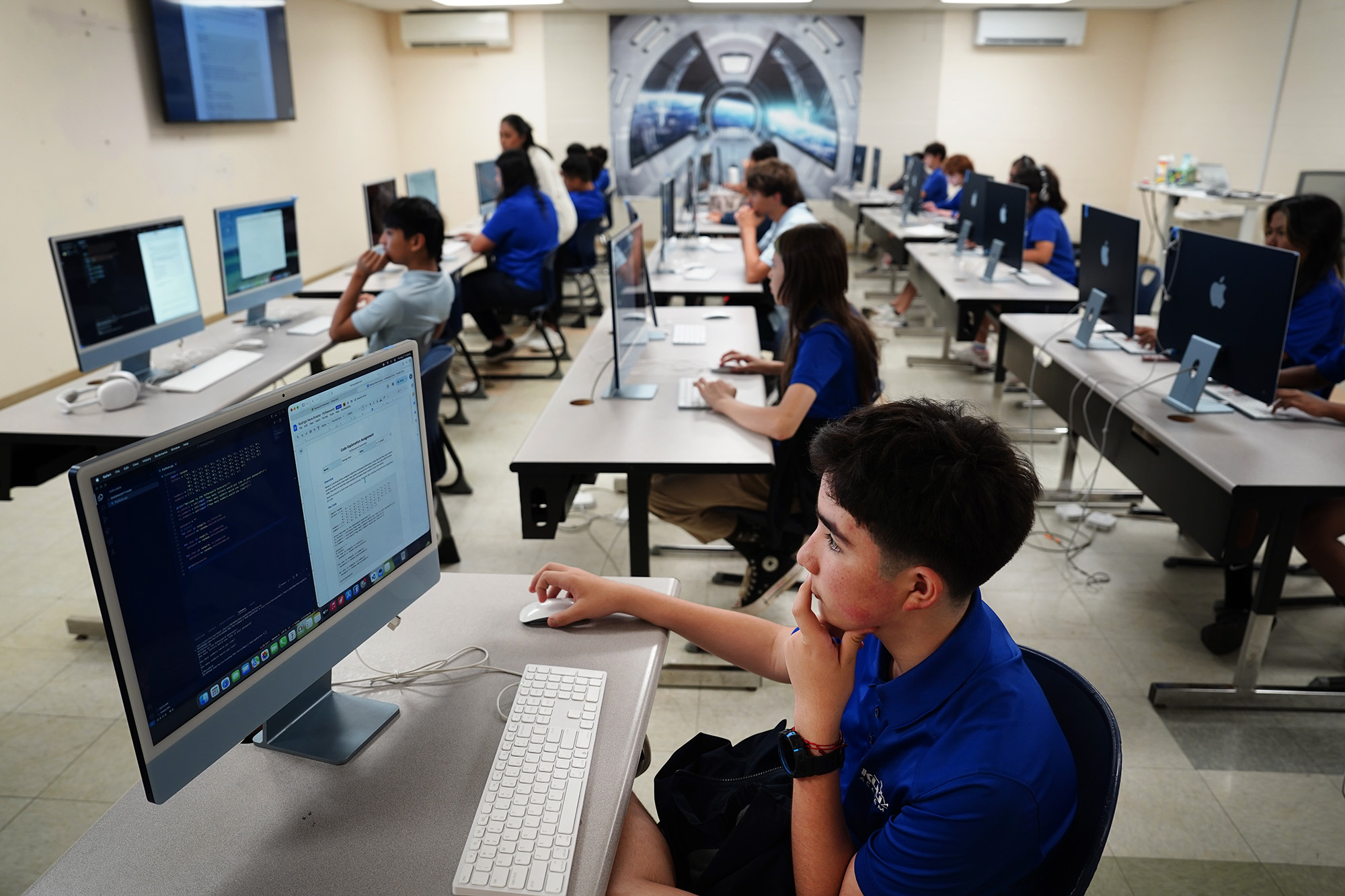
From preschoolers to high school seniors, Hawaiʻi students share how artificial intelligence is shaping their learning and plans for the future. For many schools, it’s a race to keep up. Others are leading the pack. And some are unsure what to do with it. Artificial intelligence is playing an increasingly prominent role in Hawaiʻi education, from the recent opening of the state’s first AI-focused charter school to the development of new coursework teaching students how to navigate rapidly changing technology. Teachers are also coming face-to-face with new technology, whether it’s using AI avatars to test students’ grasp of Mandarin Chinese vocabulary or confronting kids who are submitting assignments written by ChatGPT. But there’s wide variation in how much teachers and students are willing to engage with the new technology. This article explores experiences with AI in schools across Hawaiʻi, from administrators and educators to students.
McKinley High School
At McKinley High School, teacher Cynthia Reves has observed the challenges AI poses for academic integrity. Doubting the originality of student work, she has reverted to traditional paper-and-pencil assignments and minimized device use in her classroom. Reves acknowledges the tension between old and new teaching methods but is cautiously integrating AI by allowing students to compare their written answers with AI-generated responses after completing assignments. She believes that as students develop stronger critical thinking skills, they can more responsibly evaluate AI's output, preparing them for its inevitable presence in their future.
Mid-Pacific Institute
Preschool students at Mid-Pacific Institute are confidently engaging with AI. Teacher Leslie Gleim utilizes ChatGPT to transcribe and summarize class discussions, particularly after field trips. This not only saves her time in synthesizing student observations but also encourages children to be more intentional with their words. Gleim actively points out AI's limitations and inaccuracies, fostering a critical perspective in her young students, teaching them that AI is a tool to be evaluated, not an infallible source of answers.
Hawaiʻi Technology Academy
Kingston Collman, a recent graduate from Hawaiʻi Technology Academy, initially feared AI would render his dream career in game development obsolete. He pivoted to using AI to enhance his social media content creation, developing an AI assistant to generate scripts and video ideas, significantly reducing his workflow. While embracing AI for efficiency, Collman is wary of the rise of low-quality AI-generated content. Similarly, Adriana Hunt uses AI for marketing her artwork but draws the line at using it to create art, emphasizing the preservation of human creativity and critical thinking against the backdrop of AI's pervasive influence.
Kūlia Academy
Kūlia Academy, Hawaiʻi’s first AI-focused charter school in Kalihi, prioritizes teaching students the fundamentals of data science and coding from middle school. Under the guidance of teachers like James Morice, students learn to analyze complex datasets and write code. Executive director Andy Gokce aims for students to not merely consume AI but to deeply understand its mechanisms, enabling them to become future developers and innovators in AI engineering and cybersecurity. Students also use AI tools like ChatGPT to receive essay feedback under teacher supervision and learn to train AI models for specific tasks, such as distinguishing venomous snakes.
Waiākea Intermediate School
In Tyler Kojima’s world history class at Waiākea Intermediate School, sixth graders engage in a 'beat AI' challenge, defending historical inventions against an AI chatbot designed to be skeptical. This activity pushes students to develop critical thinking and argumentative skills. Kojima aims to change students' initial perception of AI as 'taboo' by demonstrating its responsible and educational uses. He carefully sets boundaries for the technology, ensuring it supports learning rather than providing shortcuts, thereby preparing students to responsibly navigate AI as an enduring tool in their lives.