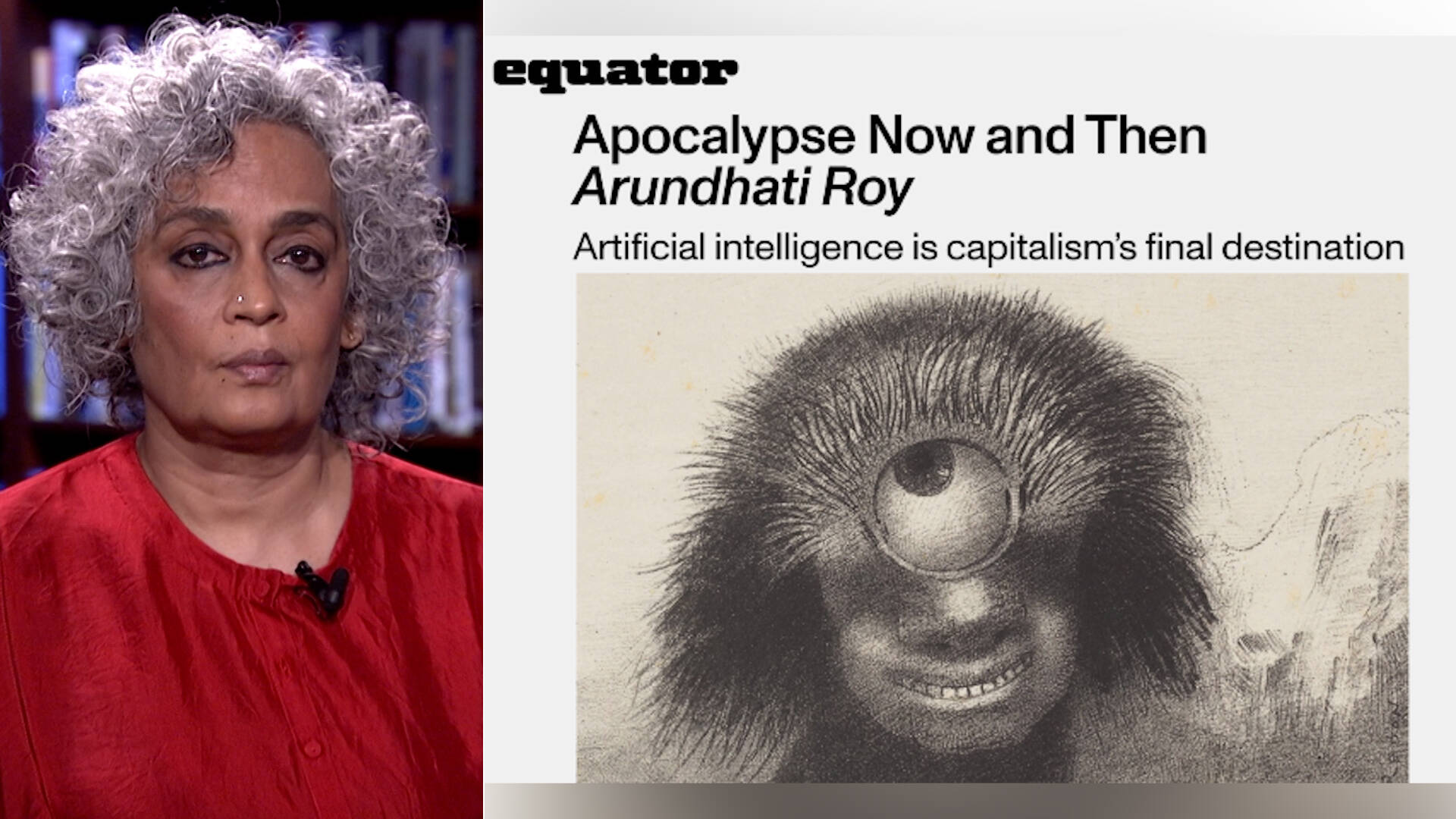
Part 2 of our conversation with Arundhati Roy talking about AI and her new essay, “Apocalypse Now and Then: Artificial Intelligence Is Capitalism’s Final Destination.”
Why 'Apocalypse Now and Then' for an Essay on AI? Arundhati Roy explains that the essay's title reflects her observation that AI, despite its existential risks, is being commodified. She notes how the perceived lethality and danger of AI are paradoxically driving up its market value, essentially turning a potential apocalypse into a profitable venture. AI and the Erosion of Language Roy voices deep concern about humanity being 'locked out of language' due to AI. She highlights how AI has disrupted the literary world, leading to publishers scrutinizing new works for AI generation and incidents where AI-written pieces have received awards. She criticizes the unauthorized use of writers' works to train large language models, viewing it as a corporatization and privatization of human creativity, literature, and civilization itself. Undermining Social Coherence through Language Roy argues that AI's disruption of the fundamental human relationship with language will 'undermine all semblance of social coherence.' Drawing parallels to foundational religious texts, she asserts that language, communication, and storytelling are central to human existence. AI, by 'skinning, stuffing, and selling' a simulated version of language, fosters an environment of distrust where it becomes impossible to verify authenticity, leading to a 'mass psychosis' and the ultimate destruction of 'humanness.' Artificial Intelligence as Capitalism's Final Destination Roy posits that AI is 'capitalism’s final destination' because it extends the historical pattern of corporatization from natural resources to the human mind itself. She compares consumer AI apps to deceptive 'shiny gifts' masking a 'tidal wave of stupidity' controlled by oligarchs. She warns of impending mass unemployment, the imposition of surveillance on workers, and the tech billionaires' disassociation from humanity, concluding that AI is a tool of 'actual idiocy' designed to extract the 'beating heart and the spirit and the soul out of us.' The Inevitability of AI's Failure and What's Called For Roy challenges the idea that AI's progression is irreversible, citing the unsustainable demand for land, money, data, energy, and water needed to power data centers. She believes that these companies are attempting to integrate into government and national security to become 'too big to fail,' but predicts their eventual collapse. She dismisses the narrative of AI as 'miraculous revolution of progress' as 'absolute nonsense' and anticipates a significant economic fallout when the AI bubble bursts. Climate Impacts of Data Centers in India Roy specifically addresses the environmental consequences of data centers in India. She highlights their construction in areas like Visakhapatnam, where clearances are given without adequate assessment of their impact on groundwater. She fears that, to avoid resistance, these centers could be relocated to ecologically sensitive regions like Ladakh, risking glaciers and global water supplies, and effectively turning developing nations into sites for 'toxic waste.' Call to Action: Spreading Awareness and Saying No Roy urges individuals to actively spread awareness about the dangers of AI and to 'be pretty brave about saying no.' She rejects the notion that it's 'too late' or that the forces behind AI are 'too big' to challenge. She emphasizes the importance of loudly declaring the truth about AI being a 'tidal wave of stupidity' that threatens humanity, regardless of perceived helplessness.
Why 'Apocalypse Now and Then' for an Essay on AI?
Arundhati Roy explains that the essay's title reflects her observation that AI, despite its existential risks, is being commodified. She notes how the perceived lethality and danger of AI are paradoxically driving up its market value, essentially turning a potential apocalypse into a profitable venture.
AI and the Erosion of Language
Roy voices deep concern about humanity being 'locked out of language' due to AI. She highlights how AI has disrupted the literary world, leading to publishers scrutinizing new works for AI generation and incidents where AI-written pieces have received awards. She criticizes the unauthorized use of writers' works to train large language models, viewing it as a corporatization and privatization of human creativity, literature, and civilization itself.
Undermining Social Coherence through Language
Roy argues that AI's disruption of the fundamental human relationship with language will 'undermine all semblance of social coherence.' Drawing parallels to foundational religious texts, she asserts that language, communication, and storytelling are central to human existence. AI, by 'skinning, stuffing, and selling' a simulated version of language, fosters an environment of distrust where it becomes impossible to verify authenticity, leading to a 'mass psychosis' and the ultimate destruction of 'humanness.'
Artificial Intelligence as Capitalism's Final Destination
Roy posits that AI is 'capitalism’s final destination' because it extends the historical pattern of corporatization from natural resources to the human mind itself. She compares consumer AI apps to deceptive 'shiny gifts' masking a 'tidal wave of stupidity' controlled by oligarchs. She warns of impending mass unemployment, the imposition of surveillance on workers, and the tech billionaires' disassociation from humanity, concluding that AI is a tool of 'actual idiocy' designed to extract the 'beating heart and the spirit and the soul out of us.'
The Inevitability of AI's Failure and What's Called For
Roy challenges the idea that AI's progression is irreversible, citing the unsustainable demand for land, money, data, energy, and water needed to power data centers. She believes that these companies are attempting to integrate into government and national security to become 'too big to fail,' but predicts their eventual collapse. She dismisses the narrative of AI as 'miraculous revolution of progress' as 'absolute nonsense' and anticipates a significant economic fallout when the AI bubble bursts.
Climate Impacts of Data Centers in India
Roy specifically addresses the environmental consequences of data centers in India. She highlights their construction in areas like Visakhapatnam, where clearances are given without adequate assessment of their impact on groundwater. She fears that, to avoid resistance, these centers could be relocated to ecologically sensitive regions like Ladakh, risking glaciers and global water supplies, and effectively turning developing nations into sites for 'toxic waste.'
Call to Action: Spreading Awareness and Saying No
Roy urges individuals to actively spread awareness about the dangers of AI and to 'be pretty brave about saying no.' She rejects the notion that it's 'too late' or that the forces behind AI are 'too big' to challenge. She emphasizes the importance of loudly declaring the truth about AI being a 'tidal wave of stupidity' that threatens humanity, regardless of perceived helplessness.