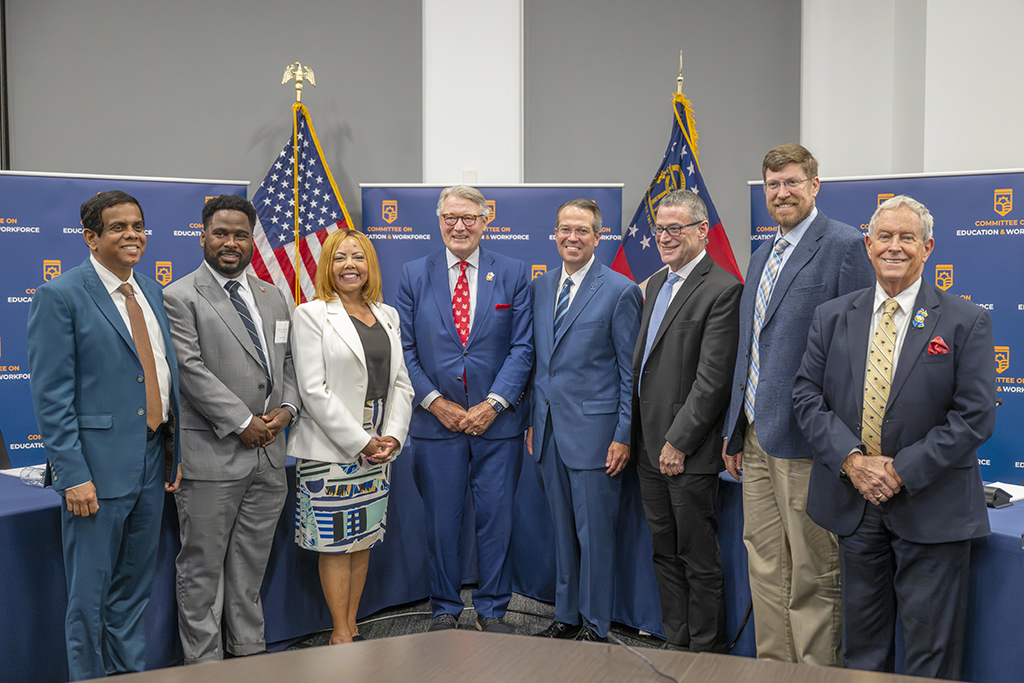
Augusta University recently hosted the U.S. House of Representatives’ Committee on Education and Workforce for its inaugural AI-focused field hearing titled ‘Building an AI-Ready America.’ The hearing, held at the Georgia Cyber Center, brought together U.S. Representatives Rick W. Allen, Joe Wilson, and Lucy McBath, along with expert witness Dr. Jeffery Talbert from Augusta University, to discuss AI's economic opportunities and its impact on the American workforce.
Augusta's Strategic Role in AI Discussion
U.S. Rep. Rick Allen highlighted Augusta as the optimal location for the AI hearing, citing the Georgia Cyber Center and Fort Gordon's combined expertise. He emphasized the area's vital role in training a superior cybersecurity workforce, which is crucial for advancing AI technology and transforming Army Defense Cyber Operations, addressing the growing demand for skilled professionals in the field.
Augusta University's Vision for AI Transformation
Augusta University President Russell T. Keen underscored the university's honor in hosting the congressional field hearing. He affirmed AU's commitment to leading the AI transformation by leveraging artificial intelligence to strengthen the workforce, drive discovery, and improve and save lives, particularly in solving complex diseases that have affected generations.
AI's Transformative Impact on Healthcare
Dr. Jeffery Talbert, chair of AI and Health at the Medical College of Georgia, detailed AI's significant value in healthcare through augmentation. He explained how AI-powered tools reduce administrative burdens, combat clinician burnout (with one implementation showing a fall from 52% to 39%), and enhance patient outcomes. Examples include ambient documentation technology and AI-assisted breast cancer screenings, which have shown up to 29% higher cancer detection rates and the potential to predict serious complications.
Fostering Responsible AI Development and Policy
Rep. Rick Allen concluded the hearing by emphasizing that America's opportunity lies in leading the responsible development, education, and implementation of AI. He stressed the importance of flexible policies that allow businesses across various industries to adopt AI in ways that best suit their specific needs, thereby fostering innovation, economic growth, and new opportunities for American workers. He highlighted the necessity of listening to diverse voices—workers, producers, entrepreneurs, and industry leaders—to craft effective solutions.