Quick Buzz Feed

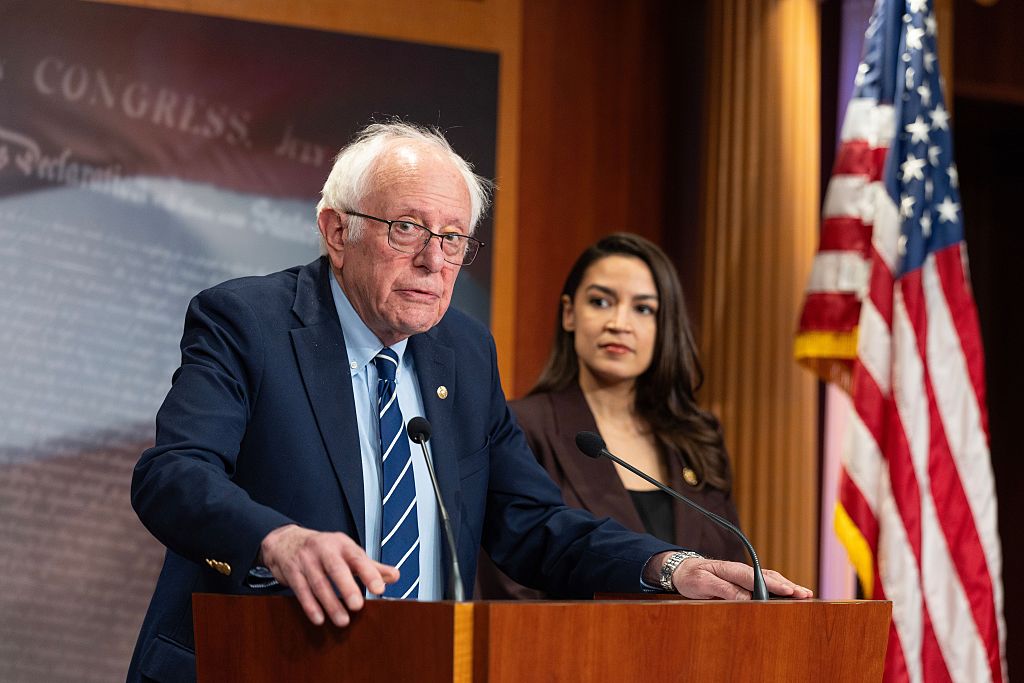
A bill from Bernie Sanders and Alexandria Ocasio-Cortez proposes a moratorium on new AI data centers until oversight mechanisms and legal safeguards are in place. Only federal legislation stands a chance at leashing a monster of this size.
Artificial intelligence is portrayed as a voracious entity designed to displace human labor, amass personal data, and consume vast amounts of energy and land, potentially devastating entire communities. Senator Bernie Sanders, a consistent critic of concentrated wealth, along with Representative Alexandria Ocasio-Cortez, warns that unregulated AI, controlled by a small group of tech oligarchs, represents an unprecedented and existential threat that could exacerbate economic inequality. The article highlights that, despite local and state-level objections, the current federal administration has largely granted tech giants unchecked permission to develop extensive AI data center networks, including a Meta facility Mark Zuckerberg likened to the size of Manhattan. This massive infrastructure directly correlates with projected widespread job displacement, with Sanders's staff estimating that AI automation could eliminate nearly one hundred million American jobs within a decade. In response to these escalating concerns, Sanders and Ocasio-Cortez introduced a landmark bill: the Artificial Intelligence Data Center Moratorium Act. This legislation proposes a federal halt on the construction of new AI data centers and the export of AI chips to countries without adequate regulatory frameworks. The moratorium would only be lifted once Congress enacts comprehensive AI legislation, ensuring robust safeguards for "the safety and prosperity of the American people." Furthermore, the bill mandates that the Department of Energy collect and publicly release all pertinent financial, environmental, and operational data concerning AI data centers. At the press conference announcing the bill, Sanders underscored that the American public is keenly aware that in an era of extreme wealth disparity, the AI revolution is being driven by billionaires like Elon Musk, Jeff Bezos, Mark Zuckerberg, and Larry Ellison, not to improve societal well-being but to significantly augment their own wealth and influence. This proposed federal action would provide critical support for over a hundred local communities already implementing their own data center restrictions and twelve states advancing similar proposals. Examples include Loudoun County, Virginia, which removed developers' previous "by-right" ability to build data centers without public oversight, and counties in the Atlanta area, such as Coweta and Douglas, that imposed emergency pauses on server farm development to establish protective zoning codes. These local initiatives primarily address immediate environmental and social impacts, such as the exorbitant consumption of municipal water for server cooling, the constant, deafening noise pollution from industrial air chillers, and the financial burden on residents who often bear the multi-billion-dollar cost of electrical grid upgrades required by the data centers' immense energy appetites. However, the article emphasizes that these localized interventions are insufficient to address the broader societal implications of unregulated AI, which extends to worker displacement, the rise of AI-driven loneliness, the proliferation of misinformation undermining democratic processes, and pervasive threats to privacy from unchecked data collection. The author firmly asserts that only comprehensive federal legislation possesses the power to truly manage and control a technology of this magnitude. Predictably, the bill has drawn sharp criticism from pro-AI executives and allied media. The Bezos-owned Washington Post's editorial board, for instance, equated the attempt to regulate AI with an opposition to the invention of the lightbulb. Critics argue that a US moratorium would hinder American competitiveness, especially against countries like China, and that market forces, rather than government intervention, are better suited to foster innovation and create new opportunities despite job disruptions. The article refutes these arguments by drawing parallels to past corporate-led "innovations" like NAFTA in the 1990s, which, despite promises of shared prosperity, resulted in thousands of American jobs being offshored and workers being forced into exploitative gig-economy roles without collective bargaining rights. This historical context suggests that market-driven innovation often leads to market cornering, worker replacement without alternative livelihoods, and the entrenchment of low-wage, un-unionized labor. Furthermore, the article highlights alarming statements from tech leaders themselves, such as Elon Musk's prediction that AI will render traditional jobs obsolete, transforming human work into hobbies, and Larry Ellison's vision of AI surveillance to ensure "citizens will be on their best behavior." These statements underscore the dystopian potential that the Sanders-Ocasio-Cortez bill aims to prevent by advocating for a pause to establish essential safeguards and oversight.