Quick Buzz Feed

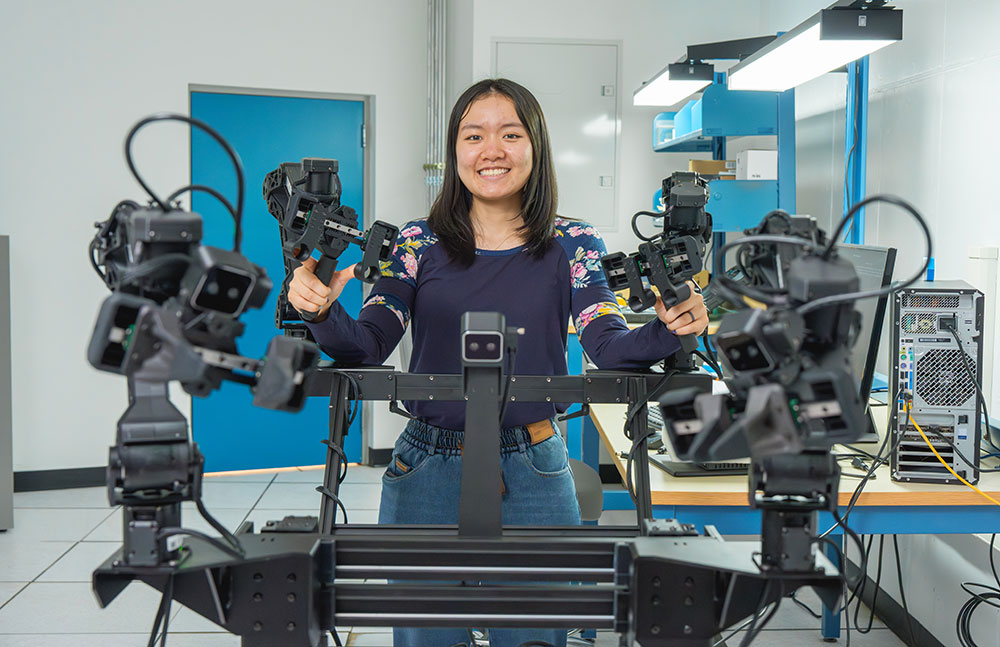
Jasmin Lin didn’t set out to study artificial intelligence (AI) and robotics, but her path has led her there. Now pursuing a master’s degree in bioinformatics at Brandeis University after earning her undergraduate degree in biology at Stony Brook University, Lin expanded her interests through hands-on research experiences at the U.S. Department of Energy’s (DOE) Brookhaven National Laboratory.
Jasmin Lin's first SULI internship (January-May 2025) involved computational biology, where she focused on integrating virtual reality (VR) with a plant digital twin. She developed a complete pipeline that connected VR interaction with a 3D Gaussian Splatting model in Unity, using C# and Python, marking her first exposure to AI. This experience later evolved into exploring and training humanoid robots in simulation using reinforcement learning policies, which laid the foundation for her interest in embodied AI.
Lin presented her summer SULI project on humanoid robots at the New York Scientific Data Summit, which was her first conference and research paper presentation. She described feeling nervous among many accomplished scientists but gained confidence through her experience at Brookhaven Lab. She prepared for the presentation by consulting her mentor, Wei Xu, and utilizing various online resources to ensure accurate information delivery.
Returning to Brookhaven Lab through the SURP, Lin fully shifted her focus to embodied AI under the mentorship of Carlos Soto in the Scientific Embodied Agents Lab (SEAL). Their mission is to support user facilities like the National Synchrotron Light Source II (NSLS-II) by exploring how robots can reduce facility downtime. Lin's current work involves connecting vision-language-action AI policies with a physical robot, successfully training it to autonomously pick up and place a 3D motherboard mockup. She is also integrating VR for teleoperation in simulation.
Despite her biology background, Lin finds artificial intelligence fascinating due to its adaptive nature and efficiency, especially in accelerating research. She uses AI to understand complex topics, query databases, and summarize articles, viewing it as a teacher-student relationship. She is particularly interested in the relatively new field of embodied AI and its potential to automate manual tasks, driven by the desire to contribute to future technologies.
Her most memorable experience at Brookhaven Lab was achieving success with the physical robot. She highlighted the immense difficulty of troubleshooting robotics, which involves intricate interactions between hardware, software, and AI model deployment. Witnessing the robot finally perform tasks correctly after numerous days of problem-solving was profoundly satisfying and paved the way for further research endeavors.
Lin advises prospective interns to acknowledge and not be discouraged by initial 'imposter syndrome,' as it's common in specialized research environments. She emphasizes that it’s acceptable not to understand everything immediately, as learning is the core purpose of these programs. She also encourages developing comfortable relationships with mentors, engaging with other scientists, and stepping out of one's comfort zone to maximize personal and professional growth.