Quick Buzz Feed

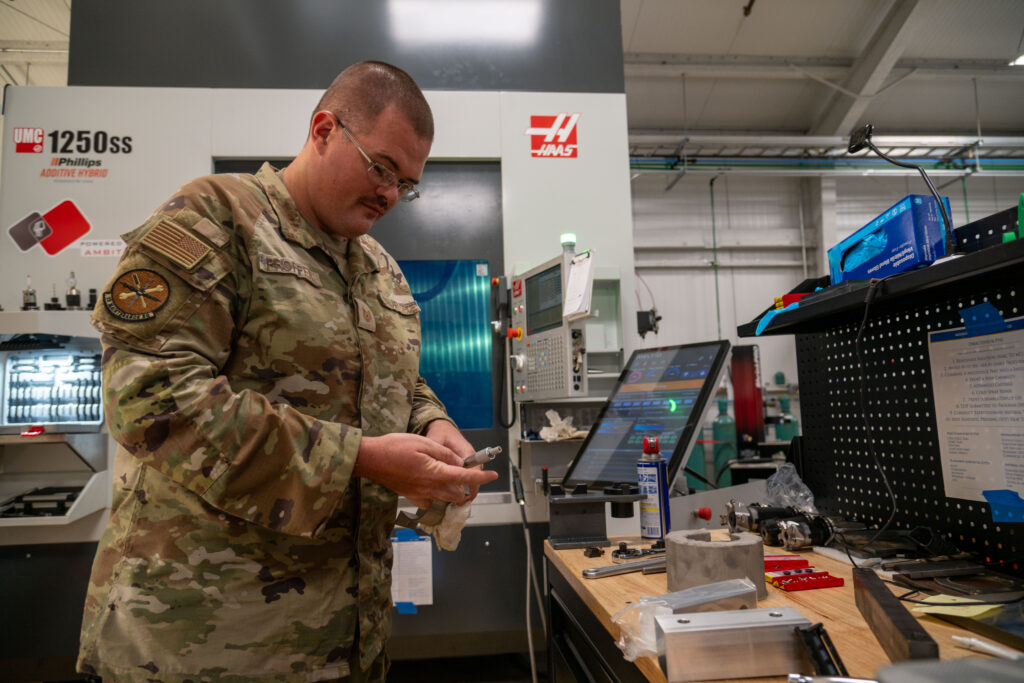
AI-enabled workflows accelerate production, but cybersecurity and governance remain central.
Ana Garcia Olson, Managing Director at Accenture Federal Services, states that the traditional, lengthy development of military platforms is a strategic vulnerability. The solution lies in transforming the Joint Force and the defense industrial base (DIB) into agile, software-defined enterprises. This transformation leverages digital engineering and modern manufacturing by integrating digital twins, IoT sensors, and robotics directly onto factory floors and into shipyards. This creates a continuous digital thread from initial mission requirements to the assembly line, facilitating real-time collaboration, compressing engineering cycles, and automating documentation, thus accelerating programs. Amy Bahrani, also a Managing Director at Accenture, adds that current constraints in materials, space, and workforce require shifting the DIB from a reactive to a predictive function. She highlights building a global system where AI, robotics, and digital twins work together, mirroring successful commercial practices, to ensure critical assets are delivered promptly to warfighters. This is achieved through secure, cloud-based digital engineering environments, operating on a zero-trust architecture, enabling secure cross-domain data sharing and high-performance simulations to field advanced military technology at commercial speed and industrial scale.
Amy Bahrani explains that AI is essential for both government and industry to evolve into an "Intelligent Enterprise," supporting a true National Enterprise. This involves comprehensive data integration with agentic AI across the entire product lifecycle, from initial concept to design, engineering, manufacturing, and field service. The core philosophy is to "simulate before we fabricate." AI enables the creation of highly complex system models, expanding the simulation space to identify and resolve critical quality assurance issues at the design stage, thereby saving significant time and cost compared to rectifying failures in the field. Ana Garcia Olson further emphasizes that merely collecting data is insufficient; its effective utilization is paramount. AI-powered operations must be re-engineered from the ground up, with human oversight as the driving force. Real-time data empowers leaders with decision advantage, but humans must be positioned to steer the system effectively, rather than simply validating automated tasks.
Ana Garcia Olson addresses the skepticism regarding AI's transition from pilot projects to scaled production by highlighting its successful implementation in advanced domestic manufacturing. By using industrial AI to feed real-time factory-floor data into a secure digital core, a shared intelligence layer is established. This enables manufacturing facilities, such as aerospace plants or commercial shipyards, to adapt quickly and ramp up production in response to real-time national demand. Amy Bahrani provides a concrete example of AI's large-scale impact: for one defense client, Accenture completely re-engineered their end-to-end ordering function using AI. This operational overhaul led to a remarkable 76% reduction in front-end cycle time, a 51% increase in productivity, and a substantial return on investment of $53.5 million in its first year. This demonstrates AI's proven ability to scale innovation and directly enhance support for warfighters.
Amy Bahrani outlines a new approach to workforce training that departs from traditional, lengthy technical manual studies. The focus shifts to task-oriented learning, demonstrating immediate practical impact and gradually expanding the scope of training over time. For instance, if a technician encounters an unfamiliar error code on an assembly line, AI-powered systems can instantly provide the correct fix by accessing ingested standard operating procedures, documentation, and blueprints, ensuring continuous production. Ana Garcia Olson suggests combining hands-on peer mentorship with digital training methods like bite-sized microlearning and virtual simulations. This blended approach allows employees to learn at their own pace on the shop floor without significantly disrupting daily operations. Moreover, this modernization strategy helps attract and retain the younger generation, who are adept at digital technologies, by providing them with intuitive, modern tools that empower them to solve problems efficiently and proactively.
Amy Bahrani identifies a critical vulnerability within the defense industrial base: the vast network of small and mid-sized suppliers. Many of these companies face significant challenges in adopting advanced AI due to the prohibitive costs of robust cybersecurity measures and the risk of eroding their profit margins, particularly in meeting strict Cybersecurity Maturity Model Certification (CMMC) requirements. The proposed solution is automated governance, which involves embedding security controls and guardrails directly into the digital infrastructure. This approach creates systemic protections that reduce reliance on human compliance and minimize single points of failure. Ana Garcia Olson further highlights the obstacles faced by dual-use commercial tech companies that possess valuable solutions for manufacturing bottlenecks but are deterred by the complex and lengthy processes for obtaining facility clearances. She emphasizes that dismantling these informational and security silos is crucial for contemporary national security and homeland defense, enabling startup innovators to securely integrate into the national enterprise and bolster overall operational readiness.