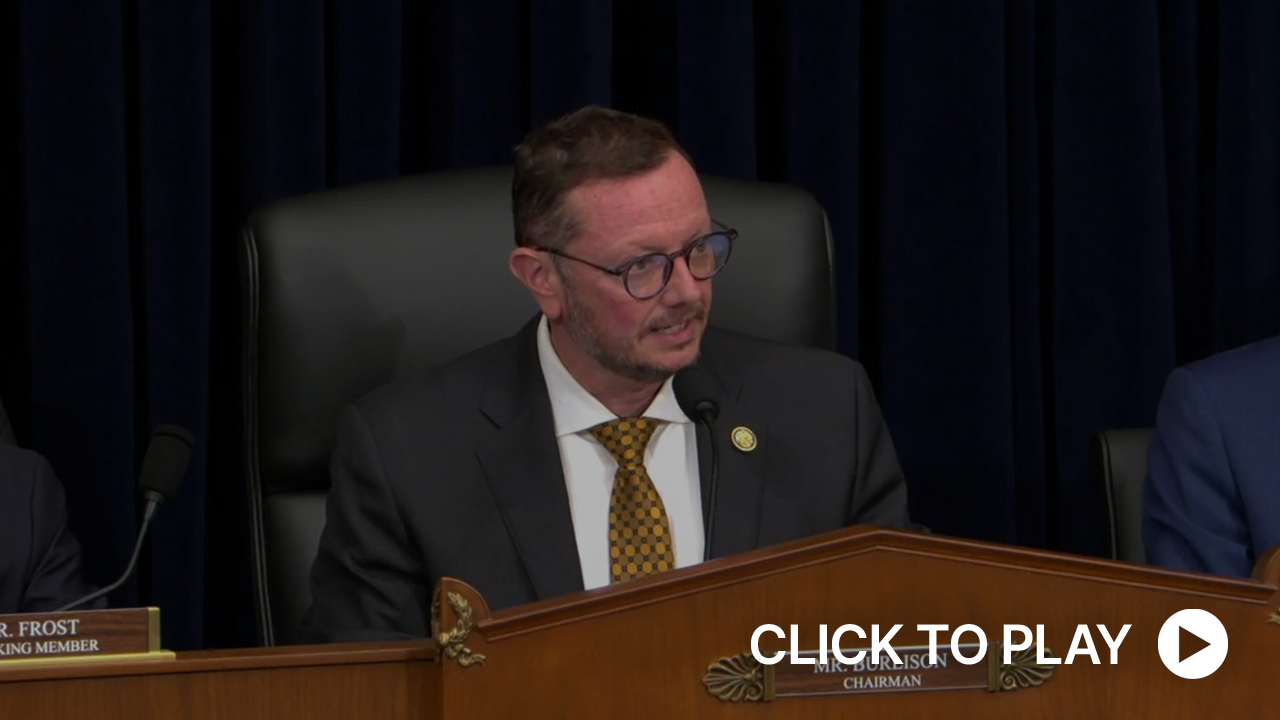
Subcommittee on Economic Growth, Energy Policy, and Regulatory Affairs Chairman Eric Burlison initiated a joint subcommittee roundtable titled "Artificial Intelligence and American Power: Leadership, Security, and Prosperity." In his opening remarks, Burlison underscored the critical imperative for the United States to address existing vulnerabilities and gaps in its AI leadership, stressing AI's transformative potential across vital sectors such as manufacturing, agriculture, healthcare, and national defense. He further posited that a robust expansion of U.S. AI capabilities is indispensable for stimulating American economic growth and urged legislative and industry leaders to proactively embrace this technological revolution. Burlison, drawing from his background as a software engineer, emphasized the rapid pace of technological change and the significant economic and military advantages awaiting nations that first integrate and master AI. He highlighted the global competition, explicitly citing China's 2017 national AI development plan aiming for global AI innovation dominance by 2030, and warned against the pervasive embedding of Chinese AI models into global infrastructure. The Chairman stated that any deficiency in American AI leadership creates exploitable vulnerabilities for adversaries and pointed to economic projections suggesting AI could contribute tens of trillions of dollars to global GDP within the next decade. He advocated for policies that prioritize American competitiveness, referencing the "Trump Administration's" executive order to revoke regulatory constraints on AI and the launch of the Stargate Initiative to accelerate AI infrastructure development in the U.S. This initiative focuses on building data centers, power generation, and computing capacity on American soil, creating domestic jobs. Additionally, he noted the administration's efforts to allow trusted allies access to American AI technology, reinforcing a crucial advantage over adversaries. Burlison expressed optimism in American ingenuity but cautioned that AI dominance requires active leadership committed to fostering growth rather than stifling it with regulations. He reiterated the goal of ensuring American businesses, workers, and communities universally benefit from AI's advancement and secure long-term economic prosperity.
Subcommittee Chairman Burlison's Opening Statement on American AI Leadership and National Strategy
In his comprehensive opening address at the joint subcommittee roundtable on "Artificial Intelligence and American Power: Leadership, Security, and Prosperity," Subcommittee Chairman Eric Burlison articulated a compelling vision for American preeminence in artificial intelligence. Drawing on his extensive professional experience as a software engineer and technology expert, Burlison emphasized the profound and rapid transformative capacity of AI, noting its potential to reshape industries, economies, and daily life. He asserted that the nations that successfully integrate and master AI first would gain substantial economic and military advantages, positioning themselves to define global technological and AI governance standards for future generations. Burlison highlighted the direct competition faced by the U.S., specifically citing the Chinese Communist Party's explicit 2017 national AI development plan, which declared an ambition to become the world's leading AI innovation hub by 2030. He warned against the strategic deployment of Chinese AI models into critical global infrastructures, including telecommunications networks, financial systems, and the governmental frameworks of developing nations, often with insufficient understanding of the implications. The Chairman stressed that any perceived weakness or gap in American AI leadership presents a significant vulnerability that U.S. adversaries are eager to exploit. Economists, he noted, project that AI could contribute tens of trillions of dollars to global GDP over the next decade, making it imperative for the United States to lead this development rather than become a recipient of foreign-developed technologies under terms set by others. To this end, Burlison commended the previous administration's efforts, including an executive order to revoke what he described as excessive regulatory constraints on AI development, arguing that such regulations merely impede American companies while competitors advance unimpeded. He also lauded the "Stargate Initiative," a public-private collaboration designed to accelerate the construction of AI infrastructure within the United States, focusing on increasing domestic data centers, power generation, and AI computing capacity, thereby creating American jobs. Furthermore, he recognized efforts to enhance trusted allies' access to American AI technology and integrate their innovations into the U.S. AI export framework, maintaining a crucial competitive edge. Burlison concluded by expressing unwavering confidence in American ingenuity and innovation but emphasized that AI dominance is not an automatic outcome. Instead, it necessitates visionary leaders who are prepared to champion American competitiveness and ensure that all sectors—businesses, workers, and communities—reap the benefits of AI's exponential growth, thereby securing American economic prosperity for generations.
Profiles of Distinguished Roundtable Guests
The roundtable convened a diverse and highly distinguished panel of seven experts, each contributing unique perspectives on artificial intelligence and its implications for American prosperity and global leadership. The first guest was Dr. Robert D. Atkinson, the esteemed President of the Information Technology & Innovation Foundation, widely recognized as one of the foremost thinkers on innovation. He brings a macro-level understanding of technology's economic and societal impacts. Following him was Mr. Bark Beall, currently the President of Government Affairs at the AI Policy Framework. Mr. Beall's deep government experience includes serving as the inaugural Pentagon AI Policy Director at the DoD Joint AI Center and co-authoring a pivotal report on frontier AI risks for the State Department, making him a critical voice on AI's national security dimensions. Mr. Charles Crain, the Managing Vice President of Policy for the National Association of Manufacturers, offered a vital industry perspective, drawing on his previous work on financial services, tax, and healthcare issues for the Biotechnology Innovation Organization, as well as his legislative experience on Capitol Hill. Mr. Kevin Czinger, Founder & Executive Chairman of Divergent Technologies, provided an entrepreneurial and advanced manufacturing viewpoint, having pioneered the world’s first end-to-end digital manufacturing platform that leverages additive manufacturing for defense, aerospace, and automotive production. Representing the agricultural technology sector was Mr. Jahmy Hindman, Senior Vice President & Chief Technology Officer of John Deere, who is responsible for developing the company’s comprehensive "tech stack" solutions—an integrated system of hardware, embedded software, connectivity, data platforms, and applications that define modern agricultural machinery. Dr. Chris Mattmann, the Chief Data and AI Officer for the University of California, Los Angeles, and a veteran of NASA’s Jet Propulsion Laboratory where he managed the Artificial Intelligence, Analytics and Innovative Development Organization for 24 years, shared his extensive expertise in data science, cybersecurity, and AI across various scientific and industrial domains, including Space Science and Earth and Planetary Science. Finally, Professor Spencer Overton from the George Washington University Law School, a Patricia Roberts Harris Research Professor of Law and director of GW Law’s Multiracial Democracy Project, contributed a crucial legal and policy perspective, having served in the Obama Administration as Principal Deputy Assistant Attorney General for Legal Policy at the Department of Justice. This diverse group of panelists ensured a multi-faceted discussion addressing the technological, economic, national security, manufacturing, agricultural, data science, and legal aspects of AI's role in American power and prosperity.