Quick Buzz Feed

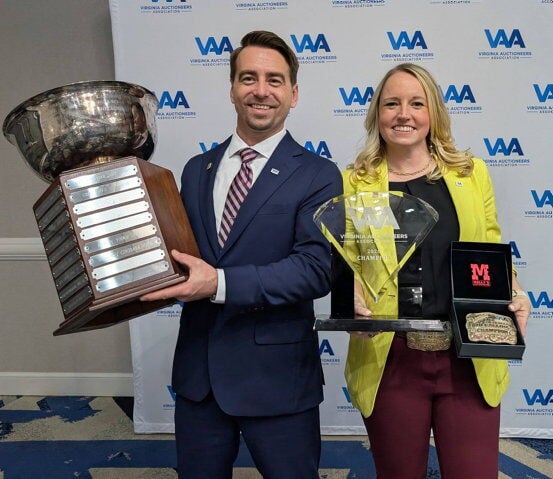
Auctioneer Michael Grimm has made a business using artificial intelligence to maximize his auction incomes.
Artificial intelligence is no longer the future; it’s the here and now, finding its spot in all industries, including auctioneering. Michael Grimm, the 2026 Virginia Auctioneers Association State Champion Auctioneer, is leading the modern evolution of the industry, combining a high-quality chant with cutting-edge artificial intelligence technology. Grimm views artificial intelligence as a powerful engine for business development, labor efficiency and strategic marketing, not a replacement for the auctioneer. An entrepreneur since 2009, he leads a business development and growth marketing agency called Poor Jellyfish and recently founded auction growth agency Big Red Gavel that focuses on artificial intelligence implementation. He also helps lead Daniel Auction Service, which was founded by his father-in-law, George Daniel. Some of Grimm’s main uses for artificial intelligence are cataloging for online sales, strategic sequencing, market research and brand personalization. He uses artificial intelligence to identify objects from photos and automatically generate item descriptions, particularly when cataloging large estates, helping him overcome the industry’s labor problem. Instead of listing items randomly, he uses the technology and e-commerce principles to sequence sales. By analyzing buyer psychology, artificial intelligence arranges items to maintains bidder attention and maximize the total sale value, rather than just individual item prices. Grimm also uses artificial intelligence to narrow down target audiences, identify potential problem statements for specific properties and find marketing partners to avoid overextending financial resources. Through Big Red Gavel, Grimm conducts business evaluations, looking at a client’s target markets, ideal customer profiles and effective social posts, to help identify pain points and areas for strategic growth. He also helps auction companies train artificial intelligence to sound like their brand for content creation. By submitting brand guides, past social posts and customer profiles into the technology, artificial intelligence can produce authentic-sounding content that acts like “hiring two employees,” Grimm said.
“I got into auctioneering because I married into an auction family,” he said. “My wife Wendy’s dad was an auctioneer for 50-plus years.” Also an auctioneer, Wendy was the 2025 Virginia Auctioneers Association State Champion Auctioneer. After a cross-country move from California to Virginia, Grimm started helping with his in-law’s business, ultimately finding his own place. “The reason I decided to (stay in the business) was because of the community,” he said. Grimm enrolled in the Mendenhall School of Auctioneering in North Carolina in 2017, which led him toward auction business development. “I expected it to be all about how to chant bids, but there was almost none of that,” he said. “The majority of the education was all about the legal requirements for being an auctioneer and conducting auctions … because you’re often handling a person’s largest transaction in their life.” He has continued his education with information from the National Auction Association and the Virginia Auctioneers Association, and he and his wife achieved the National Auction Association’s designation of Certified Auctioneers Institute Auctioneer. Daniel Auction Service started as a local auction company selling family farm equipment and later livestock, Grimm said. Today, it specializes in business liquidation, retail returns, personal property, real estate and benefit auctions.
“(Artificial intelligence) has been a whirlwind,” Grimm said. “I have spent the majority of my adult professional life at the intersection of growth, marketing and business development. What AI does is allow me to accelerate everything that we do on the business side.” Grimm’s success with the tool has relied on context and frameworks rather than simple prompts. He also acknowledged that responses must be humanized to sound like a business’s voice and brand. He uses Google AI Studio to build custom inventory apps for specialized needs, and he used Claude Code to create a “board of advisers.” By uploading core principles from his favorite business authors, Grimm can request consultation on specific questions with answers drawn from his trusted experts’ philosophies. Similarly, he also primes the tech with specific context and consumer psychology data before asking it to solve a problem — Grimm calls it “prime and prompt.” “Instead of just asking (artificial intelligence) for an answer, you prime it with the situation,” he said. “First, you give it some context and you let it lead you into the answer.” Without this honing, results fall victim to the “average trap.” “It always gives you the average of everything because (artificial intelligence) is trained on everything that’s ever been put online, good or bad,” Grimm said. He said his success has come from learning how to ask the right questions. “Instead of, ‘Hey, (artificial intelligence), write an ad for this auction coming up,’ we will ask something like, ‘Hey, let’s do a deep dive, a market research report, on this type of audience.’” For example, when marketing a campground, he used artificial intelligence to identify potential partners with an with an established audience to market to. “We’re using it to identify problem statements, the target audience and how to communicate the value of this property,” he said. He also uses artificial intelligence to help with product identification and cataloging as well as sequencing items in an online auction. Amazon and Shopify are widely doing this — leveraging consumer and buyer psychology to arrange e-commerce items in a way that maximizes the total purchase per person. And while artificial intelligence can already estimate an item’s value, Grimm is pushing it further. “Now, we’re going to ask it, ‘In order to hold people’s attention for the most amount of time while getting the most amount of value for the entire auction, (in) what order should we arrange these?’”