Quick Buzz Feed

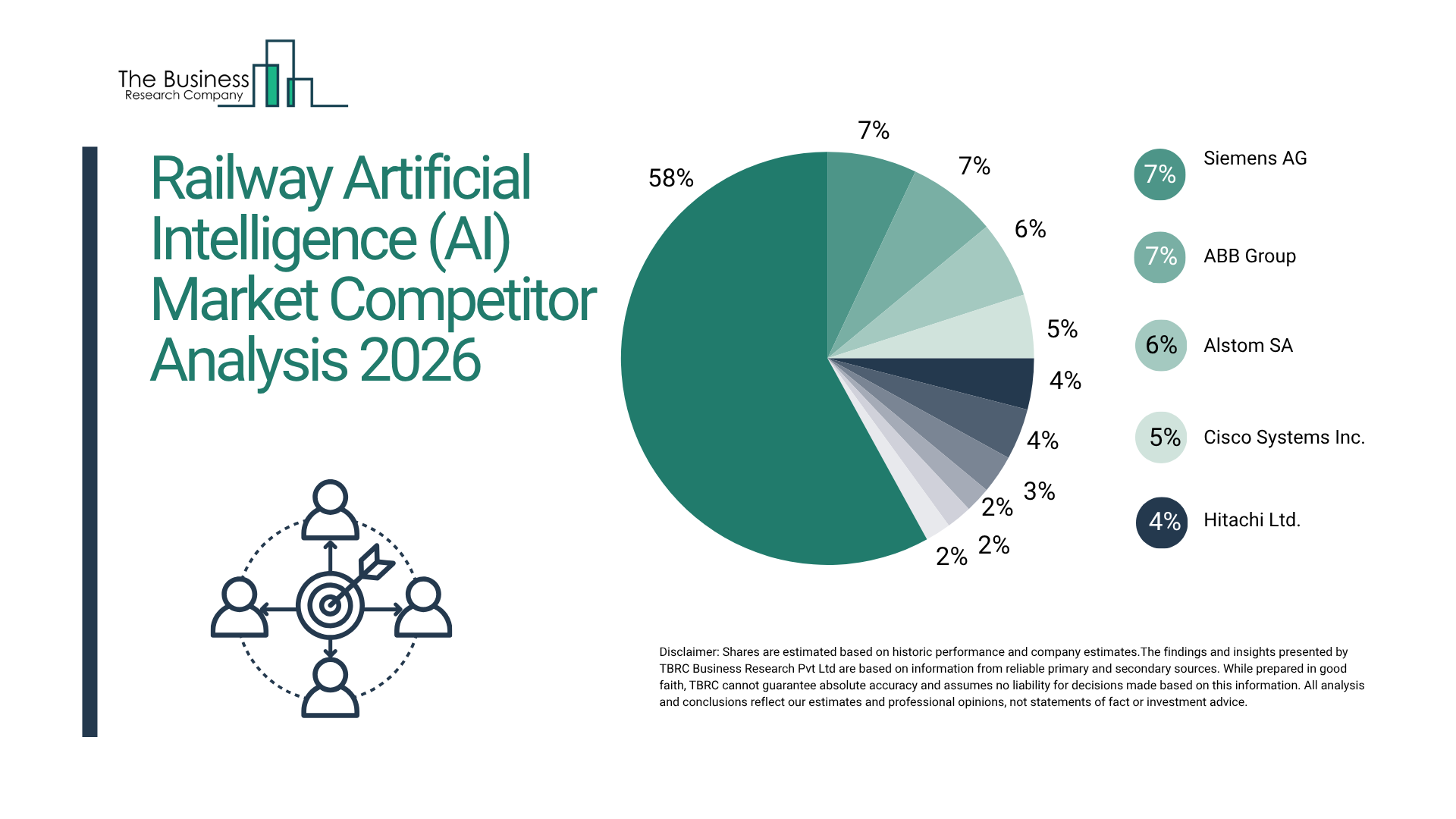
The railway artificial intelligence (AI) market is dominated by a mix of global rail technology providers and specialized AI solution companies, focusing on predictive maintenance, automated train control, and real-time passenger analytics. This market is expected to grow to $6.21 billion in 2030 at a compound annual growth rate (CAGR) of 15.1%, driven by the need for enhanced safety, efficiency, and regulatory compliance.
The railway artificial intelligence (AI) market is characterized by a blend of global rail technology providers and specialized AI solution companies. These entities are primarily focused on developing and implementing predictive maintenance systems, automated train control and signaling solutions, real-time passenger flow analytics, and advanced frameworks to enhance safety and operational efficiency. The market is driven by the need to maintain stringent performance and regulatory standards, with an emphasis on safety compliance, service reliability, and the integration of intelligent data management and monitoring systems. This evolving landscape necessitates a deep understanding for stakeholders seeking growth, innovation, and strategic partnerships within the smart transportation sector. The market is projected to reach $6.21 billion by 2030, growing at a compound annual growth rate (CAGR) of 15.1%.
Siemens AG is identified as the leading global sales player in the railway artificial intelligence market, holding a 7% market share in 2024. The company's railway AI division offers a comprehensive suite of solutions including predictive maintenance systems, automated train control, signaling solutions, real-time passenger flow analytics, and intelligent monitoring platforms. These offerings are designed to support safe, efficient, and regulated railway operations and infrastructure environments globally.
The railway artificial intelligence market features several prominent companies contributing to its growth and innovation. Key players include Siemens AG, ABB Group, Alstom SA, Cisco Systems Inc., Hitachi Ltd., International Business Machines Corporation (IBM), Huawei Technologies Co. Ltd., Thales Group, Fujitsu Limited, Toshiba Corporation, CAF (Construcciones y Auxiliar de Ferrocarriles) S.A., Nokia Corporation, Hyundai Rotem Company, Wabtec Corporation, Indra Sistemas S.A., CloudMoyo Inc., Voestalpine AG, Cervello Technologies LLC, and Cogniac Corporation. These companies collectively drive technological advancements and competitive dynamics within the sector.
The railway artificial intelligence market exhibits moderate fragmentation, with the top 10 market players collectively accounting for 21% of the total market revenue in 2024. This level of concentration is attributed to significant technological and regulatory entry barriers. These barriers include stringent railway safety standards, strict compliance requirements for transportation and signaling regulations, the demand for advanced AI and predictive analytics capabilities, and the essential need for high reliability and efficiency in rail operations and infrastructure. Leading companies maintain their strong market positions through diversified AI-powered railway solutions, well-established technology partnerships, extensive global deployment networks, and continuous innovation in areas like predictive maintenance, automated train control, and real-time passenger analytics.
The railway artificial intelligence market relies on a robust network of raw material and component suppliers. Major suppliers include Siemens Mobility GmbH, Hitachi Rail Limited, Alstom SA, CRRC Corporation Limited, Bombardier Transportation, Kawasaki Heavy Industries, Ltd., Wabtec Corporation, Stadler Rail AG, Mitsubishi Electric Corporation, General Electric Transportation, Toshiba Infrastructure Systems & Solutions Corporation, Hyundai Rotem Company, CAF (Construcciones y Auxiliar de Ferrocarriles), Knorr-Bremse AG, ABB Ltd., Thales Group, Bosch Rexroth AG, Honeywell Transportation Systems, Schneider Electric SE, ZF Friedrichshafen AG, Faiveley Transpor, Voith GmbH & Co. KGaA, PTC Inc., Transporeon Group, GE Digital, and Ericsson AB. These suppliers provide essential components and technologies that underpin the development of AI solutions for railways.
The distribution network for railway artificial intelligence solutions involves various major wholesalers and distributors. These include Tech Data Corporation, Ingram Micro Inc., Arrow Electronics, Inc., Avnet, Inc., Future Electronics Inc., RS Components plc, D&H Distributing Company, ALSO Holding AG, Esprinet S.p.A., Bechtle AG, Mindware FZ LLC, Logicom Public Limited, Redington Limited, Westcon Group, EET Group A/S, Synnex Corporation, Mouser Electronics, Digi-Key Electronics, CDW Corporation, Insight Enterprises, Inc., ScanSource, Inc., Exclusive Networks SA, Fastenal Company, Allied Electronics & Automation, and Macnica, Inc. These entities play a crucial role in delivering AI technologies to end-users in the railway sector.
The primary end-users of railway artificial intelligence solutions span a wide range of national and private railway operators globally. Key end-users include Indian Railways, Deutsche Bahn AG, Union Pacific Railroad, SNCF, Amtrak, Canadian National Railway Company, Russian Railways, East Japan Railway Company, China Railway Corporation, Australian Rail Track Corporation, DB Cargo AG, Network Rail, Ferrovie dello Stato Italiane, SNCB/NMBS, BNSF Railway Company, Southern Railway, CSX Transportation, Renfe Operadora, ÖBB, SNCF Réseau, KORAIL, SBB CFF FFS, JR West, JR Central, and MTR Corporation. These organizations leverage AI to enhance various aspects of their operations, from safety and maintenance to efficiency and passenger services.
A significant competitive trend in the railway AI market is the increasing adoption of AI-powered railway safety systems. These systems are revolutionizing accident prevention, facilitating early obstacle detection, and substantially improving overall operational safety across railway networks. A notable example is the March 2024 launch of Rail Vision's AI-based railway safety and obstacle detection system on a national railway line. This system integrates thermal imaging sensors, long-range cameras, and real-time AI analytics to boost situational awareness, mitigate collision risks, and enhance the efficiency of railway operations.
Companies in the railway AI market are employing several key strategies to maintain and advance their competitive positions. These strategies include prioritizing the advancement of railway artificial intelligence for real-time data processing, predictive maintenance, and critical safety decision-making. They are also leveraging AI-powered digital train inspection portals to improve defect detection and operational efficiency, and expanding AI-enabled intrusion detection systems, such as those designed to prevent elephant collisions, thereby enhancing both rail safety and wildlife protection. Furthermore, integrating strategic collaborations for the development of AI-powered railway monitoring platforms, safety solutions, and intelligent infrastructure is a crucial approach to staying ahead in this dynamic market.