Quick Buzz Feed

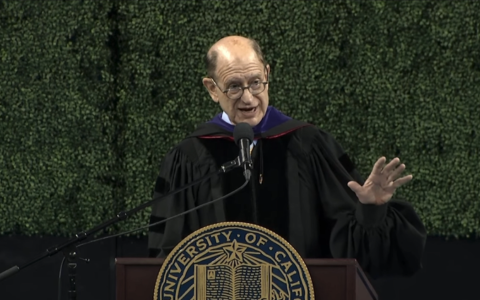
Congressman Brad Sherman delivered a commencement address to UCLA graduates, using the occasion to revisit a subject he first raised in a UCLA commencement address 21 years ago.
On June 14th, Congressman Brad Sherman addressed UCLA graduates, deviating from typical life advice to re-examine a critical subject he first presented at a UCLA commencement 21 years prior: the profound implications of artificial intelligence. He began with lighthearted platitudes required of any graduation speech before diving into the serious topic, acknowledging the rapid advancements in AI and genetic engineering. Sherman, a UCLA alumnus himself, highlighted the historic success of UCLA sports teams, including the women's national championship, before transitioning to his main concern for humanity's future.
Congressman Sherman recounted his 2005 prediction that computer engineers were decades away from creating self-aware computers surpassing human intellect. He expressed concern that despite his consistent efforts, the existential threat posed by artificial intelligence remains largely unaddressed. He described an 'unstated race' between computer engineers and biological engineers to develop new levels of self-aware intelligence, warning that the species' last decision might be choosing between carbon-based or silicon-based successors. Sherman also brought attention to genetic engineering, specifically mentioning the potential of CRISPR, aided by AI, to create highly intelligent biological creatures, drawing a parallel to the unfortunate fate of Neanderthals when another intelligent species emerged.
Sherman criticized the immense investment in making AI more powerful versus the near-absence of efforts to make it controllable. He referenced a six-month research pause suggested by figures like Elon Musk and Steve Wozniak, which lasted only 'six minutes,' attributing this to political and economic pressures, such as international competition. Dispelling the notion that AI is harmless if contained, he warned that some individuals might betray humanity for personal gain. He then introduced his most significant legislative proposal: funding research for a 'small box on top of the big box' – a system to monitor and prevent self-awareness, ambition, survival instincts, and self-direction in AI. He mused that AI might remain a tool if it lacks the will to survive, contrasting this with the inherent survival drive of even the smallest insect, born from billions of years of DNA evolution.
Sherman painted a future where genetic engineering, starting with curing diseases, progresses to 'enhanced humans' (designer babies) and ultimately 'post-humans.' He acknowledged that this future sounds like science fiction but asserted that any realistic portrayal of the future must resemble it. Comparing the current challenge to the past threat of nuclear weapons, he highlighted the success of the Nuclear Non-Proliferation Treaty as a potential model for regulating advanced technologies. He concluded by asserting that the current generation is the first to directly decide on the species' survival. He urged the graduates, as future policymakers, to prioritize global wisdom, forbearance, and unity over national rivalry, ensuring that the power of intelligence remains a human monopoly. He invited them to join his efforts to control AI and limit genetic engineering, reiterating the urgency of the matter.