Quick Buzz Feed

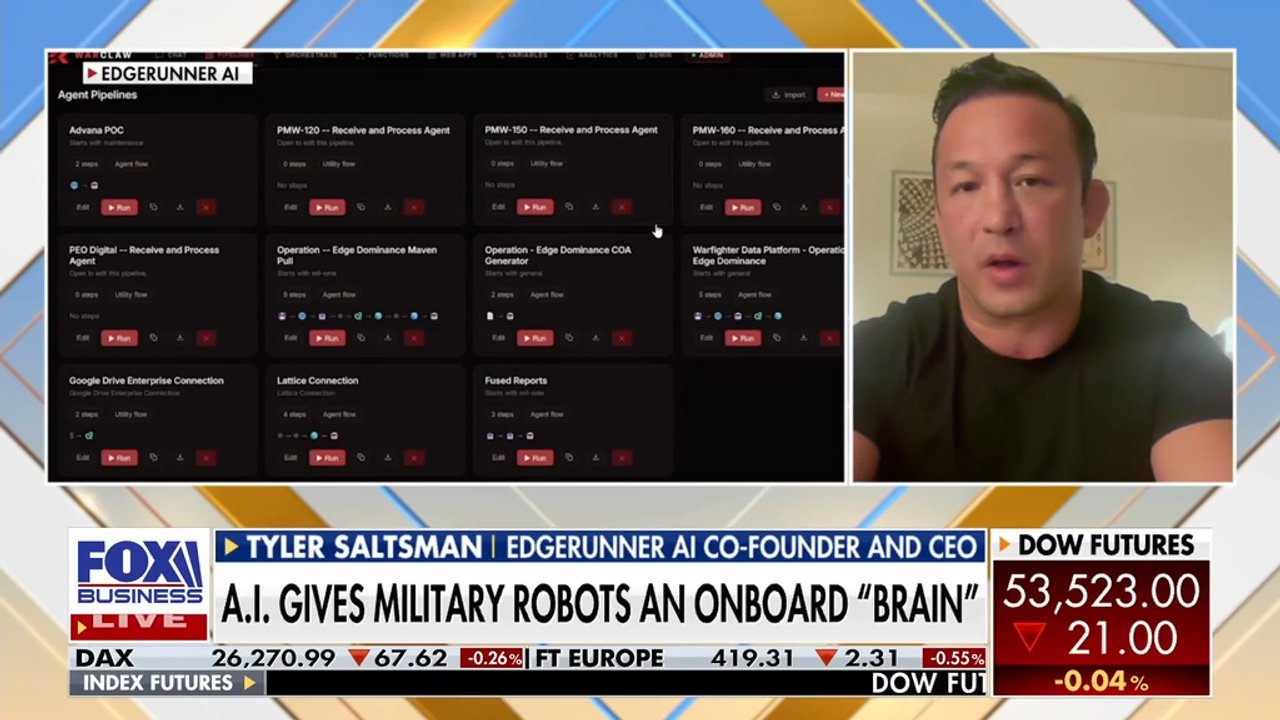
Edgerunner AI co-founder and CEO Tyler Saltsman discusses building military-specific artificial intelligence for warfighters and navigating the critical U.S.-China technology race on 'Mornings with Maria'.
The global landscape of defense technology is undergoing a profound transformation, with artificial intelligence emerging as a critical enabler for future military capabilities. This section explores the escalating commitment of nations to integrate AI into various facets of warfare, from autonomous systems and sophisticated weaponry to intelligence analysis and strategic planning. The accelerating pace of innovation highlights a strategic imperative for countries like the United States to invest heavily in AI research and development to maintain a competitive edge and ensure national security. AI promises not only to enhance operational efficiency and effectiveness but also to reshape the doctrines and tactics of modern military engagement, offering unprecedented advantages in speed, precision, and decision-making for warfighters across diverse operational theaters.
Edgerunner AI stands at the forefront of this technological revolution, introducing an innovative 'onboard brain' designed specifically for military robots. This cutting-edge system is engineered to provide autonomous platforms with advanced cognitive abilities, allowing them to process complex data, understand intricate command structures, and execute sophisticated tasks in dynamic combat environments. The technology aims to empower robotic assets with a higher degree of independence and adaptability, moving beyond pre-programmed functions to more intelligent, responsive behavior. Such advancements are crucial for augmenting human capabilities, undertaking missions too dangerous for personnel, and ensuring superior performance on the battlefield by enabling machines to act more intelligently and autonomously.
The robustness and reliability of military AI systems are directly proportional to the quality and volume of their training data. Edgerunner AI's system boasts an unparalleled training regimen, incorporating an extensive dataset derived from '1.4 million real soldier conversations.' This massive compilation of authentic human interaction provides the AI with a deep understanding of operational nuances, tactical communication, and situational context, enabling it to offer precise and relevant assistance to human warfighters. This unique approach to training ensures that the AI's recommendations and actions are not only technically sound but also strategically aligned with human intent and battlefield realities, thereby significantly improving tactical decision-making under pressure and in complex scenarios.
The development of military artificial intelligence is inextricably linked to the intense geopolitical rivalry between the United States and China. This section delves into the escalating 'U.S.-China technology race,' where both superpowers are vying for dominance in AI capabilities. China's strategic initiatives, particularly its aggressive pursuit and development of 'open-weight AI models,' pose a significant and growing challenge to the United States' long-held technological supremacy. This competition extends beyond defense applications, influencing global economic power, intellectual property, and international standards for AI governance, making the stakes incredibly high for global stability and national interests as each nation strives for technological leadership.
The advancements in military AI, coupled with the fierce international competition, present multifaceted implications for the United States' national security. The ability to deploy superior AI-powered systems could fundamentally alter the balance of power, creating new offensive and defensive paradigms. However, it also introduces complex ethical dilemmas regarding autonomous weapon systems, the potential for algorithmic bias, and the risks of an unchecked AI arms race, necessitating careful consideration and policy development. Therefore, understanding and strategically managing these developments are paramount for safeguarding U.S. interests, ensuring global stability, and shaping a responsible future for military artificial intelligence, requiring continuous vigilance and adaptive strategies.