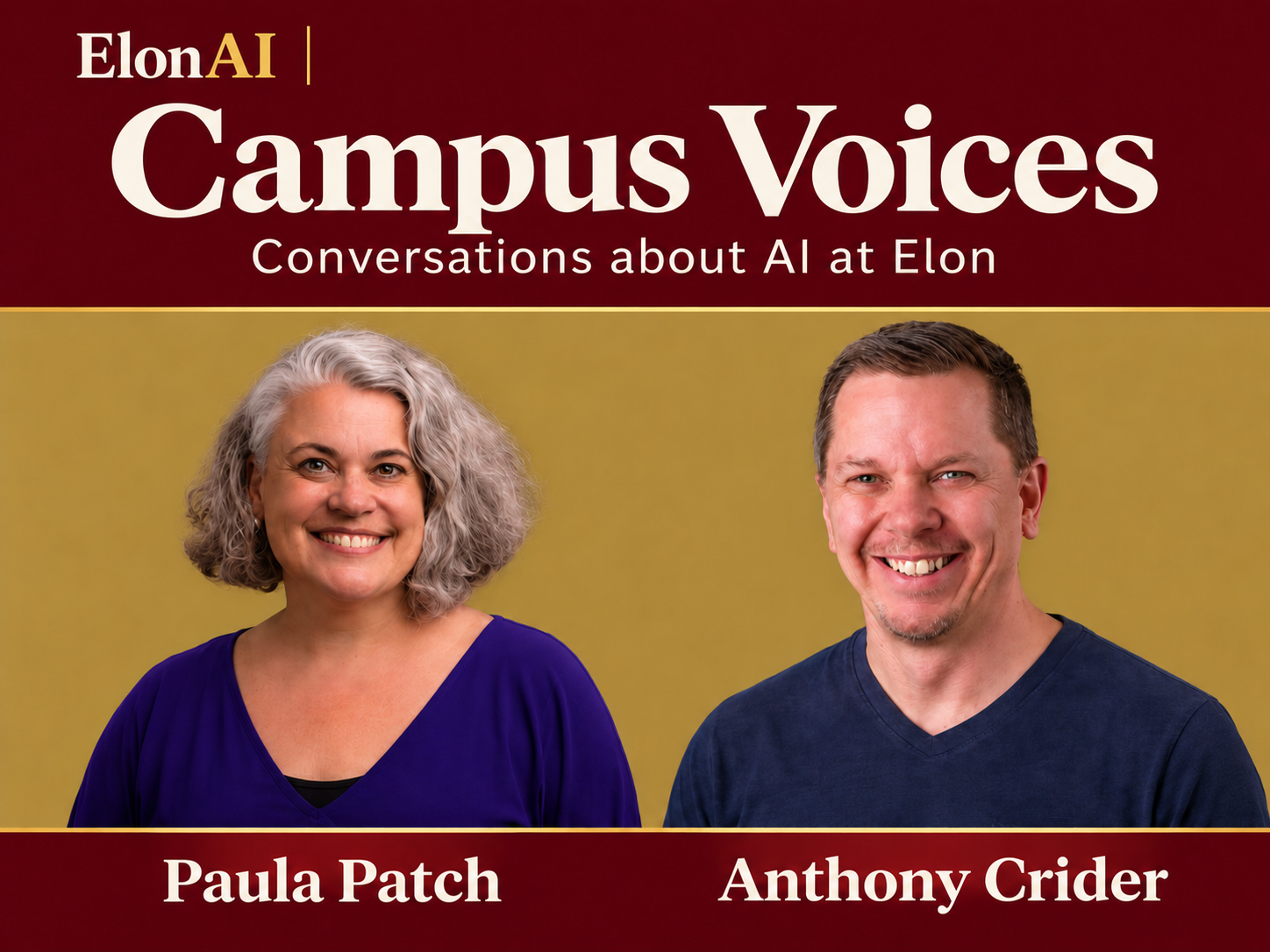
The Elon AI Hub’s “Campus Voices” series explores faculty experiences with artificial intelligence and its influence on teaching in their classrooms.
Introduction to Elon AI Hub's 'Campus Voices' Series The Elon AI Hub has initiated 'Campus Voices,' a new YouTube interview series designed to explore the profound impact of artificial intelligence on both teaching methodologies and student learning experiences within the university. The inaugural episodes feature prominent faculty members, Paula Patch, a teaching professor of English, and Anthony Crider, a professor of astrophysics. The series is expertly hosted by Paul Nunno ’27, a dedicated student employee at the AI Hub. Its core objective is to offer faculty a platform to openly discuss their practical applications of AI, to candidly address the perceived limitations and potential risks associated with these technologies, and to collectively ponder the evolving questions that arise from AI's increasing presence in academia. Nunno emphasizes a neutral observational approach to understanding AI's influence across campus life for both students and faculty alike. Professor Paula Patch's Perspective: AI as a 'Second Brain' Professor Paula Patch, featured in the episode 'AI as a Second Brain: Supporting Student Learning,' shares her practical and innovative methods for integrating ChatGPT into her English teaching. She details how AI assists her in brainstorming assignment ideas, streamlining course planning, and critically reflecting on pedagogical outcomes, asserting that AI has significantly boosted her efficiency and creative output. A central theme in her discussion is the paramount importance of safeguarding students' direct engagement with fundamental academic skills like reading and writing. Patch advocates for the ethical utilization of AI tools, suggesting they can serve as aids for students, such as helping them segment lengthy readings or structure study schedules, rather than circumventing the actual learning process. Furthermore, she raises crucial concerns about AI-generated text potentially diminishing a writer's unique voice and stresses the necessity for transparent conversations between students and faculty regarding explicit expectations and ethical boundaries for AI use in academic work. Professor Anthony Crider's Approach: AI, Education, and Future Workforce Skills Professor Anthony Crider, featured in the episode 'AI, Education, and the Future of Work,' recounts his transformative experience leveraging agentic AI—tools capable of performing complex, multi-step tasks autonomously—to rewrite all his course software during Elon University's transition from Moodle to Canvas. He elaborates on the necessity of redesigning his curriculum to address the pervasive presence of AI, particularly noting that many traditional coding assignments can now be instantly completed by AI. Crider's innovative response involves a pedagogical shift where students are first required to solve problems manually and then critically analyze AI-generated Python code for inaccuracies, before proceeding to use AI for their own code development. This method aims to ensure students grasp core conceptual understandings and cultivate the ability to critically evaluate AI tools and their outputs within their specific academic disciplines. Moreover, Crider discusses evolving assessment strategies that prioritize demonstrated skills and experiential learning. He offers valuable advice on preparing students for a rapidly changing job market, advocating for the development of strong proficiency in AI tools alongside the pursuit of interdisciplinary coursework. Upcoming Interviews and Access to AI Resources The 'Campus Voices' series will continue to expand with forthcoming interviews featuring other prominent faculty members, including Jonathan Su, an associate professor of engineering; Erin Hone, an associate teaching professor of education; and Amanda Sturgill, an associate professor of journalism, promising a broader range of perspectives on AI in academia. Both the initial episodes and all subsequent content are readily available for viewing on the official Elon University AI YouTube channel. For more comprehensive information regarding campus AI resources, opportunities for consultations, and a schedule of future events related to artificial intelligence, individuals are encouraged to visit the dedicated Elon AI Hub website.
Introduction to Elon AI Hub's 'Campus Voices' Series
The Elon AI Hub has initiated 'Campus Voices,' a new YouTube interview series designed to explore the profound impact of artificial intelligence on both teaching methodologies and student learning experiences within the university. The inaugural episodes feature prominent faculty members, Paula Patch, a teaching professor of English, and Anthony Crider, a professor of astrophysics. The series is expertly hosted by Paul Nunno ’27, a dedicated student employee at the AI Hub. Its core objective is to offer faculty a platform to openly discuss their practical applications of AI, to candidly address the perceived limitations and potential risks associated with these technologies, and to collectively ponder the evolving questions that arise from AI's increasing presence in academia. Nunno emphasizes a neutral observational approach to understanding AI's influence across campus life for both students and faculty alike.
Professor Paula Patch's Perspective: AI as a 'Second Brain'
Professor Paula Patch, featured in the episode 'AI as a Second Brain: Supporting Student Learning,' shares her practical and innovative methods for integrating ChatGPT into her English teaching. She details how AI assists her in brainstorming assignment ideas, streamlining course planning, and critically reflecting on pedagogical outcomes, asserting that AI has significantly boosted her efficiency and creative output. A central theme in her discussion is the paramount importance of safeguarding students' direct engagement with fundamental academic skills like reading and writing. Patch advocates for the ethical utilization of AI tools, suggesting they can serve as aids for students, such as helping them segment lengthy readings or structure study schedules, rather than circumventing the actual learning process. Furthermore, she raises crucial concerns about AI-generated text potentially diminishing a writer's unique voice and stresses the necessity for transparent conversations between students and faculty regarding explicit expectations and ethical boundaries for AI use in academic work.
Professor Anthony Crider's Approach: AI, Education, and Future Workforce Skills
Professor Anthony Crider, featured in the episode 'AI, Education, and the Future of Work,' recounts his transformative experience leveraging agentic AI—tools capable of performing complex, multi-step tasks autonomously—to rewrite all his course software during Elon University's transition from Moodle to Canvas. He elaborates on the necessity of redesigning his curriculum to address the pervasive presence of AI, particularly noting that many traditional coding assignments can now be instantly completed by AI. Crider's innovative response involves a pedagogical shift where students are first required to solve problems manually and then critically analyze AI-generated Python code for inaccuracies, before proceeding to use AI for their own code development. This method aims to ensure students grasp core conceptual understandings and cultivate the ability to critically evaluate AI tools and their outputs within their specific academic disciplines. Moreover, Crider discusses evolving assessment strategies that prioritize demonstrated skills and experiential learning. He offers valuable advice on preparing students for a rapidly changing job market, advocating for the development of strong proficiency in AI tools alongside the pursuit of interdisciplinary coursework.
Upcoming Interviews and Access to AI Resources
The 'Campus Voices' series will continue to expand with forthcoming interviews featuring other prominent faculty members, including Jonathan Su, an associate professor of engineering; Erin Hone, an associate teaching professor of education; and Amanda Sturgill, an associate professor of journalism, promising a broader range of perspectives on AI in academia. Both the initial episodes and all subsequent content are readily available for viewing on the official Elon University AI YouTube channel. For more comprehensive information regarding campus AI resources, opportunities for consultations, and a schedule of future events related to artificial intelligence, individuals are encouraged to visit the dedicated Elon AI Hub website.