Quick Buzz Feed

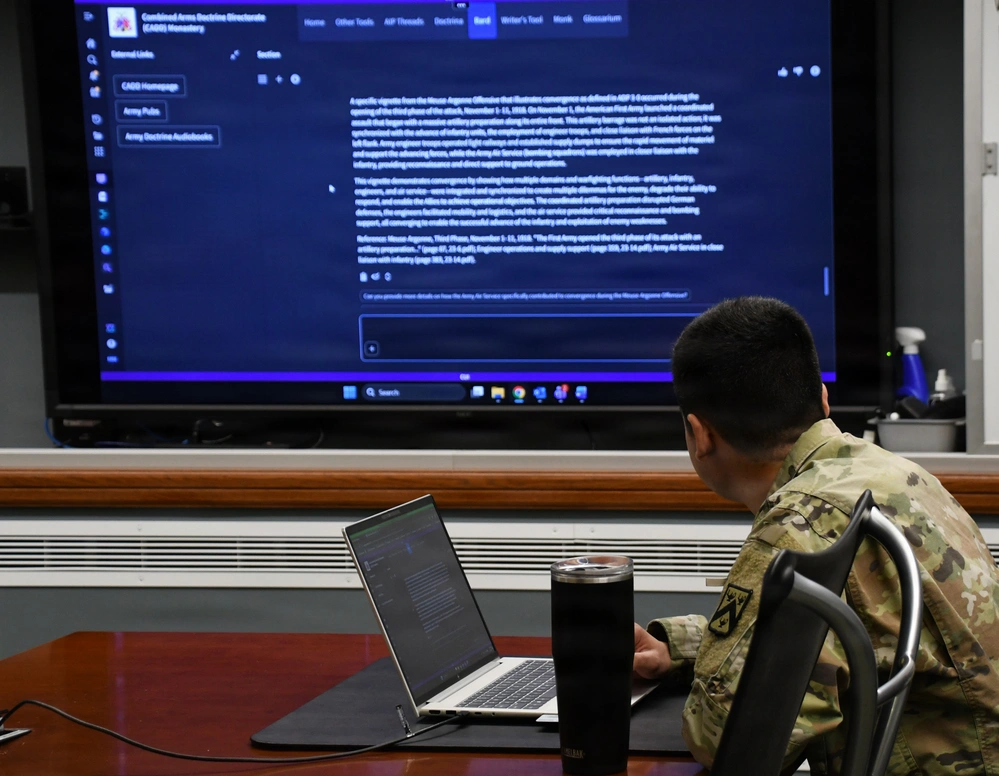
AI agents on Palantir Vantage accelerate MDMP Mission Analysis, cutting timelines by 60% while ensuring doctrinal precision.
This article details an experiment conducted at the U.S. Army Command and General Staff College (CGSC) to integrate Artificial Intelligence (AI) agents, built on the Palantir Vantage platform, into Step 2 (Mission Analysis) of the Military Decision-Making Process (MDMP). The experiment compared a traditional 14-student human staff with a two-student AI-augmented team. The AI team utilized specialized AI personas (Overall, IPOE, Combined, and MA Brief agents) to generate various mission analysis outputs like running estimates, Intelligence Preparation of the Operational Environment (IPOE) products, problem statements, and mission statements. The study concludes that AI acts as a powerful cognitive partner, significantly accelerating Mission Analysis, especially for text-heavy tasks and addressing expertise gaps. However, it emphasizes that human validation remains crucial for ensuring realism, developing graphics, and making final judgments to improve commander decision-making in modern warfare.
The evolving landscape of modern warfare necessitates that military organizations not only adapt to new threats but also harness emerging technologies like Artificial Intelligence (AI) and Large Language Models (LLMs) to gain a strategic advantage in the Military Decision-Making Process (MDMP). This article presents an experiment conducted at the Command and General Staff College (CGSC) focused on integrating AI into Mission Analysis (MA). The study aimed to test two primary hypotheses: first, whether AI could produce MA products comparable in quality to those developed by human staff; and second, if AI personas could effectively bridge expertise gaps within specialized warfighting functions. Utilizing the Palantir Vantage platform for AI agent development, the experiment yielded considerable success in improving efficiency and producing high-quality text-based outputs, while simultaneously highlighting the indispensable need for human oversight. These findings lay a foundation for accelerating the Mission Analysis phase, thereby enabling commanders to make more rapid and better-informed decisions.
The experiment was designed to compare the effectiveness of a traditional human staff against an AI-assisted team in conducting Mission Analysis (MA). The human staff consisted of 14 students who followed standard doctrinal methods, relying on their collective knowledge, scenario documents (base order and annexes), and commander’s guidance to generate running estimates, Intelligence Preparation of the Operational Environment (IPOE), and key outputs such as problem and mission statements. This team operated with minimal AI intervention, emphasizing manual analysis. In contrast, a two-student team was tasked with developing AI agents on the Palantir Vantage platform, a robust tool specifically designed for creating tailored AI solutions. Palantir Vantage facilitated the development of AI personas (AIP agents) by enabling seamless integration of doctrinal documents, scenario data, and custom instructions into Large Language Models (LLMs). The platform's ontology-based structuring converted raw documents into optimized, parsable formats, similar to techniques used in previous wargaming experiments, allowing for efficient knowledge ingestion without overburdening the model’s context window. The AI team’s objective was to produce a parallel MA brief, directly addressing both hypotheses through the use of specialized AI agents.
The development of AI agents on Palantir Vantage began with an initial assessment of warfighting functions, although this was ultimately streamlined to three core AIP agents to maximize coverage while reducing complexity. 1. **Overall Agent**: This primary agent ingested all scenario products, doctrinal references like FM 3-0 and FM 5-0, and commander’s guidance, converting documents into ontologies for efficient querying. Its responsibilities included generating running estimates by warfighting function, identifying asset availability/shortfalls, constraints, Essential Elements of Friendly Information (EEFI), facts/assumptions, specified, implied, and essential tasks, and risks. The outputs were structured text, forming the basis for broader MA products. 2. **IPOE Agent**: Focused on the intelligence warfighting function, this specialized agent executed IPOE processes as per ATP 2-01.3. It received inputs limited to Annex B (Intelligence), the base order, and relevant doctrine to simulate focused expertise. Using Palantir Vantage, it produced detailed IPOE steps, including the Intelligence Collection (IC) plan, Modified Combined Obstacle Overlay (MCOO), key terrain analysis, Areas of Operation/Interest (AoA/AoI), enemy Situation Template (SITEMP), event template, High-Value Target (HVT) list, intelligence gaps, IC requirements table, and an overall enemy situation assessment, thereby addressing potential intelligence expertise gaps. 3. **Combined Agent**: Acting similarly to an executive officer (XO) or S3, this agent synthesized outputs from both the Overall and IPOE agents. It aggregated data to produce a timeline, problem statement, mission statement, and proposed Course of Action (COA) evaluation criteria. Palantir Vantage facilitated iterative refinement, enabling the agent to cross-reference inputs without redundant data uploads. A fourth agent, the MA Brief Agent, was later introduced to compile all synthesized outputs into a cohesive brief, relying solely on processed data rather than original scenarios. All agent instructions were meticulously crafted on Palantir Vantage, emphasizing doctrinal fidelity, unit focus, and key operational elements. To minimize bias, these instructions were generated using a separate LLM (Claude Sonnet 4.5), while the operational agents utilized GPT-4.1 equivalents. The length of instructions varied, with the Overall Agent requiring the most detail for comprehensive coverage.
The experiment revealed significant differences in execution and output quality between the human and AI teams. The human staff completed Mission Analysis (MA) in approximately 5 hours (4.5 hours for analysis, 0.5 hours for slide creation, and 0.5 hours for rehearsals). In stark contrast, the AI team, leveraging Palantir Vantage’s automation capabilities, finished in just 2 hours (1 hour for agent setup and 1 hour for product generation), demonstrating a substantial 3-hour efficiency gain. The results underscored AI’s strengths in text-based outputs; the AI-generated problem and mission statements were consistently clearer, more concise, and more doctrinally aligned compared to the human team’s often verbose drafts. Similarly, running estimates and task identifications were robust, showcasing AI's capacity to rapidly process vast amounts of doctrinal information. However, visualization emerged as a notable challenge. While the IPOE Agent provided accurate text descriptions for elements like MCOO details and SITEMP narratives, it lacked the ability to generate visual outputs such as maps or diagrams, which are crucial components of MA briefs. Although the AI provided instructions for creating visuals, this fell short of the comprehensive graphical products produced by the human team, impacting the IPOE section’s overall effectiveness and resulting in only 30% equivalence when visuals were considered. Overall, the AI brief achieved 60% equivalence to the human version, which increased to 90% when visual-heavy slides were excluded. Instances of missing elements, like risk assessments, were attributed to gaps in instructional design, highlighting the critical importance of effective prompt engineering, akin to crafting clear military orders.
Using a 100% equivalence rating against human-produced products, the experiment's two hypotheses were evaluated. Hypothesis 1 was partially validated, confirming that AI could generate viable Mission Analysis (MA) outputs. In non-visual aspects, AI's products sometimes surpassed human quality in terms of synthesis and clarity. Hypothesis 2 was affirmed specifically for the Intelligence Preparation of the Operational Environment (IPOE) agent; this specialized AI successfully simulated expertise by identifying intelligence gaps and templates that closely matched human analysis, although without generating visuals. The successes of the AI team were largely attributed to Palantir Vantage’s capabilities. Its ontology structuring significantly accelerated data handling, enabling AI agents to perform doctrinal reasoning without direct human intervention. This mirrored insights from previous wargaming experiments where simplified prompts still led to realistic outcomes. Furthermore, AI's inherent impartiality helped identify hidden assumptions, thereby challenging human biases and enhancing the overall rigor of the analysis.
Several critical takeaways emerged from the experiment, providing valuable insights for the Army-wide adoption of AI in military decision-making: 1. **Human-in-the-Loop Essential**: AI serves as an augmentation tool, not a replacement for human judgment. Human validation is indispensable for ensuring realism, particularly concerning visual outputs and nuanced contextual considerations. 2. **Instructional Expertise Critical**: The effectiveness of AI outputs is directly tied to the quality of the prompts. Units must train their staff in 'AI tasking' – the art of crafting detailed, unbiased instructions – to prevent omissions and ensure desired outcomes. 3. **Data Integrity Matters**: Reliable AI outputs depend on accurate and up-to-date inputs. Maintaining current doctrines and scenario information within platforms like Palantir Vantage is paramount for generating trustworthy analysis. 4. **Efficiency as a Force Multiplier**: The significant time savings achieved through AI integration allow for more iterations of analysis, deeper examination of problems, and a reduction in staff fatigue, thereby multiplying the force's analytical capabilities. 5. **Visualization Integration Needed**: Future AI development efforts should prioritize the incorporation of tools capable of generating graphics, maps, and diagrams to address the current visualization gap and enhance the comprehensiveness of AI-assisted outputs.
Valid concerns exist regarding the potential downsides of over-reliance on AI agents in Mission Analysis. Critics rightly warn of automation bias, where military staff might uncritically accept AI-generated outputs, which are often polished and doctrinally fluent, as inherently superior, potentially eroding human judgment. There's also the risk of skill atrophy, as junior officers may increasingly delegate complex intellectual tasks like running estimates, task analysis, and assumption vetting to Large Language Models (LLMs). Furthermore, a subtle danger lies in AI's structural coherence potentially masking unresolved priorities or command trade-offs that a human staff would naturally identify through friction and debate. While these concerns are legitimate, especially in high-stakes operational environments where over-trusting shallow synthesis could degrade professional judgment over time, this experiment and article strongly advocate for rigorous human-in-the-loop validation, deliberate 'AI tasking' training, and explicit retention of commander and staff oversight. This approach positions AI as a rapid drafting and assumption-challenging tool, rather than a decision-making authority, directly mitigating these risks. Far from causing atrophy, a well-designed integration of AI can actually sharpen human skills by liberating staff from rote synthesis, allowing them to focus on creative problem-framing, visual integration, and ethical judgment – crucial higher-order functions that define military professionalism. Ultimately, approaching AI outputs with the same healthy skepticism applied to any staff recommendation ensures that the friction essential for robust MDMP is preserved, while leveraging technology for its speed and consistency as a genuine force multiplier.
This experiment successfully demonstrates AI's transformative potential to accelerate Mission Analysis, significantly streamlining Step 2 of the Military Decision-Making Process (MDMP). By developing AIP agents on platforms like Palantir Vantage, military staff can effectively address expertise gaps, particularly in areas like intelligence, and expedite critical tasks such as generating running estimates and drafting problem statements. The successes observed in text-based synthesis and processing speed firmly establish AI as a valuable cognitive partner, capable of facilitating rigorous, assumption-challenging analysis. However, the study unequivocally emphasizes that human oversight remains paramount for validating AI outputs, integrating visualizations, and applying holistic judgment. As the Army moves towards operationalizing AI, strategic investment in doctrine development, comprehensive training programs, and robust infrastructure will be crucial to ensure AI becomes a cornerstone of decision-making, providing a decisive competitive edge in future conflicts.