Quick Buzz Feed

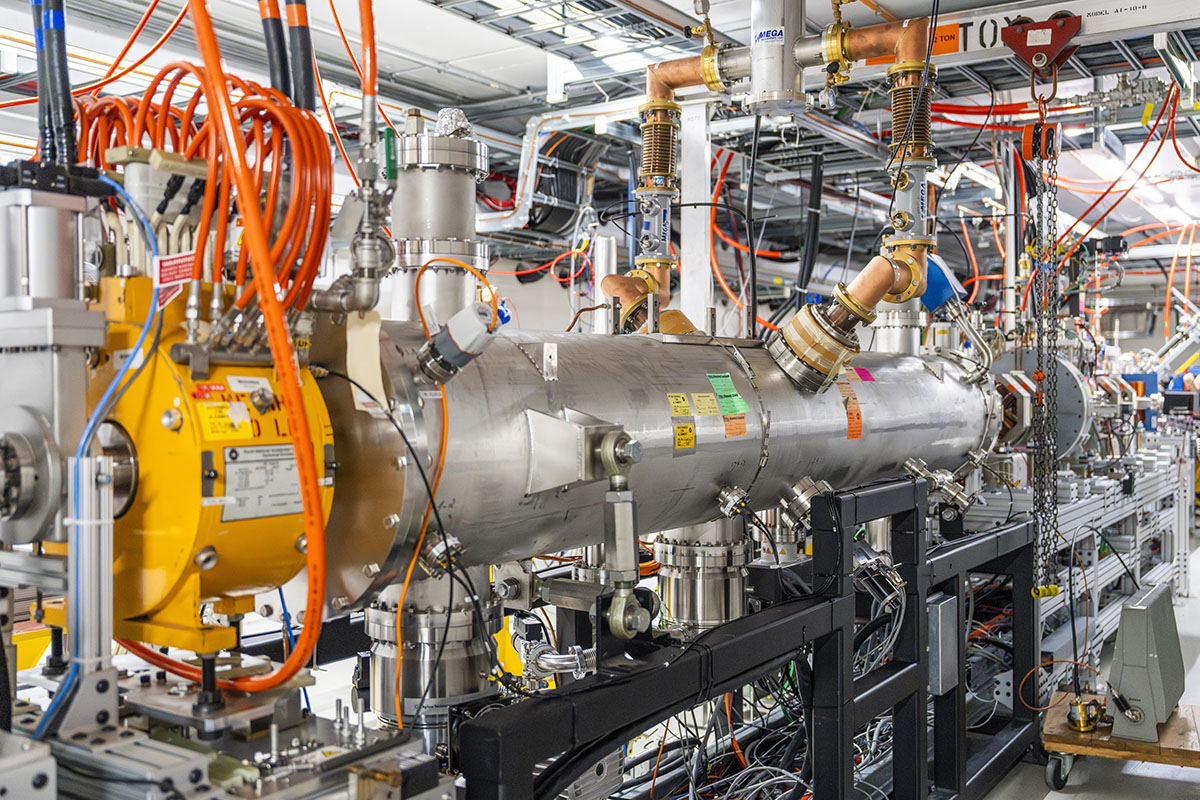
In coordination with six other national labs, Fermilab is developing AI tools to increase the efficiency and innovation in particle accelerators as part of the Department of Energy’s Genesis Mission.
Particle accelerators are powerful tools driving discoveries across physics, chemistry, materials science, and biology. However, their design and operation are incredibly complex, often involving thousands of components and years of development. To tackle these challenges, Fermilab is a key contributor to the Multi-Office particle Accelerator Team (MOAT), an initiative focused on integrating advanced artificial intelligence throughout the entire lifecycle of particle accelerators to significantly enhance their efficiency and foster innovation in the field.
Jonathan Jarvis, director of Fermilab’s Accelerator Research Division and a MOAT collaborator, articulates the ambitious vision for MOAT: to integrate AI so thoroughly into the design, construction, and operation of accelerators that it fundamentally transforms the pace of scientific discovery and the resulting innovations. This effort is a crucial component of the U.S. Department of Energy’s Genesis Mission, specifically within the Transformational AI Models Consortium (ModCon), which aims to develop and deploy self-improving AI models by leveraging the DOE’s extensive data, facilities, and expertise.
The MOAT initiative represents a broad collaborative effort, bringing together researchers from several prominent DOE national laboratories including Berkeley, Argonne, Fermilab, Jefferson, Oak Ridge, SLAC, and Brookhaven. Jean-Luc Vay, the MOAT project lead and head of the Advanced Modeling Program at Lawrence Berkeley National Laboratory, emphasizes the profound and wide-ranging impact of accelerators across numerous scientific domains, highlighting the critical importance of this concerted national effort to advance accelerator science through AI.
Fermilab's advanced accelerator technology test facility, known as FAST/IOTA, is poised to play a pivotal role as a key demonstrator and testbed for the AI tools being developed by MOAT. The facility's inherent flexibility allows for comprehensive testing across diverse types of accelerators and particle beams, making it an ideal environment to validate and refine the innovative AI solutions designed to improve accelerator performance and capabilities.
Still in its nascent stages, MOAT recently achieved a significant milestone by presenting the first demonstration of its work to the DOE Office of Science. This showcase highlighted the initial deployment of the Osprey AI tool, which leverages autonomous AI agents to accelerate specific tasks by an impressive factor of 100. Thorsten Hellert of Berkeley Lab noted that the Genesis Mission has successfully compelled the community to collaborate in developing and deploying this new AI software collectively, marking a departure from traditional standalone prototype development by individual labs.
One immediate and promising avenue for optimization lies in harnessing the vast amount of knowledge accumulated over decades from operating complex particle accelerator systems like Fermilab’s. MOAT’s AI systems are designed to be trained on this extensive archive of documented fixes and successful problem-solving strategies from accelerator operators across various DOE accelerator complexes. This will enable the AI to provide instant, citation-backed solutions to operational errors, significantly improving the speed and effectiveness of accelerator management.
A core aspect of MOAT’s development strategy involves creating 'digital twins' for each accelerator complex. These virtual counterparts will serve as sophisticated testbeds, allowing for virtual diagnostics and speculative beam tuning experiments to be conducted safely before any changes are implemented on the physical accelerator. Crucially, these digital twins will be dynamically interconnected with the real particle accelerators, establishing a continuous feedback loop that enables the AI to learn how the accelerator responds to adjustments and continuously refine the digital twin’s accuracy to reflect real-world performance.
When fully realized, MOAT’s vision holds the potential for immense benefits, including savings of billions of dollars and many years of development effort. More importantly, it is expected to dramatically increase the performance and overall value of particle accelerators. This transformative approach aims to accelerate scientific discovery, expanding our knowledge in fundamental physics, chemistry, biology, and materials science at an unprecedented rate, thereby multiplying the research potential for critical applications such as new medications and fusion energy.