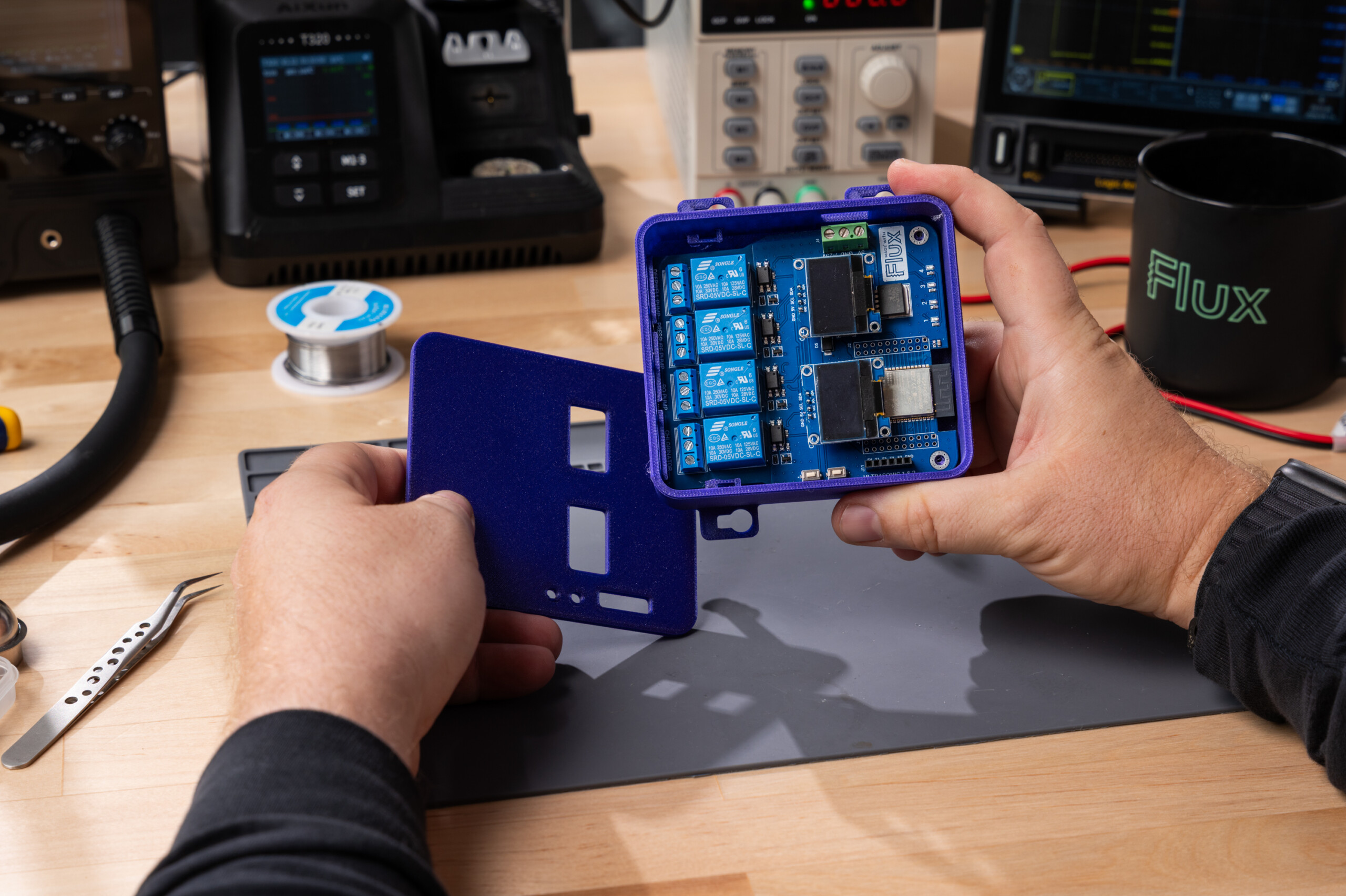
Users can describe enclosure requirements, update designs with board changes and export models for physical prototype testing.
Introduction to Flux AI Tools for Enclosures Flux has rolled out new AI-based functionalities to simplify the design of 3D-printable enclosures for Printed Circuit Boards (PCBs). This innovation allows users to generate enclosure designs by describing their requirements in a chat interface, with the system intelligently adapting to the PCB's geometry. Streamlining Traditional Enclosure Design Historically, creating PCB enclosures was a complex task, often necessitating the involvement of a mechanical engineer or specialized mCAD software. Any subsequent modifications to the PCB would frequently demand time-consuming updates to the mechanical enclosure design. Flux's new capability addresses these challenges by seamlessly connecting PCB and enclosure design workflows. Automated and Adaptive Design Generation The platform automatically generates 3D-printable enclosure models, incorporating essential features like latches, screw holes, mounting points, curved edges, vents, and port cutouts. Users can preview these designs, request specific modifications to their aesthetics or function, and then export them in standard 3D-printing formats for fabrication. Real-time Updates and Physical Prototyping A significant advantage of Flux's new tools is their ability to dynamically update the enclosure when users alter or reposition components on the PCB. The system autonomously adjusts the enclosure design and updates manufacturing and assembly instructions to reflect these changes. This feature facilitates efficient physical prototype testing, enabling users to evaluate the PCB within its intended physical context prior to formal manufacturing. The enclosure design capability is available across all Flux subscription plans.
Introduction to Flux AI Tools for Enclosures
Flux has rolled out new AI-based functionalities to simplify the design of 3D-printable enclosures for Printed Circuit Boards (PCBs). This innovation allows users to generate enclosure designs by describing their requirements in a chat interface, with the system intelligently adapting to the PCB's geometry.
Streamlining Traditional Enclosure Design
Historically, creating PCB enclosures was a complex task, often necessitating the involvement of a mechanical engineer or specialized mCAD software. Any subsequent modifications to the PCB would frequently demand time-consuming updates to the mechanical enclosure design. Flux's new capability addresses these challenges by seamlessly connecting PCB and enclosure design workflows.
Automated and Adaptive Design Generation
The platform automatically generates 3D-printable enclosure models, incorporating essential features like latches, screw holes, mounting points, curved edges, vents, and port cutouts. Users can preview these designs, request specific modifications to their aesthetics or function, and then export them in standard 3D-printing formats for fabrication.
Real-time Updates and Physical Prototyping
A significant advantage of Flux's new tools is their ability to dynamically update the enclosure when users alter or reposition components on the PCB. The system autonomously adjusts the enclosure design and updates manufacturing and assembly instructions to reflect these changes. This feature facilitates efficient physical prototype testing, enabling users to evaluate the PCB within its intended physical context prior to formal manufacturing. The enclosure design capability is available across all Flux subscription plans.