Quick Buzz Feed

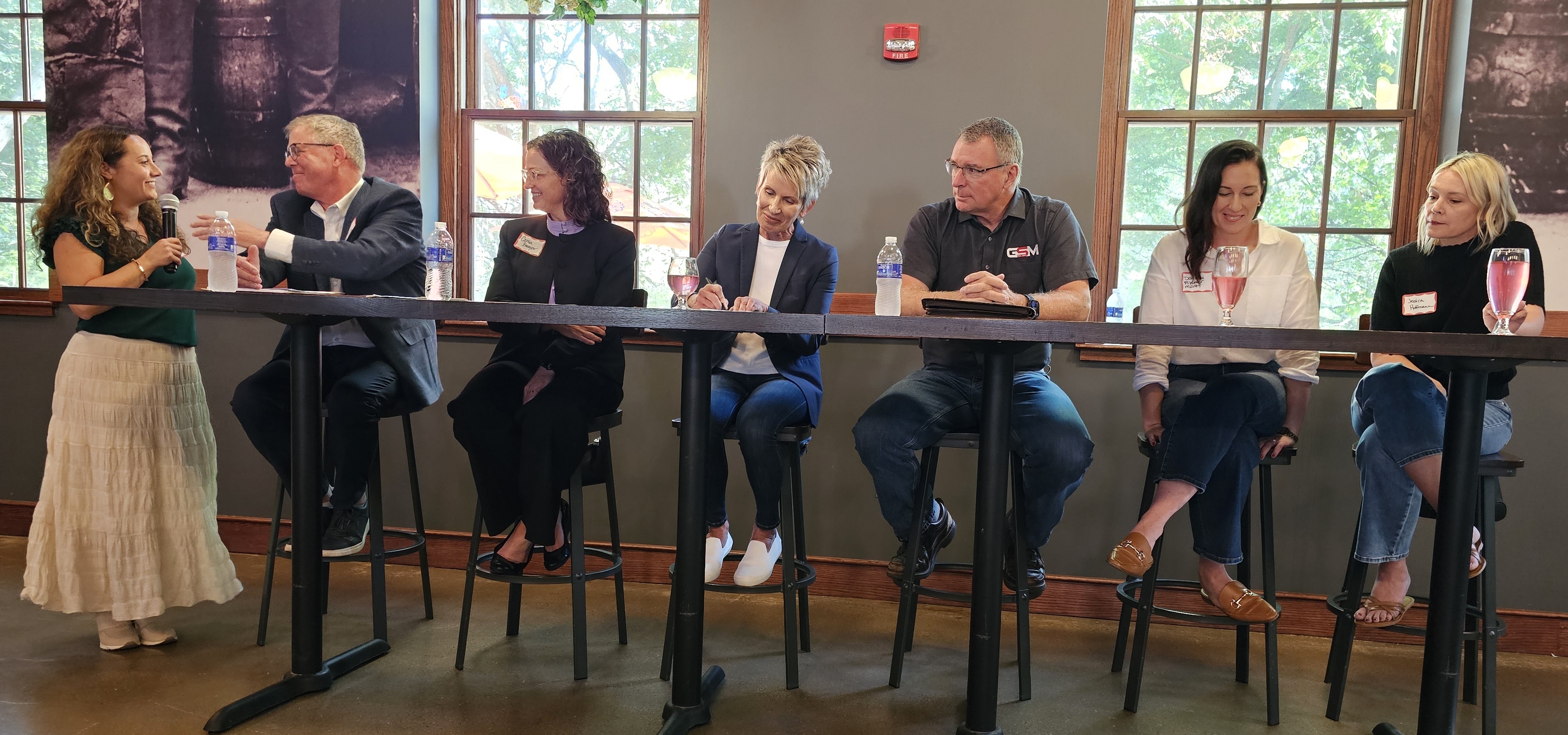
The New Ulm Area Chamber of Commerce hosted its fourth annual CEO panel, bringing together local business leaders to discuss critical contemporary challenges, ranging from effective strategies for employee retention to the burgeoning impact and application of artificial intelligence across various industries in the New Ulm community. The panel explored how local businesses are adapting to these evolving dynamics, sharing insights on maintaining a strong workforce and leveraging technology for efficiency and growth.
The fourth annual CEO panel, moderated by Ann Vote and hosted by Danny Hawkins of the New Ulm Area Chamber of Commerce, featured a diverse group of local business leaders: Mike Schwartz (Frandsen Bank & Trust), Carisa Buegler (New Ulm Medical Center), Sheryl Meshke (Associated Milk Producers Inc.), John Gag (Gag Sheet Metal Inc.), and sisters Danielle Marti and Jessica Fischer-Hoffmann (Gallery 512). The session commenced with panelists introducing their respective businesses and providing their perspectives on the current market conditions in New Ulm, setting the stage for discussions on key challenges and opportunities facing local enterprises.
Mike Schwartz, Regional President of Frandsen Bank & Trust, shared his extensive 35 years of banking experience, noting the unique stability of New Ulm's economy. He emphasized that the city's economic resilience stems from its diverse array of employers. Unlike other regions that experienced significant fluctuations, New Ulm maintained a more consistent and gradual growth trajectory, particularly in contrast to the sharp economic downturns seen in other markets during the Great Recession. Schwartz underscored that this steadier, slower growth has paradoxically led to a more robust and problem-averse economic environment for the community.
Sheryl Meshke, President and CEO of Associated Milk Producers Inc. (AMPI), provided an overview of the dairy cooperative, proudly noting her position as the first woman to lead a U.S. dairy cooperative. She detailed AMPI's significant presence in New Ulm, operating both a butter plant and its headquarters in a former grocery store building. Meshke highlighted the cooperative's impressive annual sales, approaching $2 billion, and its approximately 1,000 system-wide employees, including 60 dedicated staff in New Ulm. She vividly illustrated the demanding nature of the dairy business with the statement, 'We are 24/7, 365. The cows don’t know what day it is,' underscoring the continuous effort required.
John Gag, President of Gag Sheet Metal Inc., shared the rich history of his family business, founded in 1904 as the Gag/Ranweiler Tin Shop by his great-grandfather. He described the remarkable expansion of the company from a modest 4,000 square feet to an expansive 60,000 square feet across three city blocks. Gag reminisced about the continuous growth during his first 35 years, with weekly revenue now surpassing the annual earnings from when he started in 1986. However, he also candidly discussed the more recent period of stagnation, noting that business growth has remained flat for the past five years, attributing this to a perceived lack of consumer confidence in spending.
Carisa Buegler, the new President of New Ulm Medical Center, elaborated on the organization's substantial workforce of about 700 care team members and the ongoing efforts to recruit new providers, with six more expected by year-end. She highlighted the challenge of not just recruiting professionals, but also 'selling' them on the New Ulm community itself. Buegler shared a successful anecdote of using the Chamber's local appeal points to attract a neurologist through a 'speed dating' recruitment event. She also noted the positive impact of new apartment developments, which provided readily available housing for four of the six new providers, streamlining a previously informal and challenging housing process.
Danielle Marti, representing Gallery 512 Boutique alongside her sister Jessica Fischer-Hoffmann, emphasized the foundational role of local and repeat customers, who account for 85% of their sales since the boutique's establishment in 2013. Marti passionately articulated the irreplaceable experience of a physical store, stating, 'An online experience will never be the same as what you will get when you go into an actual brick-and-mortar store.' She highlighted the store's positive, supportive culture for its 12 part-time employees, asserting that genuine human connection is paramount: 'People support people, not businesses,' reinforcing the personal touch that defines their retail success.
The panel delved into various strategies for employee retention. Moderator Ann Vote introduced the Leader Collaboratory program, which focuses on cultivating a supportive work culture that encourages growth and values employees. John Gag detailed his personalized approach at Gag Sheet Metal, including one-on-one meetings with all 75 employees, offering 75 different compensation packages, and a policy of rarely denying paid time off requests, even implementing unlimited PTO for 18 office staff members based on job performance. Carisa Buegler acknowledged the complexities of creating flexible schedules while maintaining equity among 700 staff members. Sheryl Meshke mentioned AMPI's hybrid work model, requiring about three days in the office. Additionally, panelists recognized the broader impact of community factors, with Mike Schwartz discussing new housing developments and Sheryl Meshke emphasizing that spousal employment is often a deciding factor in relocating, underscoring the interconnectedness of business success and community infrastructure.
The discussion pivoted to the growing role of artificial intelligence in their operations. Danielle Marti of Gallery 512 shared how they leverage ChatGPT and Gemini as virtual assistants, training them to reflect their brand's voice and efficiently categorize sales data, such as 12 months of purse sales in minutes. She stressed that AI serves as an 'assistant' to make tasks easier while ensuring authenticity. Sheryl Meshke revealed that AMPI employs AI to capture the invaluable knowledge of veteran cheesemakers before their retirement, preserving institutional expertise. Carisa Buegler outlined New Ulm Medical Center's use of AI for phone answering (with humorous instances of AI missteps like 'Alli' hanging up on callers), transcribing clinic visits, and reading CT scans, primarily to reduce the significant 'documentation burden' on healthcare providers. John Gag noted his estimators use AI for emails and bids, while Mike Schwartz from Frandsen Bank & Trust reported that financial technology, powered by AI, has streamlined back-office operations, reducing staff but enhancing overall efficiency rather than replacing human roles outright. The consensus was that AI is a tool for efficiency, not a job eliminator, as Gag humorously put it, 'I don’t see it replacing any plumbers.'
Panelists also discussed their commitment to corporate social responsibility and fostering New Ulm's distinct identity. Sheryl Meshke highlighted AMPI's 'Make food, give food' motto, detailing annual contributions of approximately $100,000 in monetary and food donations, including 33,000 meals and 730,000 cheese slices. John Gag articulated that his business's generosity towards nonprofits evolved with its capacity, stemming from a strong belief in giving back to the community that has supported Gag Sheet Metal Inc. Danielle Marti added a unique perspective, identifying 'time' as a valuable currency, exemplified by John Gag providing free storage for her boutique's turf. Mike Schwartz underscored the importance of local festivals like Bavarian Blast, Oktoberfest, and Bockfest in cultivating a strong regional identity, celebrating New Ulm's heritage, and enhancing its appeal. Sheryl Meshke fittingly encapsulated this spirit by referring to New Ulm as the 'beer, brat and butter capital,' connecting its rich brewing tradition with its agricultural roots and vibrant small business sector.