Quick Buzz Feed

Maybe you’re already using Claude, but have you synced it to Wispr Flow to enable voice-to-text dictation?
Joy Allen-Altimare emphasizes that the true advantage of AI comes from combining tools rather than relying on a single one. She uses ChatGPT for rapid idea structuring, framework building, and drafting, while Claude is employed for deeper synthesis, challenging assumptions, and pressure-testing ideas. This dual approach allows her to move faster without compromising the rigor of her thinking, especially in critical areas like investment strategy and growth planning, by accelerating output and strengthening strategic thought processes.
Mike Bidgoli focuses on maximizing productivity during 'on-the-go time,' like commuting. He uses AI tools such as ChatGPT or Claude to delve deeper into learning materials and product announcements, asking for additional information or explanations of complex concepts. Additionally, he leverages mobile AI apps to continue iterating on development ideas even when away from his computer. This integration of AI into fragmented moments throughout the day significantly boosts overall productivity.
Sayantan Bose primarily uses ChatGPT and Gemini for tackling broad, open-ended problems. In addition, his team has developed an in-house "Snowflake Intelligence" system trained on Bose's first-party data. This proprietary AI allows him to quickly gain comprehensive overviews of performance and conduct deep dives into specific areas of interest, blending external large language models with customized internal AI for precise, data-driven insights tailored to Bose's needs.
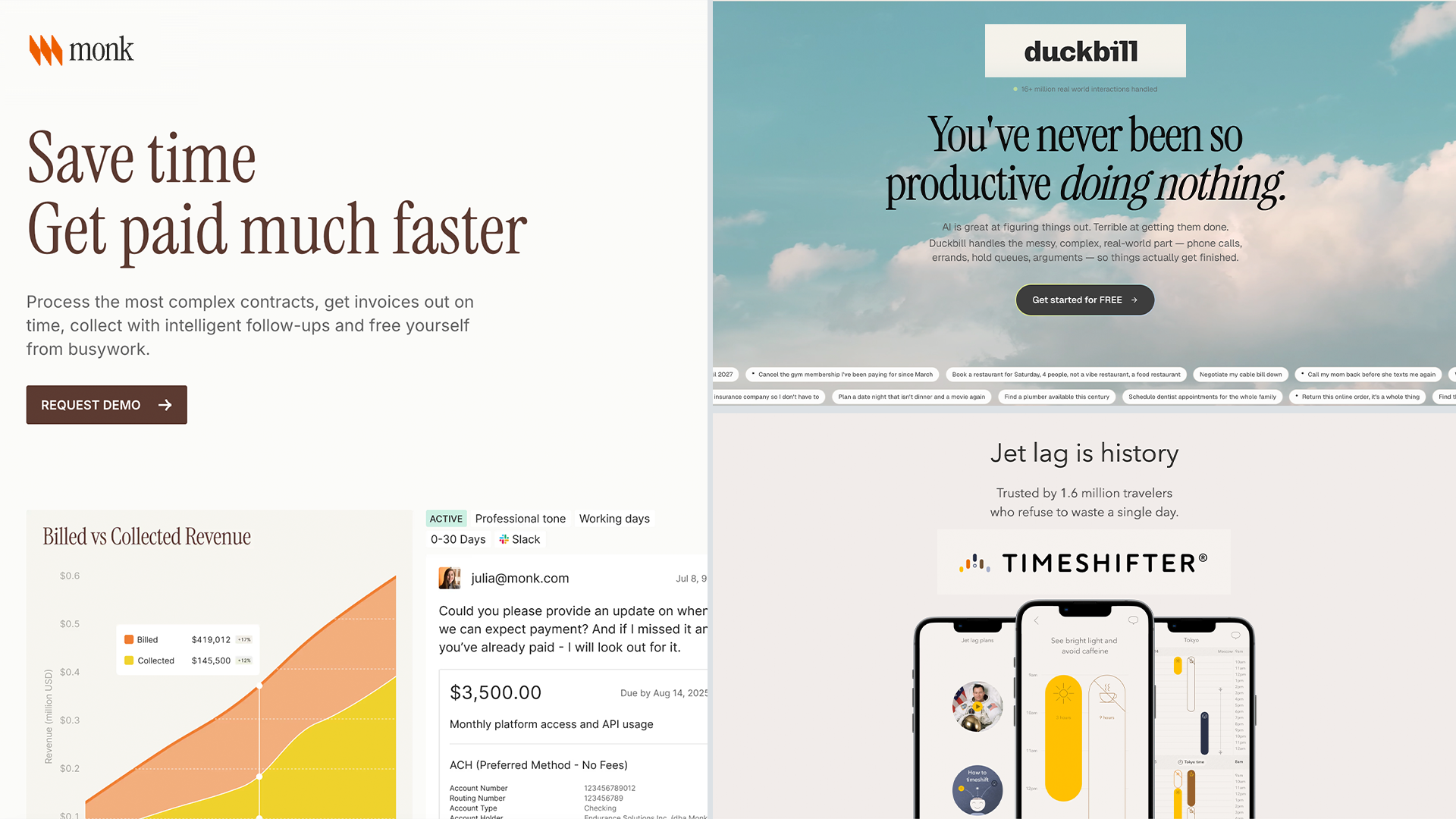
James Cadwallader highlights Monk as an excellent AI tool for managing accounts receivable. He notes that while this may seem less glamorous than frontier model discussions, Monk's ability to handle AI-powered accounts receivable efficiently is foundational to running a business. By automating this process, Monk significantly reduces the manual overhead traditionally required for ensuring timely payments, thereby streamlining a critical business function and offering a substantial operational advantage.
Melinda Han Williams identifies AI systems that learn as the most significant new edge, particularly agentic systems with continuous learning loops and knowledge bases that expand with usage. Dstillery deploys these systems for various internal technical tasks and sees their potential for advertisers to continuously learn from their own brand's data as it compounds over time, leading to evolving and increasingly effective AI applications.
Jenny Lewis relies on Duckbill to manage personal "life logistics," such as scheduling doctor's appointments, planning birthday parties, and booking vacations. As an executive and mother, this personal AI assistant provides her with immense leverage, allowing her to allocate more time and focus to her professional responsibilities and to be more present with her family, demonstrating how AI can enhance work-life balance for busy leaders.
Krysha Nair emphasizes that the ultimate edge in AI isn't the tool itself, but how AI is embedded into a company's communication culture. StackAdapt has developed an internal AI layer based on its messaging hierarchy, customer insights, and sales narratives. This system enables teams to generate consistent materials from pitch decks to internal communications, replacing repetitive, time-intensive work with fast, consistent, and aligned outputs, ensuring a unified foundation for marketing and growth.
Chris Neff employs Perplexity Computer for data triangulation, combined with Claude for data cleaning, often using a codebase for API calls across large datasets. The cleaned output then serves as a bespoke knowledge base, driving coded applications. This ensures that while large language models (LLMs) are used, it is highly specific, custom data that truly steers and informs the interactions, leading to personalized rather than generic results and tailored solutions.
Mike Nuzzo values Claude's ability to provide structured and predictable outputs consistently for production environments, as reliability is crucial in orchestrating multi-agent systems. His strategy involves connecting Claude to Hearst's internal data via MCP to allow anyone to query data and receive answers rapidly, transforming data access and analysis from minutes to mere seconds.
Drew Panayiotou uses Nano Banana for personal creative visualization, such as generating house renovation renders. Professionally, he employs Claude Design to build prototype digital experiences and create design stimuli. This allows him to quickly visualize user perspectives for projects like Dr Pepper's online experiences, helping his brand team understand his concepts more easily.
Tylynn Pettrey believes the key is using the right AI tool for the specific job, rather than having an across-the-board favorite. Chalice AI prefers building its solutions in AWS Bedrock due to its flexible access to various foundational models, allowing them to tailor their AI infrastructure to diverse needs and harness the most appropriate and effective models for each unique analytics challenge.
Amy Reinhard uses Timeshifter to manage jet lag during frequent international travel. This tool provides recommendations and guidance to help her stay rested and energized, which is a major productivity hack essential for her demanding role as President of Advertising at Netflix.
Tiffany Rolfe explores "model convergence," a phenomenon where advanced AI models can yield similar creative outputs. To maintain a creative edge, her team deliberately uses older, more unpredictable AI models for initial inspiration and then refines and scales these ideas using advanced models in a production pass. This ensures that creativity benefits from both novel unpredictability and sophisticated execution.
Natalie Silverstein has transitioned from simple prompts to configuring Claude as "persistent collaborators." These customized AI instances function as a "strategy board" to challenge ideas and encourage bolder thinking, and as a "chief of staff" to synthesize daily information and support strategic deliverables, operating with full context of her role and priorities. She emphasizes that treating LLMs as configurable systems, rather than mere search bars, significantly enhances output quality.
Omar Tawakol utilizes Claude's "coworking capabilities" for strategic idea debates, finding its suggestions surprisingly insightful. He also uses ChatGPT to read books, specifically to explore unwritten aspects and gain a deeper understanding of the content. This demonstrates a versatile application of AI, not only for business strategy and collaborative thinking but also for enriching personal learning and comprehension.