Quick Buzz Feed

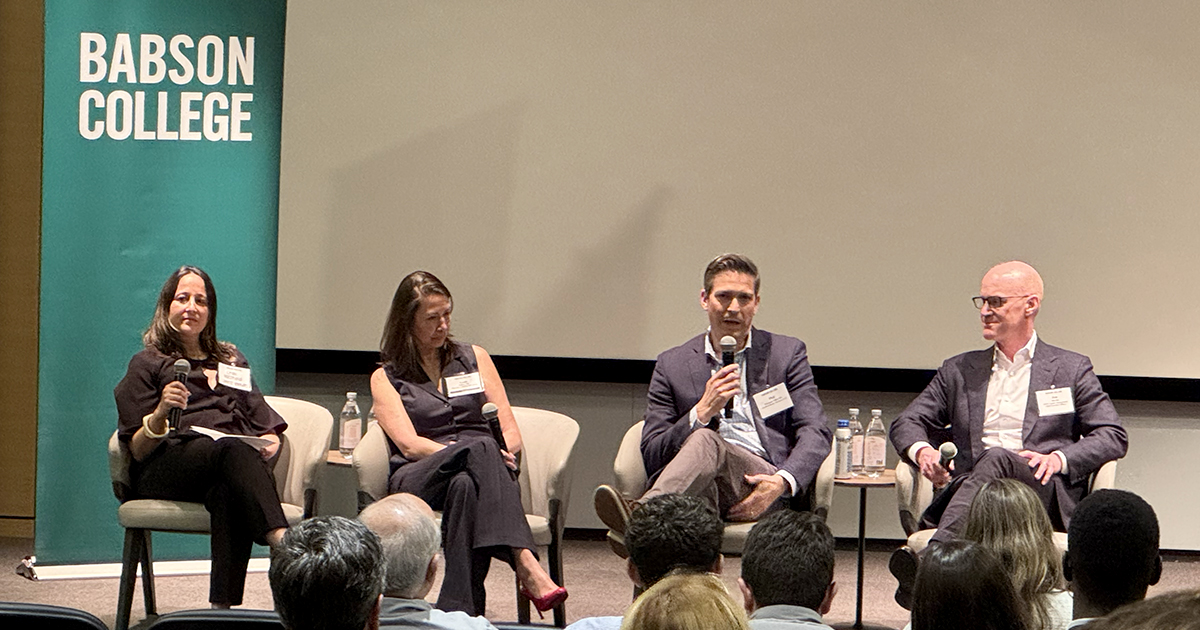
At Babson Boston, real estate industry leaders embraced AI’s advantages but cautioned that relationships remain the key to success.
The event commenced with the official unveiling of the new TARCO Institute for Real Estate and Entrepreneurship at Babson College. Established in September of the previous year, the institute derives its name from TARCO Properties, founded in 2002 by Todd Ruderman MBA’99. Donna Levin, the CEO of the Arthur M. Blank School for Entrepreneurial Leadership, under which the institute operates, initiated the segment with a dialogue alongside Ruderman, who is also the founder and president of Value Store It Management. Ruderman expressed his long-held belief in the necessity of such an institute, highlighting the strong presence of real estate alumni and companies in the Boston area, coupled with Babson's esteemed reputation in business and entrepreneurship, deeming it 'a perfect match.' Erin Degnan Escobedo, who serves as the inaugural faculty director of the TARCO Institute and an associate professor of practice at Babson, viewed this event as a significant stride towards fulfilling her vision of elevating real estate entrepreneurship within the institution. She articulated that a core mission of the TARCO Institute is to forge connections among industry stakeholders, alumni, students, and friends of the College, emphasizing the palpable momentum and excitement surrounding its tangible contributions to the real estate sector.
A central and dynamic part of the panel discussion, moderated by Leah Harsfield, founder of Lioness Ventures, revolved around the multifaceted applications of Artificial Intelligence within the commercial real estate landscape. Phil Dorman, co-founder of Greatland Realty Partners, emerged as a fervent advocate for AI, describing himself as a 'champion' keen on sharing its potential. He detailed his firm's current efforts in leveraging AI to significantly overhaul their accounting and monthly reporting frameworks. Dorman projected a remarkable 90% reduction in the approximately 1,000 human hours per month currently dedicated to data preparation and report generation for their eight investments and five distinct limited partners. Similarly, Leah Dillon ’99, Chief Operating Officer at Alliance Global Advisors, shared how her firm is assisting clients in conducting comprehensive system audits. The objective is to identify redundancies and gaps, thereby enabling the aggregation and sophisticated analysis of proprietary data. This analytical capability is crucial for identifying market trends, achieving substantial cost efficiencies, and ultimately enhancing investor returns. While acknowledging AI's capacity to streamline processes and accelerate the realization of innovative ideas, Dorman candidly noted AI's current limitations, stating, 'I don’t think Claude has come up with one original idea.' He stressed that innovation and the genesis of new processes, ideas, and products still predominantly reside with human ingenuity, with AI serving as an accelerant rather than a creator. Dillon echoed this sentiment, asserting the indispensable role of human oversight. She emphasized that while AI undoubtedly boosts job efficiency, it does not necessarily eliminate positions, as a 'human in the loop' remains vital to guide and propel progress. Jon Martin, CEO of AEW Capital Management, earlier reinforced this perspective, stating that despite AI's efficiencies, ultimate success in real estate 'comes down to individual decisions and relationships that win you deals.'
Erin Degnan Escobedo, in her capacity as the inaugural faculty director of the TARCO Institute and a Babson associate professor, underscored the profound relevance of the AI discussion to the institute's mission. She noted that Artificial Intelligence is a pervasive and ongoing theme within her classroom curricula. In her experiential learning courses, which frequently feature guest lecturers, a primary focus is placed on understanding how competitive advantages in the real estate industry will accrue to professionals who skillfully utilize AI to fortify trust in their professional capacities and relationships with clients and partners. Escobedo articulated, 'AI tools are evolving rapidly and are incredibly powerful.' She elaborated that the real differentiator for industry practitioners lies in their ability to harness AI tools to generate added value and deepen relational ties—for instance, a developer collaborating with capital partners or a property manager serving clients. This strategic application of AI is precisely where the TARCO Institute aims to exert significant leadership and influence. Escobedo expressed a strong desire for the institute to be at the forefront of this evolution, stating that one of its specific programmatic objectives is to actively foster and support incubators and accelerators dedicated to real estate ventures. She views this as an opportune arena for innovation, value creation, and critically, for empowering students to advance their own real estate ventures, particularly those integrating cutting-edge AI solutions, ensuring they reach their next developmental stage.