Quick Buzz Feed

Health systems are navigating several challenges such as balancing a sense of urgency to adopt AI tools in clinical care with avoidance of risk.
Health systems face significant pressure to quickly adopt AI tools in clinical care, yet must carefully manage associated risks. A white paper by Qventus, based on insights from over 60 senior IT leaders, identifies several critical pain points. These include a strong belief (94% of respondents) that delaying AI operationalization will lead to competitive disadvantage, a widespread struggle (80%) to quantify the ROI of AI tools, and substantial obstacles related to limited IT resources due to managing numerous AI vendors (over two-thirds). Furthermore, three-quarters of respondents highlighted that relying on their EHR vendor's AI roadmap hinders their overall AI strategy execution.
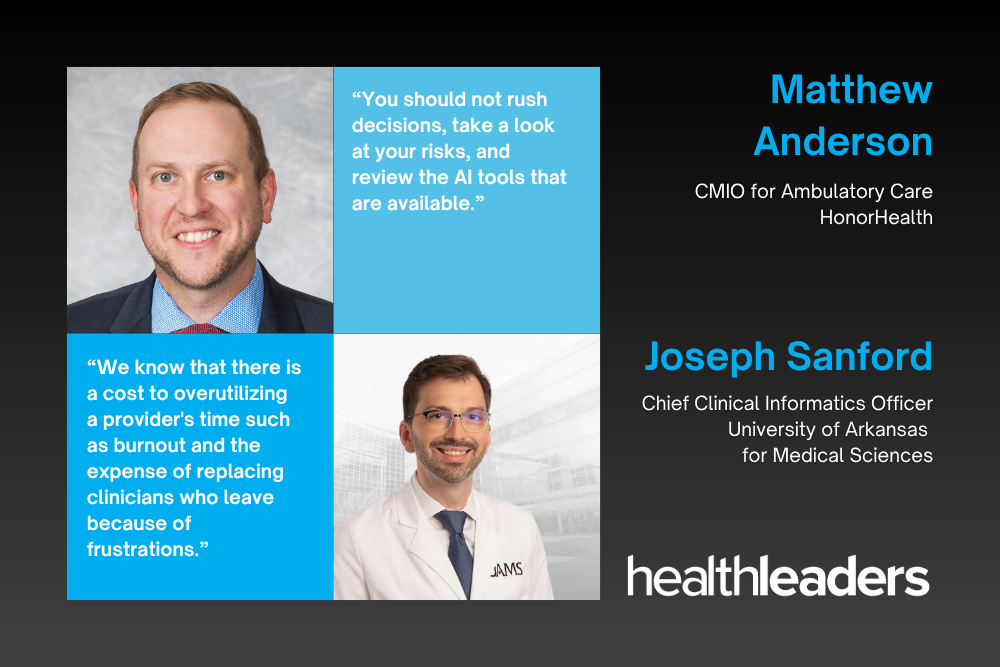
Despite the pressure to implement AI, senior health system leaders must proceed deliberately to avoid unnecessary risks. Matthew Anderson, CMIO for ambulatory care at HonorHealth, emphasizes intentionality, focusing on specific problems rather than adopting AI as a catch-all solution or just to keep up. He advises disciplined actions, reviewing risks, and evaluating available AI tools. Joseph Sanford, chief clinical informatics officer at the University of Arkansas for Medical Sciences (UAMS), adds that avoiding risk involves understanding AI tools as probabilistic data-generation engines, not magic. Leaders need to educate themselves on what AI can and cannot do, focusing on opportunities to help staff perform better and faster, rather than expecting AI to solve everything.
For clinical AI tools, Return on Investment (ROI) has both 'hard' and 'soft' components. Hard ROI examples include improving billing, capturing Hierarchical Condition Category risk, increasing productivity and patient visits, and boosting surgery numbers. Soft ROI involves enhancing patient experience and easing clinicians' workloads. HonorHealth prioritizes clinician and patient metrics, such as improved patient outcomes, faster interventions, and reduced patient falls, over purely financial ROI. UAMS also considers financial ROI alongside factors like clinician time savings, reduced burnout, administrative throughput efficiency, and time to complete tasks like chart closures and prior authorizations. For per-user-per-month licensed AI tools, they evaluate whether the tool increases revenue generation (e.g., seeing more patients) or decreases expenses.
While managing multiple AI vendors presents challenges, health system leaders can draw upon their experience with vendors in other operational areas. It requires intentionality, particularly regarding co-development approaches, and maintaining transparency. Data stewardship and transparency are crucial, especially when different vendors address similar problems. Leaders should ensure vendors provide direct access to engineers, not just sales staff. UAMS addresses this by relying on independent governance committees, staffed by experts and chaired by senior leaders, to set policies and standards. This committee monitors the AI market and works with IT, EMR services, and information security to vet contractual relationships, navigating challenges like demonstrating data quality and trust in the evolving AI vendor landscape.
Senior leaders must carefully evaluate electronic health record (EHR)-native AI tools versus point solutions, considering opportunity costs. It's essential to maximize the utilization of already-paid-for and deployed EHR technology. However, point solutions might be necessary if they uniquely solve a specific problem. If a vendor's point solution is similar in functionality to an EHR-native offering, the EHR's AI tool is usually more attractive. A point solution must offer a 'profound competitive advantage,' such as substantial cost savings, to justify its adoption when an EHR-native alternative exists. Trust in a partner is a vital factor when considering point solutions.
One effective strategy to assess the ROI of AI tools in clinical care is to look at soft ROI such as patient experience improvement and hard ROI such as expense reduction. While managing multiple AI vendors can be challenging, senior leaders at health systems should lean on their experience in dealing with multiple vendors in other areas of their operations. When electronic health record-native AI tools for clinical care are similar to point solutions, the EHR-based tool should be adopted unless the point solution has a profound competitive advantage.