Quick Buzz Feed

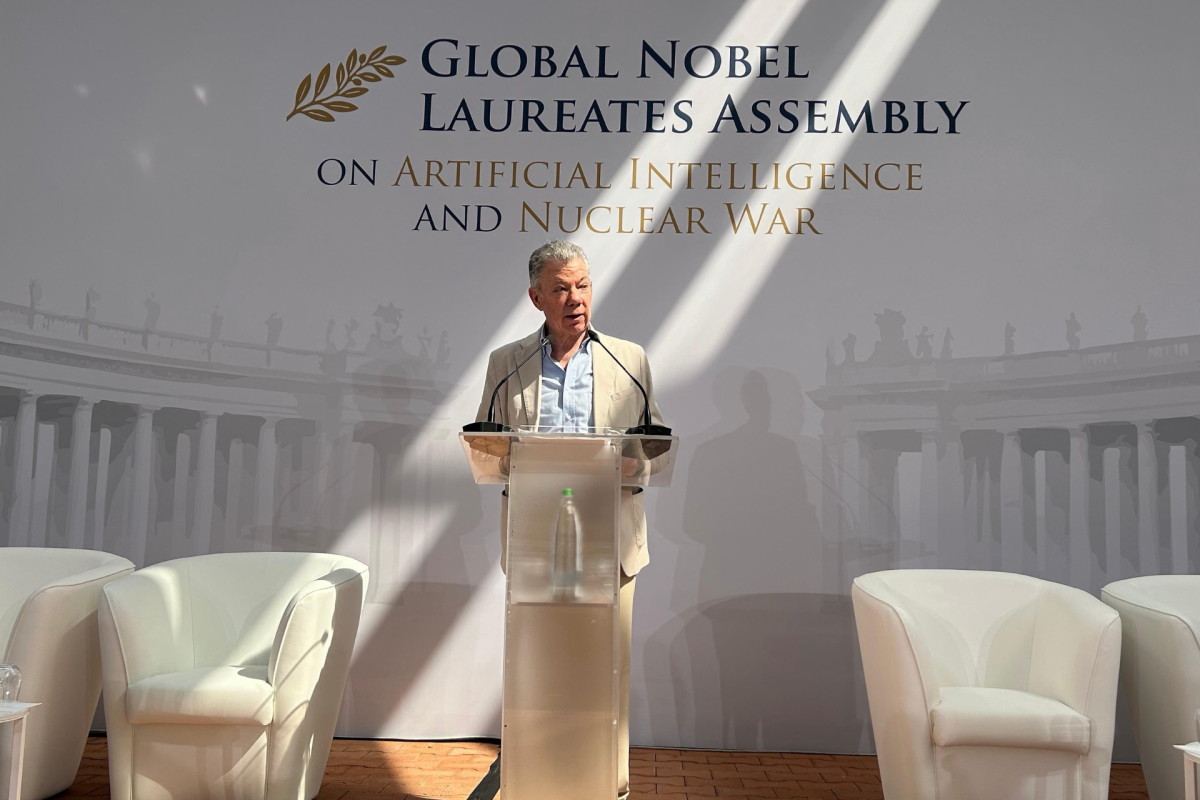
Juan Manuel Santos and Denis Mukwege were honoured to participate in this week's Global Nobel Laureates Assembly on Nuclear Weapons and AI at the Vatican, where they signed the following declaration.
Humanity stands at a defining moment in its history. More than eighty years after the dawn of the nuclear age, and at the threshold of the age of artificial intelligence, we are presented with an unprecedented challenge. Never before has scientific progress offered such extraordinary opportunities while simultaneously creating such profound risks to our common future. When nuclear weapons were first being developed, the world had a chance to avoid living in a permanent dynamic of fear. We failed, and as a result, humanity has lived at the edge of nuclear annihilation. With AI, a similar danger presents itself. AI built into nuclear systems leaves little time for, or even replaces, human judgement in a crisis. This technology changes the context in which nuclear-armed states compete with each other. AI will likely cause mass job loss and sharpen economic competition between nuclear-armed states. AI uplifts cyber attacks that can fracture critical civilian and strategic infrastructure. AI enables information warfare: Peace depends on a shared reality. Without facts there can be no truth; without truth there can be no trust; and without trust, no dialogue, no verification, and no restraint among nations. The most advanced AI capabilities, computing resources, and data infrastructures are becoming increasingly concentrated in a small number of countries and corporations, creating significant asymmetries of power and limited incentives for cooperation. AI is a technology that causes economic, military, and social disruption, and is developing at a pace unprecedented in human history. In the midst of a worsening nuclear arms race, we are embarking on an equally dangerous AI race. Pope Leo XIV, invoking values shared across religious traditions, has called humanity toward an "unarmed and disarming peace." We reject the belief that lasting security can be built on fear, domination, or the permanent threat of mutual destruction. Security cannot rest indefinitely upon the reality of mutual destruction. Conscious of our shared responsibility toward present and future generations, we adopt the following principles:
We recognize that AI is an arena of strategic competition, like nuclear weapons before it. We call on governments, frontier AI developers, researchers and the international community to act now, through governance arrangements such as benefit-sharing mechanisms, the promotion of AI applications that serve human wellbeing, and restraint in its most destabilizing applications, to reduce these risks while the choice remains ours. We must disarm the next arms race, both AI and nuclear, before they define the next century as well.
AI developers should transparently publish the principles that guide the behavior of their models and be held responsible and liable for those models' adherence to such principles. AI should be developed and monitored to be in alignment with humanity’s interests, including international law and respect for human rights. Furthermore, no organisation should initiate, and no government should permit, fully-automated recursive self-improvement in artificial intelligence systems without the means to monitor, and if needed, to halt such systems.
An automated system should never make the final decision to launch a nuclear weapon. We call for the adoption of an international treaty prohibiting the reckless integration of artificial intelligence into nuclear command, control, and launch systems so that meaningful human control is maintained. We must prevent the malicious use of artificial intelligence in cyber operations and attacks against critical nuclear infrastructure. Nuclear states must engage in fail-safe reviews to reduce the vulnerability of their nuclear forces to unauthorized control or manipulation by AI. We promote the responsible development and use of artificial intelligence to improve human well-being, accelerate scientific and medical progress, protect the environment, strengthen resilience, and advance peace, sustainable development, and the common good.
We call on governments, corporations, and international organizations to enable coordinated slowdown of frontier AI development by establishing shared mechanisms, such as verification and robust internal and external evaluations. We support the United Nations Independent International Scientific Panel on AI, and promotion of other efforts in the spirit of Magnifica Humanitas. We call for expanded research and dialogue to propose new institutional pathways for international governance of AI and future implementation of global governance initiatives.
We recognize that the challenges we face will likely be solved by the next generation of leaders. Young people must be empowered to engage with nuclear, AI, and other potentially catastrophic threats, through education, mentorship, intergenerational partnership, and inclusive participation across all regions, cultures, and communities. We must advance education initiatives that foster ethical responsibility, critical thinking, media and AI literacy, and a culture of peace. We acknowledge that humanity faces numerous connected threats, the unintended consequences of which often impact those who do not have access or control over such technologies. We call for a digital commons which grows data to advance understanding and action for nuclear weapons, ungoverned AI, and other existential threats.
We call for urgent, sustained, and good-faith negotiations leading, within an agreed and time-bound framework, to the verifiable and irreversible elimination of nuclear weapons. The international community must reject the normalization of nuclear weapons as permanent instruments of security and strengthen the humanitarian and legal norms embodied in the Treaty on the Non-Proliferation of Nuclear Weapons and the Treaty on the Prohibition of Nuclear Weapons. We call on nuclear-armed states to halt renewed arms racing and the expansion of their arsenals, resume bilateral and multilateral negotiations on arms control and disarmament, and fulfill their obligations and commitments under international law. States should pursue verifiable restraints and reductions; lower alert levels; extend decision time; move away from launch-on-warning and prompt-retaliatory postures; reduce the role of nuclear weapons in security doctrines; strengthen crisis communications; prevent cyber operations against nuclear command, control, and communications; and build cooperation to prevent misunderstanding, miscalculation, and unintended escalation. Nuclear nations must promote policies and doctrines that diminish the role of nuclear weapons, and reduce the likelihood of first use and catastrophic war. Inspired by the words of Nobel Laureates Bertrand Russell and Albert Einstein, “We appeal as human beings to human beings: remember your humanity, and forget the rest.” Our survival and the survival of future generations are at stake.