Quick Buzz Feed

Ironclad's second-annual State of AI in Procurement Report, released on October 15, 2026, highlights that while 64% of procurement professionals extensively use general AI tools, they encounter significant challenges in integrating and scaling these tools effectively across their business operations. The survey, which gathered insights from over 800 procurement professionals involved in both direct and indirect procurement, indicates that larger organizations and those with more advanced AI governance frameworks are increasingly adopting purpose-built AI tools specific to procurement. This strategic shift is proving to be more impactful, enabling these companies to achieve greater strategic value and enhance their understanding of complex supplier relationships. The report emphasizes the need for a more connected and context-aware approach to AI in procurement to fully realize its potential beyond single-document analysis.
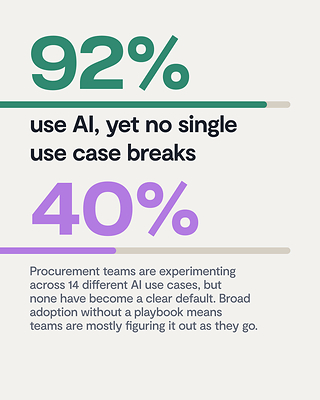
The report finds widespread AI adoption among procurement professionals, with 92% using AI. However, this usage is fragmented, as no single AI use case outside of contracting achieves more than 40% adoption. Instead, AI is broadly applied across 14 distinct use cases, including vital areas such as procurement data analysis, supplier discovery and evaluation, comprehensive spend analysis, forecasting, and identifying cost-saving opportunities. A significant portion of AI users (41%) integrates general AI assistants with at least one specialized procurement or contract-specific tool, while 29% rely exclusively on these specialized solutions. Notably, specialized AI users report demonstrably better outcomes, including improved visibility across supplier relationships (48% vs. 37% for non-specialized users), enhanced risk analysis capabilities (47% vs. 37%), and greater automation of manual tasks like due diligence and SLA tracking (29% vs. 20%). Only 8% of professionals currently do not utilize AI tools for procurement.
While 21% of contract-AI users currently find the technology most impactful for managing contract approvals, amendments, and extensions, a substantial 52% anticipate this to be one of the most significant future benefits. A larger expectation exists for AI to deliver value by helping teams grasp the full commercial context embedded within contracts, cited by 49% of respondents. Current applications of AI in contracting include extracting and summarizing terms (45%), drafting and reviewing contracts (41%), assessing contract risk (40%), and tracking expiration dates (40%). Despite these benefits, a high percentage (98%) of contract AI users have encountered problems, with security concerns (57%), accuracy issues (45%), and a lack of support or training from vendors (42%) being the most commonly reported challenges.
The survey clearly indicates that the benefits and sophistication of AI adoption increase with company size and the maturity of AI governance. Among companies with over 1,000 employees, 84% utilize specialized AI tools, significantly higher than the 60% observed in companies with 500 or fewer employees. Correspondingly, 73% of large companies report engaging in more strategic work due to AI, compared to 59% in smaller firms. Organizations with extensive AI guidelines also show better results, with 67% reporting more strategic work, as opposed to 58% with only basic guidelines. Furthermore, 53% of companies with more than 1,000 employees credit AI with improving visibility into supplier relationships, a marked difference from the 38% in companies with 500 or fewer employees.
Despite widespread enthusiasm, the direct time-saving benefits of AI are not uniformly experienced. An overwhelming 98% of AI users agree that the technology has improved their work processes. A majority, 63%, report spending more time on strategic and complex work, indicating a shift towards higher-value activities. However, a notable one-third (33%) of users paradoxically find themselves spending more time reviewing and meticulously checking AI outputs than the actual time saved by the tools, suggesting a need for improved AI reliability or integration.
The impact of AI on career development and workload varies by seniority. A high 99% of Vice Presidents and those at higher levels perceive that AI actively assists them in achieving their career objectives, significantly higher than the 84% reported by managers and junior staff. However, VPs and above also experience the most substantial increase in workload, with 35% reporting a sharper increase compared to 20% of directors and 13% of managers. This senior group, along with managers, also reports a challenge in time efficiency, with 29% spending more time reviewing AI outputs than the time saved, reflecting a potential bottleneck at higher decision-making levels.