Strong Growth Prospects for the Artificial Intelligence in Life Sciences Market The artificial intelligence in life sciences market has seen significant expansion recently and is projected to continue this upward momentum. The market is expected to increase from $3.59 billion in 2025 to $4.44 billion in 2026, representing a robust compound annual growth rate (CAGR) of 23.6%. This growth is largely due to the rising complexity of biological data, expanding genomics research, the broader adoption of digital laboratory technologies, early AI integration in biotechnology, and the increasing demand for faster research cycles. Looking further ahead, the market is forecast to reach $10.43 billion by 2030, growing at an impressive CAGR of 23.8%. Key factors driving this future growth include growing investments in personalized medicine, wider use of AI-powered lab automation, the expansion of cloud-based life science platforms, stronger collaboration between technology and life science companies, and greater regulatory acceptance of AI-derived insights. Understanding AI’s Role Within Life Sciences Applications Artificial intelligence in life sciences involves the use of AI technologies and methods across various areas within the industry. The primary goal is to accelerate workflows, enhance decision-making, and extract meaningful insights from complex biological data sets. AI technologies are transforming how research is conducted, enabling faster discovery and more precise medical solutions by analyzing vast amounts of information that would be difficult for humans to handle manually. Key Drivers Behind Market Expansion in Artificial Intelligence for Life Sciences One major factor propelling the growth of AI in life sciences is the increasing adoption of real-time remote patient monitoring (RPM) systems. These technologies allow patients to be monitored outside of traditional healthcare environments, providing continuous health data that AI can analyze to support proactive care management. AI’s ability to deliver personalized and data-driven insights through RPM enhances healthcare outcomes and patient engagement. For example, in April 2025, the Peterson Center on Healthcare reported that spending on remote therapeutic monitoring (RTM) under Traditional Medicare soared from $2.2 million in 2022 to $10.4 million in 2023, while 451,000 Medicare patients used RPM services in 2023. This surge highlights the growing influence of RPM technologies powered by AI, which is a significant contributor to overall market growth. Additional Growth Factors Supporting AI Adoption in Life Sciences Beyond remote patient monitoring, other drivers include the increasing complexity of biological datasets that require advanced AI tools for interpretation, the expanding field of genomics research demanding faster data processing, and the rising preference for digital laboratory technologies. Additionally, early-stage AI integration in biotechnology research and the need for accelerated research cycles continue to push the market forward, establishing AI as an indispensable tool across the life sciences sector. Regional Market Insights for Artificial Intelligence in Life Sciences In terms of geographical distribution, North America held the largest portion of the global artificial intelligence in life sciences market in 2025, reflecting its strong technological infrastructure and significant healthcare investments. Meanwhile, the Asia-Pacific region is forecasted to be the fastest-growing market during the coming years, driven by increasing research activities and technology adoption. The market report also covers key regions such as South East Asia, Western Europe, Eastern Europe, South America, Middle East, and Africa, providing a comprehensive global perspective on market dynamics and opportunities.
Strong Growth Prospects for the Artificial Intelligence in Life Sciences Market
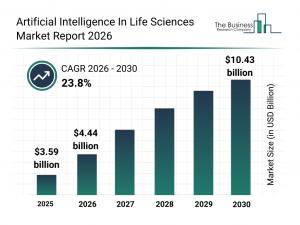
The artificial intelligence in life sciences market has seen significant expansion recently and is projected to continue this upward momentum. The market is expected to increase from $3.59 billion in 2025 to $4.44 billion in 2026, representing a robust compound annual growth rate (CAGR) of 23.6%. This growth is largely due to the rising complexity of biological data, expanding genomics research, the broader adoption of digital laboratory technologies, early AI integration in biotechnology, and the increasing demand for faster research cycles. Looking further ahead, the market is forecast to reach $10.43 billion by 2030, growing at an impressive CAGR of 23.8%. Key factors driving this future growth include growing investments in personalized medicine, wider use of AI-powered lab automation, the expansion of cloud-based life science platforms, stronger collaboration between technology and life science companies, and greater regulatory acceptance of AI-derived insights.
Understanding AI’s Role Within Life Sciences Applications
Artificial intelligence in life sciences involves the use of AI technologies and methods across various areas within the industry. The primary goal is to accelerate workflows, enhance decision-making, and extract meaningful insights from complex biological data sets. AI technologies are transforming how research is conducted, enabling faster discovery and more precise medical solutions by analyzing vast amounts of information that would be difficult for humans to handle manually.
Key Drivers Behind Market Expansion in Artificial Intelligence for Life Sciences
One major factor propelling the growth of AI in life sciences is the increasing adoption of real-time remote patient monitoring (RPM) systems. These technologies allow patients to be monitored outside of traditional healthcare environments, providing continuous health data that AI can analyze to support proactive care management. AI’s ability to deliver personalized and data-driven insights through RPM enhances healthcare outcomes and patient engagement. For example, in April 2025, the Peterson Center on Healthcare reported that spending on remote therapeutic monitoring (RTM) under Traditional Medicare soared from $2.2 million in 2022 to $10.4 million in 2023, while 451,000 Medicare patients used RPM services in 2023. This surge highlights the growing influence of RPM technologies powered by AI, which is a significant contributor to overall market growth.
Additional Growth Factors Supporting AI Adoption in Life Sciences
Beyond remote patient monitoring, other drivers include the increasing complexity of biological datasets that require advanced AI tools for interpretation, the expanding field of genomics research demanding faster data processing, and the rising preference for digital laboratory technologies. Additionally, early-stage AI integration in biotechnology research and the need for accelerated research cycles continue to push the market forward, establishing AI as an indispensable tool across the life sciences sector.
Regional Market Insights for Artificial Intelligence in Life Sciences
In terms of geographical distribution, North America held the largest portion of the global artificial intelligence in life sciences market in 2025, reflecting its strong technological infrastructure and significant healthcare investments. Meanwhile, the Asia-Pacific region is forecasted to be the fastest-growing market during the coming years, driven by increasing research activities and technology adoption. The market report also covers key regions such as South East Asia, Western Europe, Eastern Europe, South America, Middle East, and Africa, providing a comprehensive global perspective on market dynamics and opportunities.