Quick Buzz Feed

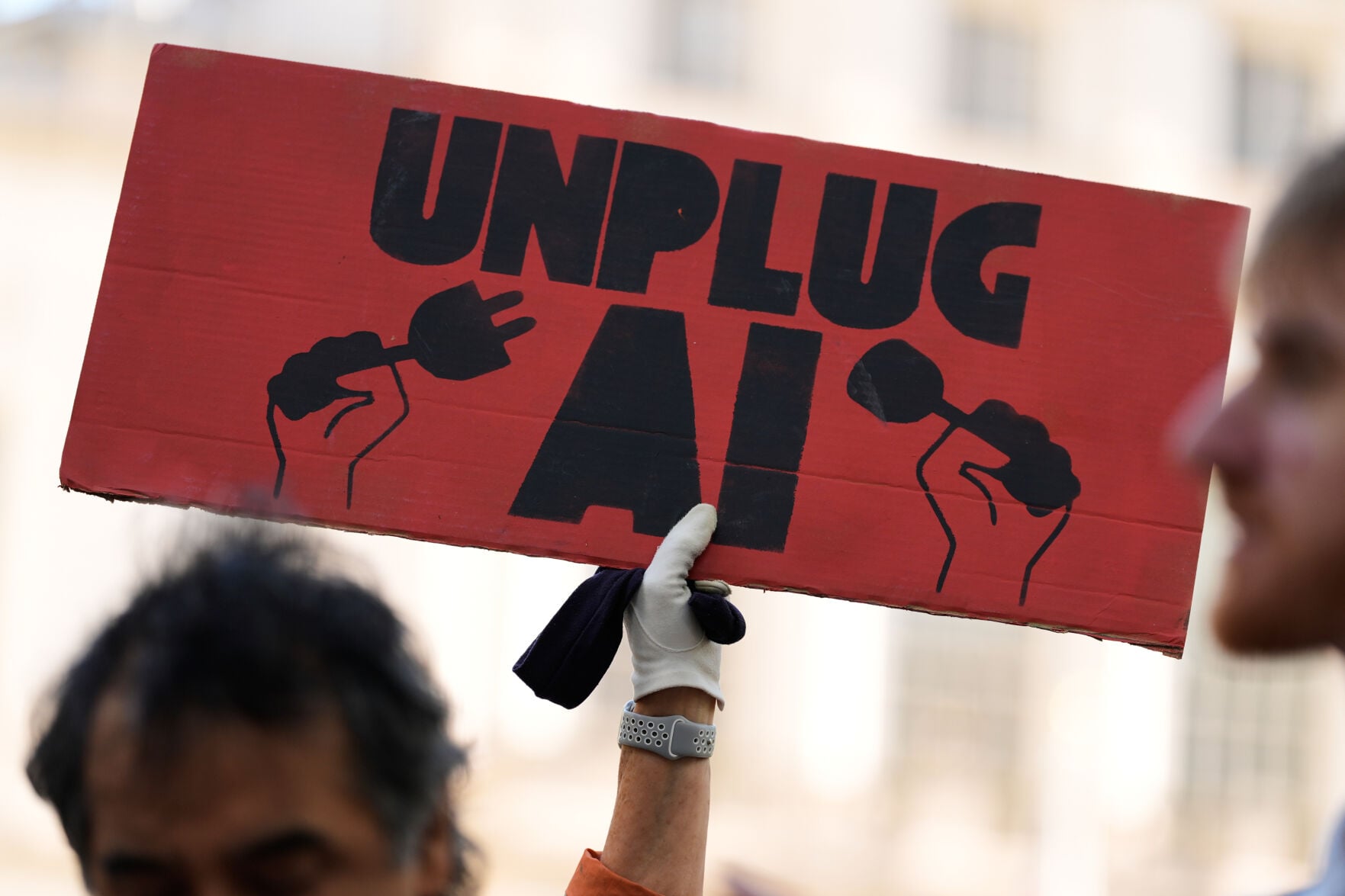
A new AP-NORC poll finds that most Americans think artificial intelligence is developing too fast. And the vast majority of U.S. adults say it's highly important for the government to ensure that AI stays under human control and that U.S. workers are protected. Despite bipartisan concern about the speed of AI's development, few Americans think either major political party is better equipped to handle artificial intelligence. President Donald Trump also has a low approval rating on the issue, as even leaders of the companies that are developing frontier AI models are calling for a slowdown so government regulation can catch up.
Ron Theusch, a truck driver from Alden, Minnesota, voiced his primary concern about AI leading to job losses, envisioning self-driving trucks operating continuously. The poll revealed that most Democrats and Republicans agree on the importance of government prioritizing worker protection and maintaining human control over AI, drawing parallels to fictional scenarios like 'Terminator.' However, consensus on other AI priorities is less clear. Republicans tend to emphasize growing the U.S. economy and competing with countries like China more than Democrats. Conversely, Democrats place higher importance on minimizing environmental harm from AI. Teacher Stephanie Stewart questioned the rationale for U.S. competition with China in AI development if it sacrifices humane considerations. While three-quarters of Democrats believe AI is advancing too quickly, only half of Republicans share this view. The survey also found that younger individuals (under 30) are more concerned about AI's speed than older individuals (60+). Kelly Opp, a 62-year-old Republican, acknowledged AI's benefits for certain applications but expressed concerns about overuse, potential for decreased personal connections, and intellectual laziness due to readily available information, though the speed of its progression doesn't personally bother her.
Stephanie Stewart, a junior-high science teacher, utilizes AI for her professional tasks like creating assignments and tests, but harbors deep concerns regarding its impact on children, emphasizing the need to protect kids, teens, and their privacy through regulation. The poll indicates a general lack of confidence in both major political parties to effectively manage AI issues, with approximately 4 out of 10 Americans distrusting both Democrats and Republicans on this front. Nearly 2 out of 10 trust both equally, and the remainder are split. Even within their own ranks, only about half of Republicans and Democrats believe their respective party is better equipped to handle AI, with roughly 3 in 10 from each party feeling that neither is capable. Stewart, identifying as moderate, observed a perceived weakness in Washington, stating, 'Anyone back in Washington is weak on doing anything for anyone but themselves right now. So, no, I don’t think the Democrats would do a better job per se. Maybe they would definitely tout it. But until I see anything coming from anyone, I’m going to be like, ‘Yeah, no. You’re all just sitting there.’” This highlights a widespread skepticism about political efficacy in regulating rapidly advancing AI.