Quick Buzz Feed

The convergence of synthetic biology, artificial intelligence (AI), and automation (SynBioxAI) creates research activities that simultaneously engage biosecurity, AI governance, export control, and data sovereignty frameworks – none of which are designed for convergent science. We conduct a comprehensive cross-jurisdictional analysis of this regulatory landscape across sixteen nations, identifying critical ambiguities where novel SynBioxAI objects fall between established regulatory categories. Through seven realistic collaboration scenarios, we demonstrate that regulatory friction is multiplicative rather than additive. We propose the SynBioxAI Regulatory Interoperability Toolkit (RIOT): a practical, seven-lens institutional framework that gives research institutions the capacity to navigate regulatory divergence efficiently and transparently. The convergence of synthetic biology, AI, and automation creates new challenges for regulatory frameworks. In this Perspective, the authors analyse national regulations and propose the SynBioxAI regulatory interoperability toolkit to give research institutes the capacity to navigate divergent regulatory landscapes.
The convergence of synthetic biology, AI, and automation (SynBioxAI) presents complex regulatory challenges across biosecurity, AI governance, export control, and data sovereignty. This article conducts a cross-jurisdictional analysis across sixteen nations, identifying ambiguities and demonstrating multiplicative regulatory friction. It proposes the SynBioxAI Regulatory Interoperability Toolkit (RIOT) as a practical, seven-lens institutional framework to navigate these divergent regulatory landscapes efficiently and transparently.
This section highlights SynBioxAI as a transformative area in life sciences, enabling rapid design-build-test-learn cycles. It identifies a significant governance gap where technical capabilities outpace regulation, leading to complex, interacting layers of requirements rather than simple summation. The paper aims to provide clear frameworks for these interactions across jurisdictions.
SynBioxAI involves technologies like AI-driven hypothesis generation, automated biofoundries, and engineering biology platforms, accelerating the design-build-test-learn cycle. The OECD identifies this convergence as having transformative potential but notes that governance, safety, and strategic intelligence lag behind. Regulatory challenges arise not from individual technologies but from their convergence, leading to multiplicative complexity that spans various regulatory frameworks (biosecurity, AI transparency, export controls, data sovereignty, etc.).
The SynBioxAI Regulatory Interoperability Toolkit (RIOT) was developed through comparative analysis of regulatory frameworks across sixteen jurisdictions in four domains: biosafety and biosecurity, artificial intelligence governance, export controls and technology protection, and data governance. Ambiguities identified were translated into a practical seven-lens institutional assessment framework, validated using seven realistic international collaboration scenarios tested by experts.
This section details the regulatory analysis across sixteen nations and four domains (biosecurity, AI governance, export controls, and data governance), identifying principal instruments, their legal character, and specific addressal of SynBioxAI technologies. This analysis shows that each jurisdiction has its own framework, leading to a complex and often divergent regulatory landscape, summarized in a condensed regulatory matrix.
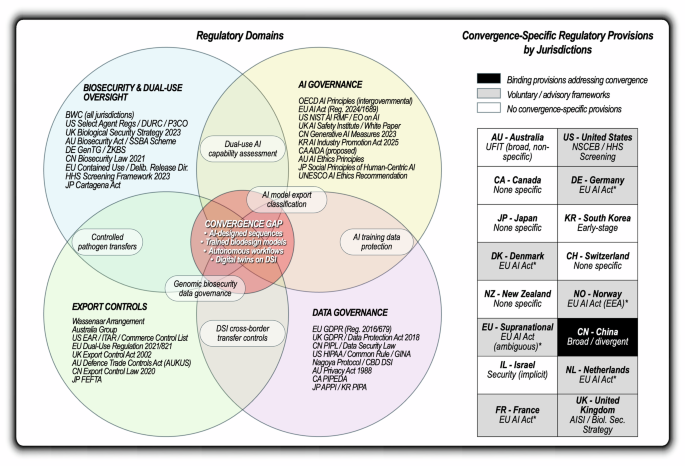
The international biosecurity framework, based on the Biological Weapons Convention, establishes a shared normative floor, but implementation varies significantly across countries (e.g., USA, UK, Australia, Germany, Canada, Japan, EU member states, China). A critical observation is the lack of specific regulatory provisions for AI-designed biological constructs, which can evade traditional pathogen screening systems and pose dual-use risks.
AI governance shows the greatest regulatory divergence globally, despite the OECD AI Principles. The EU AI Act imposes risk-tiered obligations with extraterritorial scope, while the USA relies on voluntary frameworks like the NIST AI Risk Management Framework. The UK delegates governance to existing sectoral regulators, Australia has voluntary ethics principles, and China has binding regulations with a focus on content control. This leads to scenarios where an AI system may be unregulated in one jurisdiction but high-risk in another.
Export control regimes, including the Wassenaar Arrangement and Australia Group, cover biological agents and dual-use technologies, but China's non-participation creates a structural asymmetry. Alliance-based frameworks like AUKUS facilitate frictionless transfers among partners but introduce friction for broader networks. A key ambiguity remains in classifying intangible technology transfers, such as trained AI models or biodesign datasets, under existing export control lists.
Data governance is crucial for SynBioxAI, particularly for digital twin development. The EU's GDPR sets a global benchmark for personal data protection with extraterritorial reach. China has highly restrictive laws (PIPL, Data Security Law, Cybersecurity Law) with data localization requirements. The USA lacks comprehensive federal privacy law, relying on a sectoral patchwork. The governance of digital sequence information (DSI) under benefit-sharing frameworks is an unresolved issue that could significantly disrupt SynBioxAI data pipelines.
Figure 1 illustrates a 'governance gap' at the central intersection of the four established regulatory domains (biosecurity, AI governance, export controls, data governance). Novel SynBioxAI objects like AI-designed biological sequences, trained biodesign models, autonomous biofoundry workflows, and digital twins lack comprehensive coverage, leading to significant classification and jurisdictional ambiguities. Regulatory clarity diminishes sharply moving from domain-specific governance to this convergent center.
Seven realistic collaboration scenarios were developed to illustrate how broad normative convergence in principles, significant operational divergence in implementation, and critical ambiguity in novel convergent objects create practical regulatory friction. These scenarios are grounded in current or foreseeable SynBioxAI project types and demonstrate the complex interactions between different regulatory instruments.
A collaboration among biofoundries in Australia, UK, USA, and South Korea to share AI models for microbial strain performance encounters friction from ambiguous export control classification of AI models, differing data governance requirements (e.g., South Korea's mandatory access-and-benefit-sharing vs. USA's lack of comprehensive federal data protection), and the potential extraterritorial reach of the EU AI Act.
A joint project involving Dutch, Swiss, and Australian partners for agricultural soil remediation using AI-driven metabolic engineering faces regulatory hurdles for environmental release. The EU's Deliberate Release Directive demands mechanistic understanding which AI designs may not provide, unlike Australia's acceptance of empirical data. Switzerland's GMO moratorium adds further constraints, intertwining AI transparency and biosafety with differing evidentiary standards.
A UK AI company generating novel enzyme sequences for synthesis in the USA, Germany, and China faces inconsistent screening standards. Existing protocols struggle with novel AI-generated sequences. The USA's framework for contextual risk assessment is advanced, while Germany's application of the EU Dual-Use Regulation is ambiguous, and China's implementation lacks transparency, leading to varied oversight for the same sequence.
An international consortium building a microbial community digital twin using Brazilian metagenomic data faces legal uncertainty regarding benefit-sharing obligations. Brazil's law applies to DSI, but Germany's EU Nagoya Protocol Regulation doesn't clearly address AI model training on DSI. Japan hasn't ratified the Protocol, creating asymmetry. This leads to difficulty in determining and operationalizing benefit-sharing across different frameworks.
A US-France collaboration using an AI system for therapeutic enzyme design in a highly autonomous US biofoundry (48-72h without human intervention) is challenged by the EU AI Act's requirement for real-time human oversight for high-risk AI. The US biofoundry's voluntary NIST framework (periodic review, kill-switch) may not meet EU standards, forcing the French partner to adapt operations or accept legal risk.
A PhD training consortium across Canada, UK, Australia, and Japan, with access to proprietary data, faces varied research security requirements. Policies like Canada's on Sensitive Technology Research and Affiliations of Concern, the UK's Trusted Research, Australia's UFIT, and Japan's affiliation verification impose different due diligence, leading to differential access to shared research outputs based on student nationality and affiliations within the same consortium.
Australia, UK, and USA co-develop an AI-powered biosurveillance system within AUKUS's licence-free environment. Extending it to non-AUKUS allies like Canada, Japan, and South Korea requires reverting to standard export controls and compliance with each country's data governance. China's data localization rules would preclude integration of its epidemiological data, fragmenting the data environment despite scientific value.
Three structural patterns emerge across scenarios: regulatory friction is multiplicative; novel SynBioxAI objects fall into gaps between existing AI and biology regulations; and alliance-based frameworks create efficient 'inner-circle' collaborations but friction for broader networks. A friction-point map (Figure 2) shows that 'Global Interoperability,' 'National Interest,' and 'Innovation Velocity' are the most friction-prone lenses, with 'Classification ambiguity' and 'Extraterritorial reach' being dominant friction types.
The RIOT is a practical framework addressing regulatory divergence through interoperability, enabling institutions to collaborate effectively by making governance transparent and compatible. Organized around a seven-lens governance canvas (trust and reputation, safety, global interoperability, national interest, social licence, innovation velocity, and integrity), it comprises five operational components for research design.
This is the entry point for international SynBioxAI projects, completed by the lead researcher and institutional governance coordinator. It assesses the project against the seven governance lenses, identifying engaged regulatory domains, jurisdictions, convergence/divergence points, and required actions, leading to a Triage Summary Report before funding or partnership agreements.
A structured, searchable reference tool that catalogs SynBioxAI regulatory requirements across partner jurisdictions. Organized as a matrix, it records applicable instruments, legal status, scope, enforcement, treatment of convergent technologies, and known ambiguities, drawing on resources like the OECD’s AI Index and requiring continuous updates.
This framework assesses prospective international partners against the seven governance lenses prior to collaboration agreements. It evaluates biosafety infrastructure, AI governance, export control compliance, data protection standards, research security posture, community engagement processes, and integrity frameworks, yielding a Partner Governance Profile with mitigation recommendations.
A tool to track regulatory risks identified during triage and due diligence, monitoring their evolution and triggering escalation when risks materialize or the regulatory landscape shifts. Each risk is assigned to governance lenses, assessed for likelihood and impact, linked to mitigation measures, and paired with trigger conditions for appropriate institutional escalation.
This package makes an institution’s governance posture visible to external audiences through four tailored documents: an Institutional Governance Statement (for partners), a Governance Capability Brief (for funders), a Regulatory Engagement Summary (for regulators), and a public-facing Social Licence Statement, effectively communicating a coherent governance approach.
The RIOT's practical application is demonstrated with Scenario 3. The project undergoes triage, regulatory obligations are mapped, partner capabilities are assessed, a dynamic risk register is generated, and a governance-legibility assessment is produced. This process transforms a complex regulatory challenge into a structured, auditable, and actionable assessment, often suggesting the adoption of harmonized project-level frameworks to achieve interoperability.
The RIOT is designed for incremental adoption, aligning with institutional governance maturity, from a compliance baseline (Triage, JRM) to integration (Due Diligence, Risk Register), stewardship (Legibility Package), and strategic capability (contributing to toolkit evolution). This approach supports institutional decision-making and engagement with international collaborators.
The analysis concludes that the international SynBioxAI regulatory landscape is marked by a paradox: shared normative principles but significant operational divergence, leading to actionable friction. This friction arises because novel SynBioxAI objects don't fit existing regulatory categories, tiered collaboration architectures create disparities, and regulatory paces across domains are misaligned.
Regulatory divergence in SynBioxAI is a structural, not temporary, condition. Harmonization is often unachievable and undesirable, making interoperability – the capacity for institutions to collaborate effectively despite differing frameworks through transparent and compatible governance – a necessary path forward.
Governance should be viewed as a strategic capability rather than mere compliance. Institutions with integrated, transparent, and internationally legible governance postures are better positioned for partnerships and funding. The SynBioxAI RIOT operationalizes this by providing structured tools for upstream assessment, risk monitoring, and external communication of governance capability, offering a competitive advantage.
This analysis has limitations: it's a point-in-time snapshot of a rapidly evolving landscape, with underrepresentation of Global South jurisdictions, and relies on hypothetical scenarios. The JRM must be a living document, and future validation of RIOT is needed through longitudinal empirical research tracking international SynBioxAI collaborations.
The convergence of synthetic biology, AI, and automation presents enormous potential but also significant regulatory complexity that existing frameworks cannot coherently address for international collaboration. The analysis shows that this challenge is navigable through interoperability, not harmonization. The RIOT offers a practical, structured framework for institutions to act responsibly, assess partner maturity, and make informed judgments about acceptable risk in a complex, divergent regulatory environment. It also suggests that regulators and funding agencies could adopt elements of RIOT to guide oversight and grant assessment, signalling that governance capability is crucial for research excellence in convergent science.