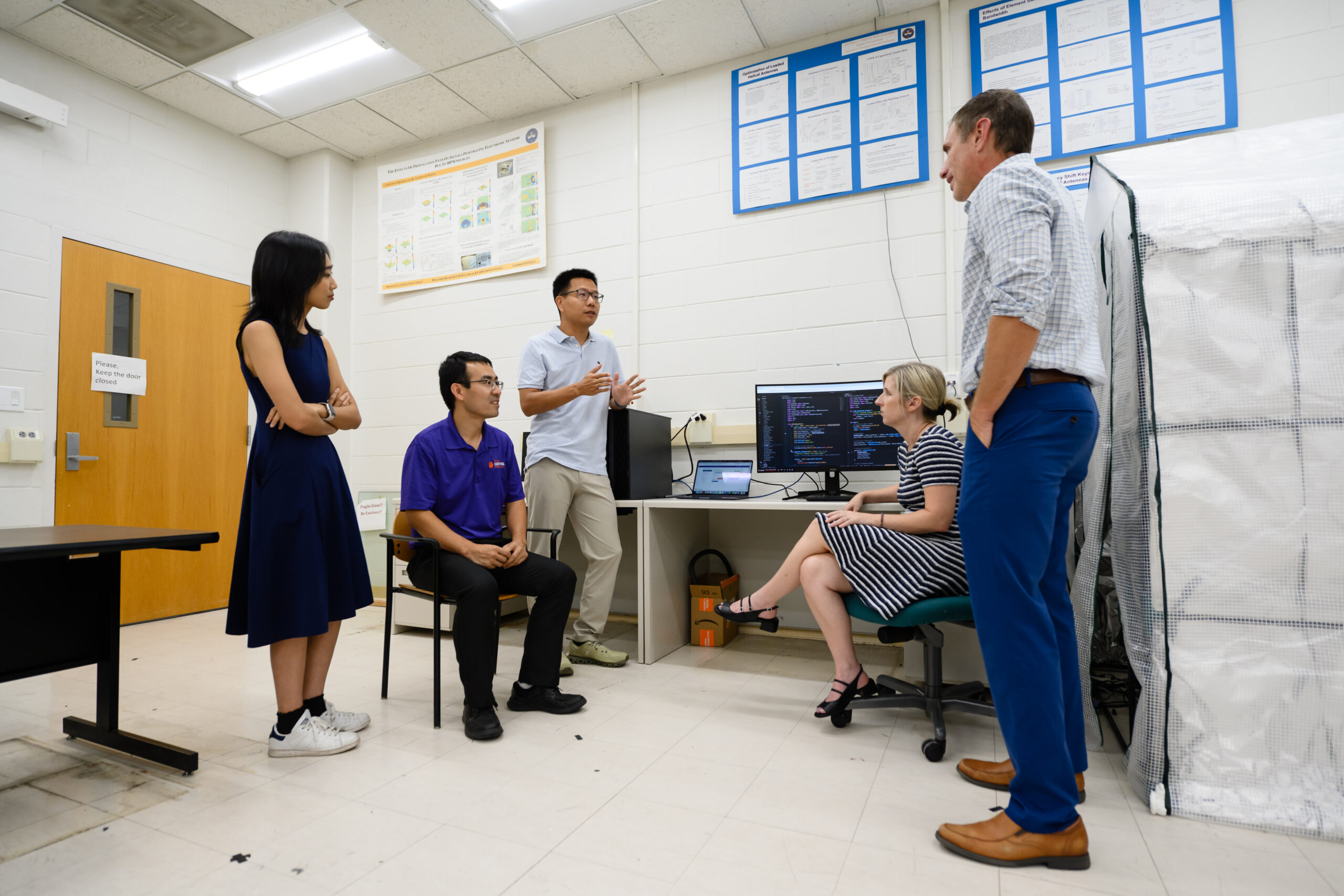
An interdisciplinary team led by Clemson University is working to make AI safer with support from the National Science Foundation.
The Threat of Unsafe AI Content for Youth The rapid advancement of artificial intelligence has made it notably easier to create and disseminate content that could be detrimental to young individuals. This encompasses sexually explicit or abusive materials, toxic language, and other content deemed "not-safe-for-work." Such exposure is a growing concern due to its potential links to serious mental health issues among youth, including increased anxiety, experiences of cyberbullying, feelings of isolation, and the development of eating disorders. An interdisciplinary team at Clemson University is proactively addressing this issue by initiating new research focused on developing effective safeguards to protect this vulnerable demographic online. Interdisciplinary Collaboration and National Funding The foundational research for this project is spearheaded by Linke Guo, an associate professor in Clemson's Holcombe Department of Electrical and Computer Engineering. He is joined by a diverse group of co-principal investigators from Clemson, including Long Cheng, an associate professor in the School of Computing, and two associate professors of sociology, Heather Hensman Kettrey and Matthew Costello. The team also collaborates with Ming Li, an associate professor of computer science and engineering at the University of Texas at Arlington. This robust four-year initiative is generously supported by a $1.2 million grant from the National Science Foundation, specifically through its Secure & Trustworthy Cyberspace program, highlighting the national importance of this work. Developing Multi-faceted Safeguards and Evaluating Impact The core of the project involves a dual approach: first, understanding the mechanisms by which generative AI platforms process prompts and produce potentially unsafe content, and second, developing practical safeguards. These safeguards are designed to identify and interpret hidden malicious intent within user prompts, intelligently remove inappropriate or unsafe elements from generated images, and meticulously verify the safety and appropriateness of generated images and videos before they reach young users. Crucially, the research extends beyond technical development to include a sociological component, where young adults and their parents will be surveyed and interviewed to gauge the effectiveness of these safeguards in reducing harmful online exposure and to observe any resulting changes in how people interact with AI technologies. This holistic approach ensures both technical efficacy and real-world impact are considered. Expert Perspectives on AI Security for the Next Generation Zhuoyang Wang, a Ph.D. student in electrical and computer engineering involved in the project, offers a firsthand perspective on the rapid integration of AI into the daily lives of young people, noting its uses for both productive tasks and casual entertainment. She underscores the critical need to ensure AI content remains safe and appropriate for young users. Reinforcing this sentiment, Hai Xiao, the chair of the Holcombe Department of Electrical and Computer Engineering, emphasizes the increasing urgency of this research. He states that as generative AI continues to grow in power and accessibility, especially among younger populations, robust safeguards must be developed concurrently to mitigate potential harms. He commends Linke Guo's leadership in assembling an interdisciplinary team capable of tackling such a complex and vital challenge.
The Threat of Unsafe AI Content for Youth
The rapid advancement of artificial intelligence has made it notably easier to create and disseminate content that could be detrimental to young individuals. This encompasses sexually explicit or abusive materials, toxic language, and other content deemed "not-safe-for-work." Such exposure is a growing concern due to its potential links to serious mental health issues among youth, including increased anxiety, experiences of cyberbullying, feelings of isolation, and the development of eating disorders. An interdisciplinary team at Clemson University is proactively addressing this issue by initiating new research focused on developing effective safeguards to protect this vulnerable demographic online.
Interdisciplinary Collaboration and National Funding
The foundational research for this project is spearheaded by Linke Guo, an associate professor in Clemson's Holcombe Department of Electrical and Computer Engineering. He is joined by a diverse group of co-principal investigators from Clemson, including Long Cheng, an associate professor in the School of Computing, and two associate professors of sociology, Heather Hensman Kettrey and Matthew Costello. The team also collaborates with Ming Li, an associate professor of computer science and engineering at the University of Texas at Arlington. This robust four-year initiative is generously supported by a $1.2 million grant from the National Science Foundation, specifically through its Secure & Trustworthy Cyberspace program, highlighting the national importance of this work.
Developing Multi-faceted Safeguards and Evaluating Impact
The core of the project involves a dual approach: first, understanding the mechanisms by which generative AI platforms process prompts and produce potentially unsafe content, and second, developing practical safeguards. These safeguards are designed to identify and interpret hidden malicious intent within user prompts, intelligently remove inappropriate or unsafe elements from generated images, and meticulously verify the safety and appropriateness of generated images and videos before they reach young users. Crucially, the research extends beyond technical development to include a sociological component, where young adults and their parents will be surveyed and interviewed to gauge the effectiveness of these safeguards in reducing harmful online exposure and to observe any resulting changes in how people interact with AI technologies. This holistic approach ensures both technical efficacy and real-world impact are considered.
Expert Perspectives on AI Security for the Next Generation
Zhuoyang Wang, a Ph.D. student in electrical and computer engineering involved in the project, offers a firsthand perspective on the rapid integration of AI into the daily lives of young people, noting its uses for both productive tasks and casual entertainment. She underscores the critical need to ensure AI content remains safe and appropriate for young users. Reinforcing this sentiment, Hai Xiao, the chair of the Holcombe Department of Electrical and Computer Engineering, emphasizes the increasing urgency of this research. He states that as generative AI continues to grow in power and accessibility, especially among younger populations, robust safeguards must be developed concurrently to mitigate potential harms. He commends Linke Guo's leadership in assembling an interdisciplinary team capable of tackling such a complex and vital challenge.