OpenAI, the maker of ChatGPT, has written bans on autonomous weapons and mass domestic surveillance into its Pentagon work
OpenAI's Stance on Military AI OpenAI, the artificial intelligence company behind ChatGPT, has established clear principles barring the military from using its technology for autonomous weapons systems and mass domestic surveillance. These principles, published in July, also indicate the company's support for legislation addressing the highest-risk military applications of AI. Caroline Zier, OpenAI's lead for national security strategic initiatives, is scheduled to speak at an upcoming event on AI and catastrophic risk, highlighting the critical debate on AI's role in national security. From the Pentagon to OpenAI Caroline Zier, a veteran with over 15 years in defense policy and former deputy chief of staff to the secretary of defense, now spearheads OpenAI's national security strategic initiatives. She recently urged caution regarding information sharing in U.S.-China AI discussions, as reported by Dataconomy. OpenAI's national security principles, released on July 8, explicitly prohibit the use of its technology in Defense Department contracts for mass domestic surveillance, autonomous weapons systems, or high-stakes automated decisions, stating that the company's role is to inform such decisions, not to make them independently. OpenAI also engages in cyber defense partnerships with key allies like Japan, South Korea, Germany, and the European Union's cybersecurity agency. Testing before release OpenAI advocates for federal oversight in the testing of advanced AI models, suggesting the Commerce Department's Center for AI Standards and Innovation as a potential venue. Chris Lehane, OpenAI's chief global affairs officer, emphasized this position in a July 15 post. The company also communicated its support to California Gov. Gavin Newsom for mandatory 'effective shutdown controls' and annual independent audits for AI systems. However, Miranda Bogen of the Center for Democracy & Technology raised concerns about the redundancy of technical kill switches. Furthermore, OpenAI faced a lawsuit from California's attorney general on November 16 regarding its testing practices, which the company deemed unfair. What to watch at 'Broadband and AI in the Next Congress' The upcoming 'Broadband and AI in the Next Congress' event will address several critical questions. Discussions will focus on identifying the specific 'highest-risk military uses of AI' for which OpenAI believes Congress should enact safeguards. Attendees will also consider whether the voluntary, NSA-run testing framework, outlined in Executive Order 14409 on AI cybersecurity, is an adequate federal approach for pre-release AI evaluations. Additionally, a key point of debate will be the appropriate extent of information sharing between Washington and Beijing in AI-related discussions, as measured by Caroline Zier's insights.
OpenAI's Stance on Military AI
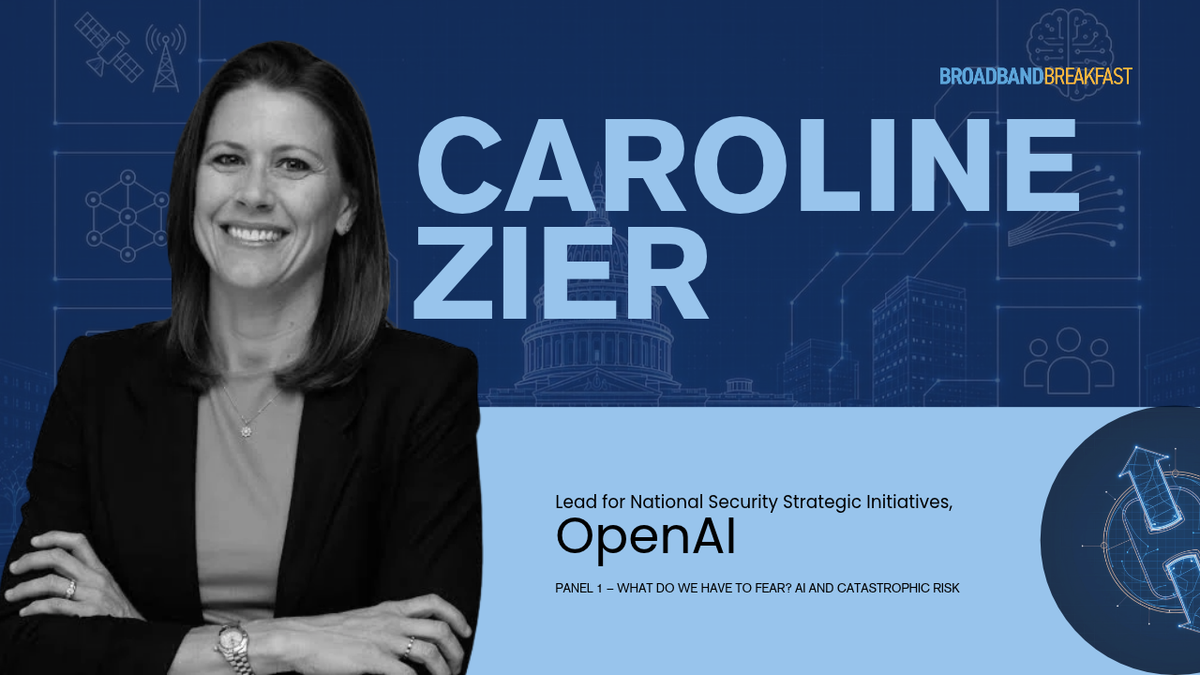
OpenAI, the artificial intelligence company behind ChatGPT, has established clear principles barring the military from using its technology for autonomous weapons systems and mass domestic surveillance. These principles, published in July, also indicate the company's support for legislation addressing the highest-risk military applications of AI. Caroline Zier, OpenAI's lead for national security strategic initiatives, is scheduled to speak at an upcoming event on AI and catastrophic risk, highlighting the critical debate on AI's role in national security.
From the Pentagon to OpenAI
Caroline Zier, a veteran with over 15 years in defense policy and former deputy chief of staff to the secretary of defense, now spearheads OpenAI's national security strategic initiatives. She recently urged caution regarding information sharing in U.S.-China AI discussions, as reported by Dataconomy. OpenAI's national security principles, released on July 8, explicitly prohibit the use of its technology in Defense Department contracts for mass domestic surveillance, autonomous weapons systems, or high-stakes automated decisions, stating that the company's role is to inform such decisions, not to make them independently. OpenAI also engages in cyber defense partnerships with key allies like Japan, South Korea, Germany, and the European Union's cybersecurity agency.
Testing before release
OpenAI advocates for federal oversight in the testing of advanced AI models, suggesting the Commerce Department's Center for AI Standards and Innovation as a potential venue. Chris Lehane, OpenAI's chief global affairs officer, emphasized this position in a July 15 post. The company also communicated its support to California Gov. Gavin Newsom for mandatory 'effective shutdown controls' and annual independent audits for AI systems. However, Miranda Bogen of the Center for Democracy & Technology raised concerns about the redundancy of technical kill switches. Furthermore, OpenAI faced a lawsuit from California's attorney general on November 16 regarding its testing practices, which the company deemed unfair.
What to watch at 'Broadband and AI in the Next Congress'
The upcoming 'Broadband and AI in the Next Congress' event will address several critical questions. Discussions will focus on identifying the specific 'highest-risk military uses of AI' for which OpenAI believes Congress should enact safeguards. Attendees will also consider whether the voluntary, NSA-run testing framework, outlined in Executive Order 14409 on AI cybersecurity, is an adequate federal approach for pre-release AI evaluations. Additionally, a key point of debate will be the appropriate extent of information sharing between Washington and Beijing in AI-related discussions, as measured by Caroline Zier's insights.