Quick Buzz Feed

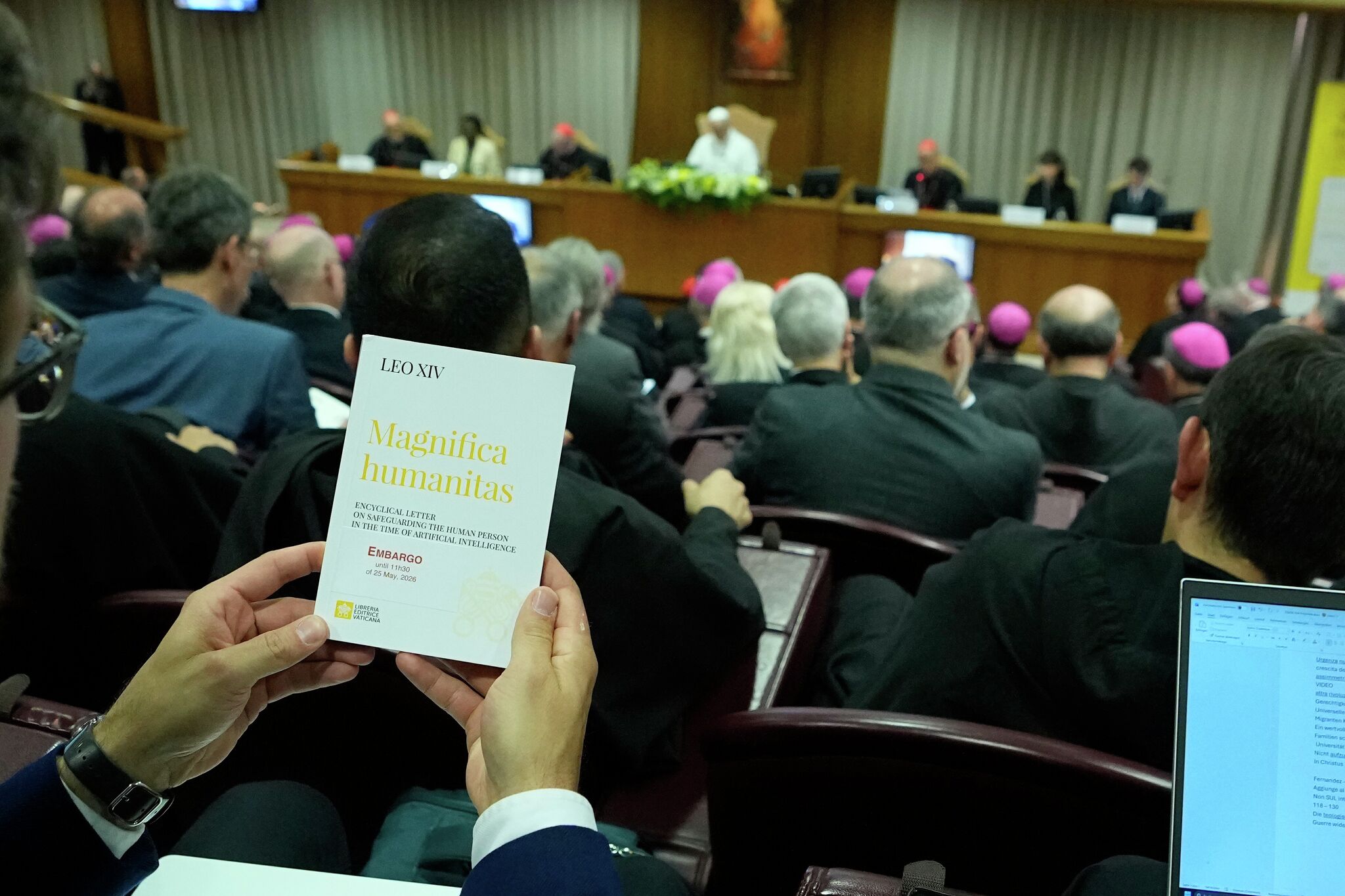
Joshua Whitfield: Pope Leo’s encyclical on technology and AI emphasizes human dignity, democratic oversight and ethical responsibility while warning against dehumanizing visions.
The article introduces Pope Leo XIV's recent encyclical, “Magnifica Humanitas,” which addresses pressing existential questions concerning justice and artificial intelligence. The author advises readers to approach it thoughtfully, adopting a 'Merton’s pace' – a concept of consuming news 'slightly stale' to foster deeper intellectual engagement rather than impulsive reactions. This measured approach is deemed essential for truly grappling with the profound ideas presented in the encyclical.
The encyclical is presented as a continuation of two ancient, ongoing discussions: one about technology and another on Catholic Social Teaching. The article highlights the historical depth of the technology debate, tracing its origins back to Greek myths of Prometheus and Theuth (as chronicled by Plato). It then lists a rich lineage of modern thinkers, including Martin Heidegger, Ernst Kapp, Georg Simmel, Nicolas Berdyaev, Jacques Ellul, Ivan Illich, Lewis Mumford, Marshall McLuhan, Neil Postman, Albert Borgmann, Hubert Dreyfus, and contemporary scholars like Mark Coeckelbergh, Evan Selinger, and Shannon Vallor, all of whom have contemplated the societal implications of technology. This extensive background underscores that contemporary anxieties about technology are not unprecedented.
The author emphasizes that Pope Leo XIV is entering a profound, intellectual discourse on technology and AI, rather than merely echoing popular sentiment. This calls for diligent engagement from readers, as the seriousness of the subject demands comprehensive understanding beyond superficial opinions. The encyclical's significance lies in its role as a compilation and organization of established ethical and philosophical insights, a 'Petrine thing to do,' which bridges ancient wisdom with modern challenges, thereby inviting all, especially technology innovators, to consider AI within a broader human context.
A core message of Pope Leo’s encyclical is the firm reassertion of the human person’s paramount importance. It resonates with Nicolas Berdyaev's century-old warning against humanity conforming to the 'image' of the machine, emphasizing a 'pivotal choice' to 'remain profoundly human.' While acknowledging the Pope's inherent optimism, the author expresses personal reservations, fearing certain technologies, such as Elon Musk’s Neuralink, might indeed be inherently 'antagonistic to humanity,' prompting a consideration of stepping back, similar to George Orwell's 'proles' who 'stayed human' in a dystopian future.
Pope Leo directly addresses transhumanism and posthumanism, labeling these technocratic philosophies as 'false accounts of salvation.' He argues that such ideologies, which view human beings as perfectible or replaceable by superior AI, inherently promote injustice and violence. By asserting that if 'the human being is treated as something to be perfected or surpassed, it becomes easier to accept that some lives are less useful, less desirable or less worthy,' the Pope engages in what the author describes as a century-long 'war against anti-humanism' between the papacy and intellectual movements stemming from figures like Friedrich Nietzsche and Michel Foucault, vying for control over the most powerful tools ever created.
The Pope's encyclical includes a repeated plea for 'forms of cooperation' in the development and application of new technologies and artificial intelligence. A notable, potentially unique, claim is that elements like 'patents, algorithms, digital platforms, technological infrastructure and data' should be considered 'shared goods.' This is interpreted as a call not for socialism, but for enhanced democratic oversight. The article highlights that the current technological landscape is largely controlled by a powerful and wealthy few, making it 'opaque' and susceptible to excluding and dehumanizing the poor. Therefore, democratic involvement in these critical questions is essential for a just future.
The article concludes by underscoring the critical importance of reading the encyclical, as it addresses profound, existential questions that extend beyond mere political or economic considerations. It posits that achieving collective flourishing in an increasingly technologically advanced world necessitates genuine cooperation and interhuman dialogue. Paradoxically, the very technologies that prompt these discussions have often made such essential human interaction more difficult to achieve, emphasizing the urgency of the Pope's message.