Quick Buzz Feed

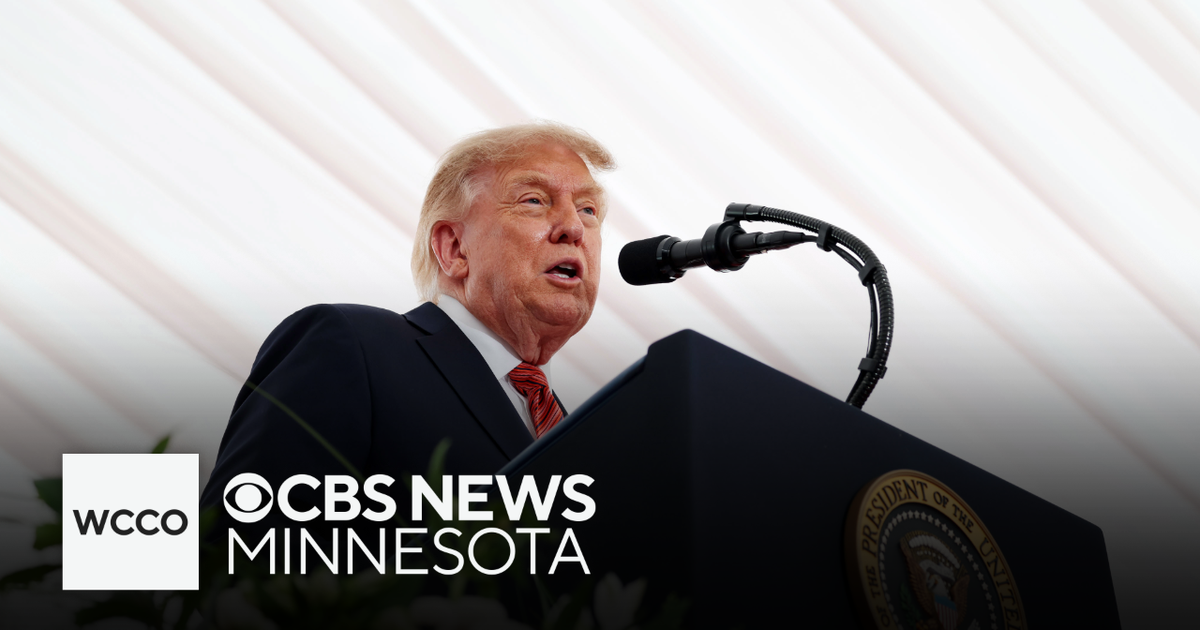
Some of the biggest names in technology want to pump the brakes on artificial intelligence. CBS's Natalie Brand reports from Washington, where President Trump has brushed off concerns and Congress has not agreed to support any proposals for AI guardrails.
The extract highlights President Trump's competitive view on artificial intelligence, encapsulated by his statement, 'Whoever wins AI wins.' This perspective frames AI development as a geopolitical race, where national leadership in AI translates directly to global power and influence. Trump's stance suggests a focus on accelerating AI innovation and adoption, potentially brushing aside concerns about its risks, as mentioned in the article. This approach emphasizes the strategic importance of AI for national security, economic competitiveness, and technological supremacy, possibly driven by a desire to maintain or gain an advantage over rival nations like China. His administration's policy, therefore, appears to prioritize rapid advancement over precautionary measures, viewing AI as a critical frontier where victory is paramount. This robust, pro-innovation stance often contrasts with more cautious approaches advocating for strict regulatory frameworks or ethical guidelines. It implies that for his administration, the perceived benefits of leading the AI race—such as military applications, economic growth, and scientific breakthroughs—outweigh immediate societal or ethical considerations, positioning AI development as a high-stakes competition with significant international implications. This viewpoint suggests that failing to achieve AI leadership would be seen as a strategic defeat, underscoring the urgency and ambition behind his public declarations on the subject.
In contrast to President Trump's bullish outlook, 'some of the biggest names in technology' are reportedly advocating for a more cautious approach, urging to 'pump the brakes on artificial intelligence.' This indicates a growing apprehension within the tech community regarding the rapid, unregulated advancement of AI. These concerns likely stem from a range of potential issues, including ethical dilemmas related to AI bias, job displacement, privacy infringements, and the potential for autonomous weapons systems. Experts in the field, who are intimately familiar with AI's capabilities and limitations, often foresee risks that might not be immediately apparent to policymakers. Their calls for 'AI guardrails' suggest a need for robust regulatory frameworks, ethical guidelines, and possibly international agreements to ensure AI development is conducted responsibly and benefits humanity, rather than leading to unforeseen negative consequences. This includes discussions around transparency in AI algorithms, accountability for AI-driven decisions, and mechanisms to prevent misuse. The push from tech leaders often highlights the industry's own moral responsibility and a recognition that unchecked progress could lead to societal instability or even existential risks. Their advocacy for a pause or slower development is typically aimed at allowing time for society to adapt, for regulatory bodies to catch up, and for comprehensive safety protocols to be established before AI becomes too powerful or pervasive to control effectively.
The extract notes that 'Congress has not agreed to support any proposals for AI guardrails,' revealing a legislative inertia or disagreement in Washington on how to approach artificial intelligence regulation. This lack of consensus could be attributed to several factors, including differing political ideologies, a lack of deep understanding of AI's complexities among some lawmakers, intense lobbying efforts from various tech companies, or simply the inherent challenges of legislating rapidly evolving technology. The absence of agreed-upon 'guardrails' means that AI development in the United States may continue with minimal oversight, potentially exacerbating the very concerns raised by the tech industry. This legislative paralysis can create a vacuum where the rapid pace of technological advancement outstrips the ability of governments to set appropriate ethical and safety standards. It also reflects the broader difficulty in translating complex technological challenges into effective public policy, especially when there are competing interests between fostering innovation, ensuring national security, and protecting societal well-being. The implications of this congressional inaction are significant, potentially leading to a fragmented regulatory landscape, a reactive rather than proactive policy approach, and a missed opportunity to shape the future of AI in a manner that aligns with broader public interest and safety.
President Trump's assertion, 'Whoever wins AI wins,' coupled with the mention of China in the keywords, underscores the profound geopolitical dimension of artificial intelligence. This framing positions AI not merely as a technological advancement but as a critical domain of international competition, akin to historical arms races or space races. The implication is that the nation that achieves supremacy in AI will gain a decisive advantage in military capabilities, economic power, and global influence. This perspective drives nations, particularly major powers, to invest heavily in AI research and development, potentially leading to a less collaborative and more confrontational global environment for AI innovation. The focus shifts from shared ethical guidelines and international cooperation to a zero-sum game where one nation's gain is perceived as another's loss. This competitive dynamic raises concerns about a potential 'AI arms race,' where the rapid deployment of AI technologies in military contexts could destabilize international relations and increase the risk of conflict. Furthermore, economic dominance through AI leadership could lead to significant shifts in global power balances, impacting trade, labor markets, and technological dependencies worldwide. The article hints at this high-stakes competition, suggesting that the lack of internal 'guardrails' in the U.S. might be seen by some as a necessary cost to 'win' this global race, while others fear the unchecked proliferation of powerful AI systems without a global ethical framework.