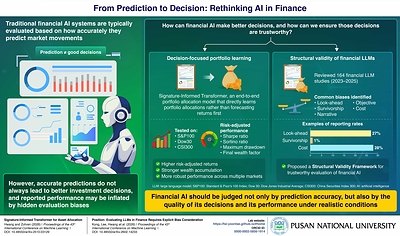
Artificial intelligence (AI) is fundamentally reshaping the landscape of modern finance, driving innovations in diverse applications from intricate stock market forecasting to personalized investment advice. However, groundbreaking research conducted by Pusan National University, in collaboration with the University of Oxford, challenges the prevailing assumption that high predictive accuracy in AI automatically leads to superior investment outcomes. These studies advocate for a paradigm shift, emphasizing that financial AI should be primarily judged on its capacity to optimize real-world financial decisions rather than solely on its ability to forecast markets. The research introduces an innovative decision-focused AI model designed for robust portfolio allocation and establishes a comprehensive framework for rigorously evaluating the reliability, practical utility, and trustworthiness of financial AI systems when deployed in dynamic, unpredictable market environments.
Rethinking AI's Role in Financial Decision-Making
Artificial intelligence is increasingly vital in finance, enabling sophisticated stock market predictions and automated investment guidance. Despite AI's predictive power, a core finding from Pusan National University researchers is that achieving highly accurate market forecasts does not inherently translate into optimal investment decisions. They draw an analogy to a weather app that might accurately predict temperature but fail to advise on carrying an umbrella during a storm. This perspective advocates for evaluating AI based on its efficacy in supporting practical financial decisions, moving beyond a sole focus on prediction accuracy to encompass real-world decision quality.
The Signature-Informed Transformer (SIT) for Asset Allocation
To overcome the limitations of purely prediction-focused AI, Professor Yoontae Hwang from Pusan National University and Professor Stefan Zohren from the University of Oxford developed the Signature-Informed Transformer (SIT) framework. This advanced AI model innovates by learning from the intricate ways market prices evolve over time and how different assets interact and influence each other. Unlike conventional approaches, SIT directly optimizes investment decisions, incorporating crucial risk considerations. Extensive evaluations across major equity markets in the United States and China demonstrated that the decision-focused SIT model consistently delivered stronger risk-adjusted performance and more resilient wealth accumulation, validating its practical superiority.
Establishing Trust and Validity in Financial AI Systems
The trustworthiness of financial AI successes was scrutinized in a second, complementary study. Reviewing 164 research papers on large language models (LLMs) in finance published between 2023 and 2025, the researchers identified significant, recurring biases that could artificially inflate reported performance metrics. These biases included the inadvertent use of future information, survivor bias (excluding failed companies), unrealistic evaluation objectives, and the omission of practical constraints like transaction costs. In response, the team introduced a "Structural Validity Framework," a practical checklist designed to guide the evaluation of financial AI systems, ensuring they are tested under truly realistic conditions and that their reported performance is likely to hold up outside controlled laboratory environments.
Envisioning the Future of Ethical and Robust Financial AI
The combined insights from both studies underscore a fundamental message for the advancement of financial AI: it must be developed and refined with a direct emphasis on consequential financial decisions and then rigorously assessed under conditions that mirror the complexities and uncertainties of the real world. The researchers propose a forward-looking vision involving "AI-powered flight simulators" for financial markets. These virtual environments would allow financial institutions and regulatory bodies to thoroughly test new policies, innovative products, and potential market shocks in a safe, simulated setting. This proactive approach aims to cultivate more transparent financial advice, enhance user confidence, and ultimately lead to the deployment of more trustworthy and effective AI in the financial sector.