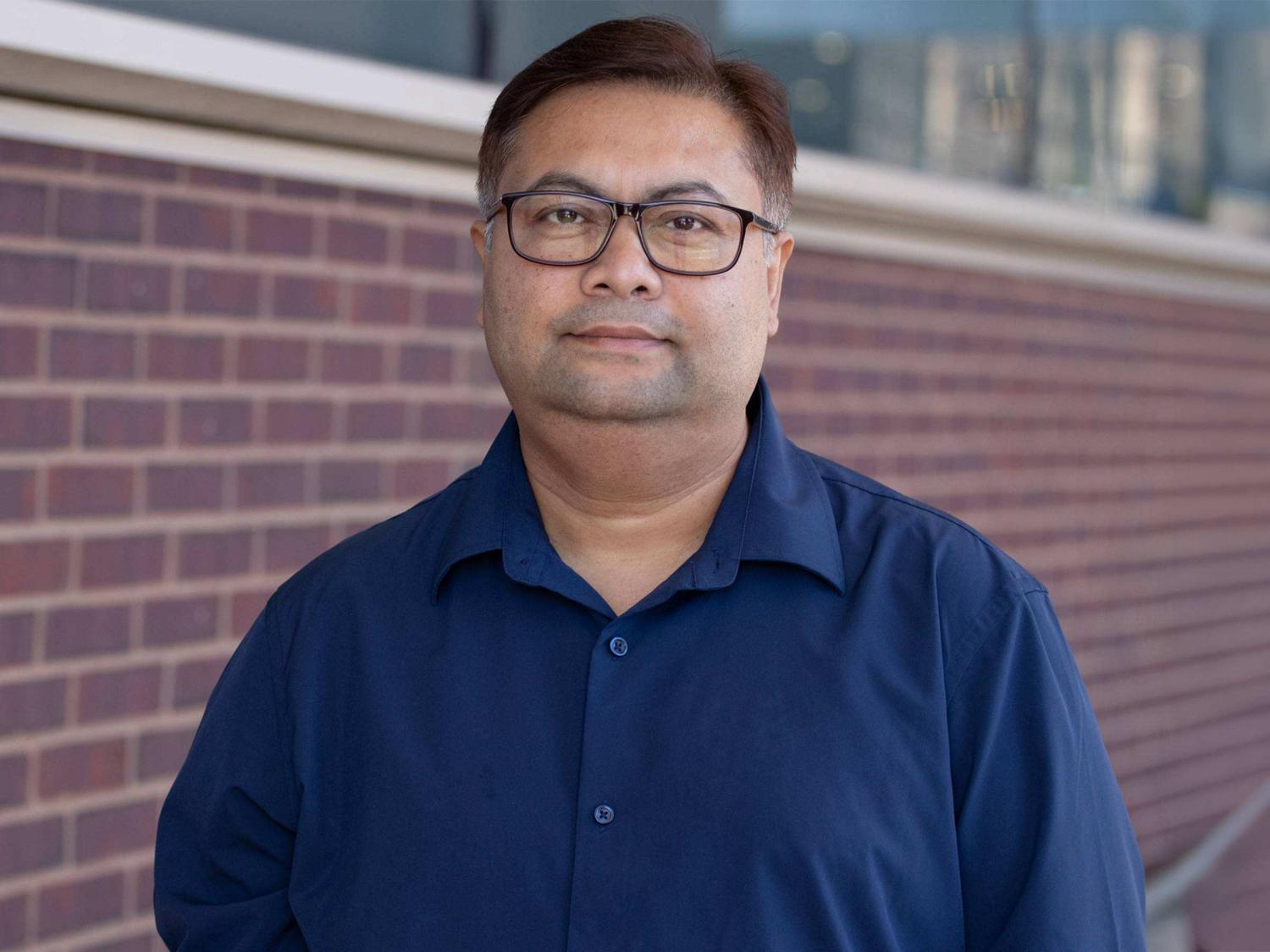
Suman Saha, associate teaching professor of computer science and engineering at Penn State, was awarded a two-year, $199,009 U.S. National Science Foundation Research Initiation in Engineering Formation grant to support the implementation of an artificial intelligence-enabled adaptive tutoring platform.
Q: What do you see as the biggest challenges and opportunities for engineering education with regard to generative AI? The primary challenge generative AI poses to engineering education is the risk of students bypassing the critical reasoning and judgment skills that are fundamental to the field. Engineers must develop abilities to examine assumptions, compare alternatives, learn from mistakes, and exercise professional judgment. Over-reliance on AI for final answers could prevent students from cultivating these essential habits. Conversely, AI presents a significant opportunity when utilized as a learning scaffold. It can deliver timely questions, hints, and personalized feedback, which is especially beneficial in large courses where instructors struggle to provide individual support. The objective is not to eliminate AI from the learning environment, but to guide students in using it critically, understanding its capabilities and limitations, questioning its outputs, and recognizing when human judgment is indispensable. Q: When did you develop ALAASKA, how does it work and how has it been used previously? ALAASKA, an Adaptive Learning for All through AI-Powered Student Knowledge Assessment platform, began development in 2025. Its creation was informed by earlier classroom experiences with short AI-generated learning activities like quizzes, flashcards, summaries, and videos. ALAASKA functions by adapting to a student's progress and responses, assessing their current understanding, and then providing tailored explanations, questions, hints, or brief knowledge checks. Instead of directly solving problems, it guides students through the next necessary steps of the problem-solving process. The platform was first implemented in spring 2026 within an upper-level artificial intelligence course, where students used it for nine homework assignments and four projects. Early analysis showed that students appreciated its ability to break down complex problems into manageable segments without revealing the answers directly. This usage also indicated that evidence of student reasoning often emerged during interactions with the AI, even if not present in the final submitted work, suggesting the value of examining the learning process itself. Q: What do you hope to achieve with this grant? With the recently awarded grant, the research aims to evaluate the effectiveness of 'conversational microlearning' – an AI-driven teaching method that provides questions, hints, and feedback during brief exchanges to guide student reasoning. The goal is to determine if this approach enhances students' comprehension of problem relevance, their perseverance through challenging tasks, and their ability to reflect on their own reasoning processes. Additionally, the project seeks to identify patterns in student-AI conversations that could help instructors detect when students are developing these critical behaviors or when they might need extra support. To achieve this, a comparative study will be conducted, involving two sections of a large computing course: one utilizing the ALAASKA platform for adaptive AI tutoring, and the other completing equivalent activities through a standard learning management system. Both sections will engage in similar activities and reflections, with the comparison specifically testing the impact of AI's conversational support on learning outcomes. The study will analyze surveys, course performance, interaction records, and student reflections. The broader objective is to produce practical design guidelines, assessment tools, and methodologies for analyzing student-AI interactions that can be adopted by other educators and researchers. The grant will also facilitate deeper expertise in mixed-methods research, assessment, and inclusive engineering education, contributing to a long-term research agenda on responsible AI-supported learning. Q: How does this work tie into Penn State’s AI Transformation initiatives? This initiative directly supports Penn State’s broader AI Transformation goals by generating classroom-based evidence pertinent to AI literacy, teaching methodologies, assessment strategies, and the responsible, human-centered application of AI. Instead of merely asking if AI can be integrated into a course, the project delves into how AI can be designed and evaluated to meaningfully enhance student learning, ensuring that reasoning, judgment, and responsibility remain central to the student's role. While the initial study focuses on a large computing course, the conversational microlearning approach is versatile and can be extended to other academic areas requiring students to tackle complex problems, articulate their decisions, and reflect critically. A key advantage of ALAASKA is its adaptive nature, allowing it to provide support based on real-time student responses without needing extensive prior data. The project plans to disseminate its design guidelines, assessment instruments, and analysis methods through faculty development programs with Penn State’s Leonhard Center for the Enhancement of Engineering Education. In the long term, there are aspirations to test and refine this approach across a wider range of courses, Penn State campuses, and collaborating institutions, further solidifying the university's commitment to pioneering AI in education.
Q: What do you see as the biggest challenges and opportunities for engineering education with regard to generative AI?
The primary challenge generative AI poses to engineering education is the risk of students bypassing the critical reasoning and judgment skills that are fundamental to the field. Engineers must develop abilities to examine assumptions, compare alternatives, learn from mistakes, and exercise professional judgment. Over-reliance on AI for final answers could prevent students from cultivating these essential habits. Conversely, AI presents a significant opportunity when utilized as a learning scaffold. It can deliver timely questions, hints, and personalized feedback, which is especially beneficial in large courses where instructors struggle to provide individual support. The objective is not to eliminate AI from the learning environment, but to guide students in using it critically, understanding its capabilities and limitations, questioning its outputs, and recognizing when human judgment is indispensable.
Q: When did you develop ALAASKA, how does it work and how has it been used previously?
ALAASKA, an Adaptive Learning for All through AI-Powered Student Knowledge Assessment platform, began development in 2025. Its creation was informed by earlier classroom experiences with short AI-generated learning activities like quizzes, flashcards, summaries, and videos. ALAASKA functions by adapting to a student's progress and responses, assessing their current understanding, and then providing tailored explanations, questions, hints, or brief knowledge checks. Instead of directly solving problems, it guides students through the next necessary steps of the problem-solving process. The platform was first implemented in spring 2026 within an upper-level artificial intelligence course, where students used it for nine homework assignments and four projects. Early analysis showed that students appreciated its ability to break down complex problems into manageable segments without revealing the answers directly. This usage also indicated that evidence of student reasoning often emerged during interactions with the AI, even if not present in the final submitted work, suggesting the value of examining the learning process itself.
Q: What do you hope to achieve with this grant?
With the recently awarded grant, the research aims to evaluate the effectiveness of 'conversational microlearning' – an AI-driven teaching method that provides questions, hints, and feedback during brief exchanges to guide student reasoning. The goal is to determine if this approach enhances students' comprehension of problem relevance, their perseverance through challenging tasks, and their ability to reflect on their own reasoning processes. Additionally, the project seeks to identify patterns in student-AI conversations that could help instructors detect when students are developing these critical behaviors or when they might need extra support. To achieve this, a comparative study will be conducted, involving two sections of a large computing course: one utilizing the ALAASKA platform for adaptive AI tutoring, and the other completing equivalent activities through a standard learning management system. Both sections will engage in similar activities and reflections, with the comparison specifically testing the impact of AI's conversational support on learning outcomes. The study will analyze surveys, course performance, interaction records, and student reflections. The broader objective is to produce practical design guidelines, assessment tools, and methodologies for analyzing student-AI interactions that can be adopted by other educators and researchers. The grant will also facilitate deeper expertise in mixed-methods research, assessment, and inclusive engineering education, contributing to a long-term research agenda on responsible AI-supported learning.
Q: How does this work tie into Penn State’s AI Transformation initiatives?
This initiative directly supports Penn State’s broader AI Transformation goals by generating classroom-based evidence pertinent to AI literacy, teaching methodologies, assessment strategies, and the responsible, human-centered application of AI. Instead of merely asking if AI can be integrated into a course, the project delves into how AI can be designed and evaluated to meaningfully enhance student learning, ensuring that reasoning, judgment, and responsibility remain central to the student's role. While the initial study focuses on a large computing course, the conversational microlearning approach is versatile and can be extended to other academic areas requiring students to tackle complex problems, articulate their decisions, and reflect critically. A key advantage of ALAASKA is its adaptive nature, allowing it to provide support based on real-time student responses without needing extensive prior data. The project plans to disseminate its design guidelines, assessment instruments, and analysis methods through faculty development programs with Penn State’s Leonhard Center for the Enhancement of Engineering Education. In the long term, there are aspirations to test and refine this approach across a wider range of courses, Penn State campuses, and collaborating institutions, further solidifying the university's commitment to pioneering AI in education.