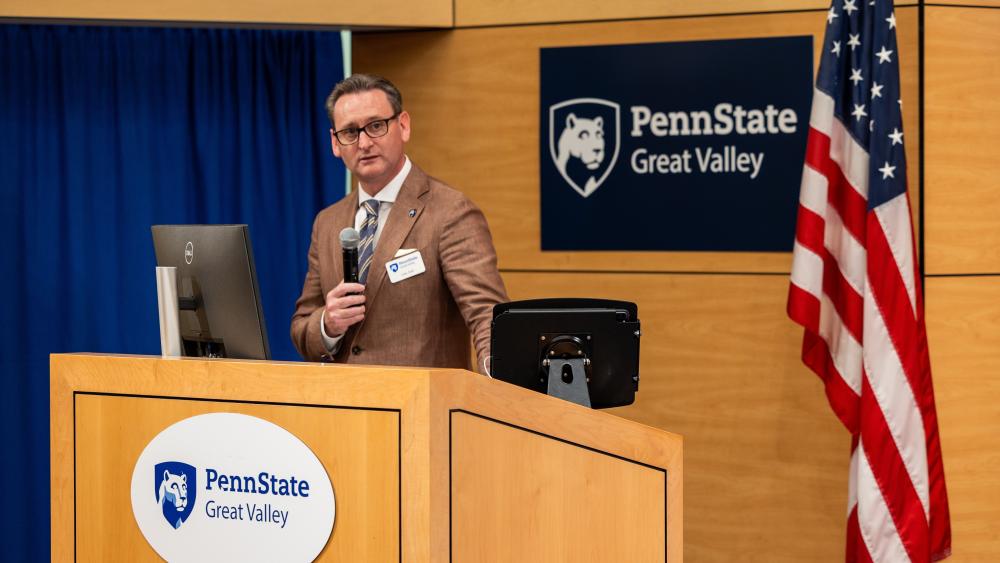
Great Valley Chancellor Colin Neill discussed his experience working with artificial intelligence (AI) in the 1990s and how Great Valley is preparing students and organizations today for the far-reaching changes AI is sparking across industries. Neill also explained why AI often produces mediocre output and how to use it to get exceptional results.
Q: How has AI evolved in the last few decades?
Chancellor Colin Neill discusses the cyclical nature of AI, recalling its prominence in the 1990s in fields like robotics and manufacturing automation, despite limitations at the time. He highlights the significant advancements in AI's capabilities today, attributing them to evolved computing power, techniques, and algorithms, enabling 'incredible things'.
Q: How can you get better output from AI?
Neill advises approaching AI not as a replacement for human capabilities, but as a tool to significantly enhance them. He stresses the necessity of human critical thinking, values, ethics, and morals in decision-making, as general AI solutions often produce 'average' outcomes. The goal is for humans to leverage their deep understanding to refine these average AI outputs into exceptional solutions, emphasizing that human reasoning and tailoring are crucial for success.
Q: How can professionals prepare for the industry changes AI is bringing?
Penn State Great Valley focuses on preparing professionals for AI-driven industry changes by integrating AI across its curriculum, including accounting and finance. Their programs range from technical AI development to 'no-code, low-code' solutions, with a new MBA in AI launching to teach professionals how to implement AI effectively within organizations, understanding where human involvement remains vital.
Q: How can professionals and organizations learn to use AI well?
Penn State Great Valley provides various avenues for AI education and collaboration, including degree programs and experiential learning opportunities for students to work on real-world problems. They offer a consulting model for corporate and non-profit clients through the Community Impact Collective, assisting with everything from exploring AI tools like Copilot to developing full AI pipelines, and encourage discussions on potential collaborations.