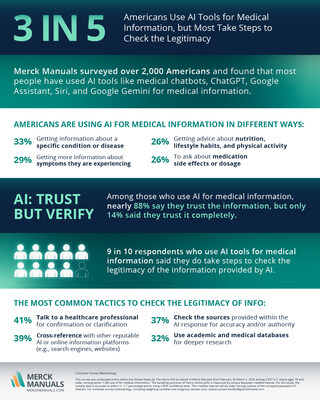
Many Americans are increasingly turning to Artificial Intelligence (AI) tools for medical information, though opinions on the trustworthiness of these results are divided. A recent online poll conducted by The Harris Poll on behalf of Merck Manuals surveyed 2,057 U.S. adults, revealing that over three in five (62%) Americans have utilized AI tools such as medical chatbots, ChatGPT, Google Assistant, Siri, and Google Gemini to seek medical information. Despite this high usage, approximately one-third of Americans (32%) express a lack of trust in the medical information provided by these AI platforms. Notably, nine out of ten individuals who have used AI for medical purposes indicate they take proactive steps to verify the legitimacy and accuracy of the information they receive from these tools.
Common Uses of AI for Medical Information
The survey by The Merck Manuals and Harris Poll identified several common applications for AI tools in accessing medical information. The most frequent uses include obtaining detailed information about a specific medical condition or disease (reported by 33% of users), understanding and researching symptoms they are experiencing (29%), seeking advice on general wellness topics such as nutrition, healthy lifestyle habits, and physical activity (26%), and inquiring about potential side effects or appropriate dosages for medications (26%). These varied uses highlight the diverse ways individuals are integrating AI into their health information-seeking behavior.
Specific Actions When Using AI for Medical Information
Americans employing AI tools for medical information engage in specific actions to utilize these platforms effectively. A significant portion (54%) enters a list of symptoms into AI to receive a potential diagnosis. Furthermore, 44% craft detailed prompts for the AI, incorporating sensitive personal health data such as vital signs, medical history, or other relevant health records. Additionally, 39% of users specifically opt for AI tools that are purpose-built and designed to focus exclusively on health and medical topics, suggesting a preference for specialized, potentially more reliable, health-oriented AI solutions.
Methods for Verifying AI Medical Information
A crucial finding of the survey indicates that nearly nine out of ten Americans (90%) who use AI tools for medical information do not blindly accept the results and instead implement strategies to verify the information's legitimacy. The most frequently reported tactics include: discussing the information with a healthcare professional for confirmation or clarification (41%), cross-referencing the AI-provided details with other reputable AI or established online information platforms like traditional search engines or medical websites (39%), meticulously checking the sources cited within the AI's response for accuracy and authority (37%), and conducting deeper research using academic and specialized medical databases (32%). This emphasizes a cautious approach to AI-generated medical advice.
Demographic Trends in AI Medical Information Usage
The survey also unveiled distinct demographic patterns in the adoption of AI for medical information. Younger generations, specifically Gen Z (ages 18-29) and Millennials (ages 30-45), are considerably more inclined to use AI for health inquiries, with 77% from each group reporting usage. In contrast, Gen X (ages 46-61) shows a usage rate of 58%, while Baby Boomers (ages 62-80) are the least likely, at 40%. Furthermore, parents with children under 18 exhibit a markedly higher propensity to use AI for medical information (83%) compared to non-parents (52%), often leveraging it to gather details about specific conditions or diseases (46%) and to understand symptoms their children might be experiencing (41%). This indicates a particular reliance on AI among younger individuals and parents for health-related queries.