The integration of artificial intelligence (AI) is rapidly transforming orthopedic surgery, enhancing surgical outcomes and patient care through increased precision and personalized treatments. This report examines the current market status, key growth drivers, regional market dominance, and emerging trends shaping the AI in orthopedic surgery sector.
Overview of the Artificial Intelligence in Orthopedic Surgery Market Size and Expansion The global market for Artificial Intelligence in orthopedic surgery has experienced substantial growth, projected to increase from $0.26 billion in 2025 to $0.33 billion in 2026, at a Compound Annual Growth Rate (CAGR) of 27.5%. This significant expansion is attributed to several factors, including a rising volume of orthopedic procedures, continuous advancements in medical imaging technologies, the wider adoption of minimally invasive surgical techniques, the ongoing digitalization of hospital infrastructure, and a heightened emphasis on achieving surgical precision and improved patient outcomes. Future Projections Highlight Robust Growth in AI for Orthopedic Surgery Looking forward, the AI in orthopedic surgery market is forecasted for robust growth, with its size expected to reach an estimated $0.87 billion by 2030, sustaining a strong CAGR of 27.2%. This projected surge is driven by increasing patient demand for highly personalized orthopedic care, significant investments flowing into advanced surgical robotic technologies, the expanding integration of AI-driven clinical decision support systems, a growing focus on outcome-based healthcare models, and deeper embedding of AI with electronic health records. Key emerging trends include the expanded use of AI for surgical planning, advanced computer vision applications in surgical procedures, increased deployment of robotic systems, the application of predictive analytics for patient outcomes, and enhanced accuracy in implant placements. Understanding Artificial Intelligence Applications in Orthopedic Surgery Artificial Intelligence in orthopedic surgery involves the application of sophisticated AI tools to significantly improve surgical planning, enhance operational accuracy, and ultimately optimize patient recovery and results. This technology plays a crucial role in the precise diagnosis of various bone and joint disorders, the customization of individualized surgical approaches based on unique patient data, the prediction of potential post-operative complications, and ensuring the highly accurate placement of implants. The overarching goal of integrating AI is to minimize surgical errors, significantly accelerate patient recovery times, and deliver tailored treatments that are precisely matched to each patient's specific physiological data, thereby elevating the overall standard of care. Key Factors Accelerating Growth in AI for Orthopedic Surgery A primary driver propelling the growth of the AI in orthopedic surgery market is the escalating global prevalence of musculoskeletal disorders (MSK). These conditions, which include injuries or chronic ailments affecting muscles, bones, joints, tendons, or ligaments, frequently result in chronic pain and limitations in movement. The increasing adoption of sedentary lifestyles is a significant contributing factor to the rise in MSK cases, leading to muscle atrophy and increased joint stress. AI technology markedly improves the management of MSK conditions by facilitating early and highly accurate diagnoses through sophisticated image analysis and intricate data interpretation. Furthermore, AI supports the development of personalized treatment plans and provides predictive insights into patient outcomes, which collectively contribute to enhanced patient recovery processes. Real-World Data Supporting Growth in AI Orthopedics Concrete real-world data further underscores the growth trajectory in AI orthopedics. For instance, a report from January 2024 by the UK’s Office for Health Improvement and Disparities revealed that 18.4% of individuals aged 16 and older experienced a long-term musculoskeletal condition in 2023, marking an increase from 17.6% in 2022. This clear upward trend in the incidence of MSK disorders robustly supports the increasing adoption and integration of AI technologies within orthopedic surgery, as healthcare providers actively seek more effective, efficient, and precise methods to address these widespread and growing health challenges. North America’s Leading Role in the AI Orthopedic Surgery Market In the year 2025, North America emerged as the dominant region, securing the largest share of the artificial intelligence in orthopedic surgery market. The comprehensive market report extends its analysis beyond North America, encompassing a global perspective on market dynamics and opportunities across various other significant regions. These regions include Asia-Pacific, South East Asia, Western Europe, Eastern Europe, South America, the Middle East, and Africa, collectively highlighting the widespread interest and development in the application of AI within orthopedic surgery worldwide.
Overview of the Artificial Intelligence in Orthopedic Surgery Market Size and Expansion
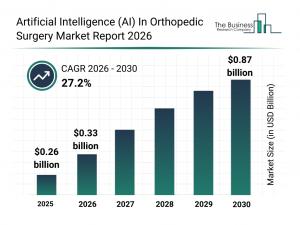
The global market for Artificial Intelligence in orthopedic surgery has experienced substantial growth, projected to increase from $0.26 billion in 2025 to $0.33 billion in 2026, at a Compound Annual Growth Rate (CAGR) of 27.5%. This significant expansion is attributed to several factors, including a rising volume of orthopedic procedures, continuous advancements in medical imaging technologies, the wider adoption of minimally invasive surgical techniques, the ongoing digitalization of hospital infrastructure, and a heightened emphasis on achieving surgical precision and improved patient outcomes.
Future Projections Highlight Robust Growth in AI for Orthopedic Surgery
Looking forward, the AI in orthopedic surgery market is forecasted for robust growth, with its size expected to reach an estimated $0.87 billion by 2030, sustaining a strong CAGR of 27.2%. This projected surge is driven by increasing patient demand for highly personalized orthopedic care, significant investments flowing into advanced surgical robotic technologies, the expanding integration of AI-driven clinical decision support systems, a growing focus on outcome-based healthcare models, and deeper embedding of AI with electronic health records. Key emerging trends include the expanded use of AI for surgical planning, advanced computer vision applications in surgical procedures, increased deployment of robotic systems, the application of predictive analytics for patient outcomes, and enhanced accuracy in implant placements.
Understanding Artificial Intelligence Applications in Orthopedic Surgery
Artificial Intelligence in orthopedic surgery involves the application of sophisticated AI tools to significantly improve surgical planning, enhance operational accuracy, and ultimately optimize patient recovery and results. This technology plays a crucial role in the precise diagnosis of various bone and joint disorders, the customization of individualized surgical approaches based on unique patient data, the prediction of potential post-operative complications, and ensuring the highly accurate placement of implants. The overarching goal of integrating AI is to minimize surgical errors, significantly accelerate patient recovery times, and deliver tailored treatments that are precisely matched to each patient's specific physiological data, thereby elevating the overall standard of care.
Key Factors Accelerating Growth in AI for Orthopedic Surgery
A primary driver propelling the growth of the AI in orthopedic surgery market is the escalating global prevalence of musculoskeletal disorders (MSK). These conditions, which include injuries or chronic ailments affecting muscles, bones, joints, tendons, or ligaments, frequently result in chronic pain and limitations in movement. The increasing adoption of sedentary lifestyles is a significant contributing factor to the rise in MSK cases, leading to muscle atrophy and increased joint stress. AI technology markedly improves the management of MSK conditions by facilitating early and highly accurate diagnoses through sophisticated image analysis and intricate data interpretation. Furthermore, AI supports the development of personalized treatment plans and provides predictive insights into patient outcomes, which collectively contribute to enhanced patient recovery processes.
Real-World Data Supporting Growth in AI Orthopedics
Concrete real-world data further underscores the growth trajectory in AI orthopedics. For instance, a report from January 2024 by the UK’s Office for Health Improvement and Disparities revealed that 18.4% of individuals aged 16 and older experienced a long-term musculoskeletal condition in 2023, marking an increase from 17.6% in 2022. This clear upward trend in the incidence of MSK disorders robustly supports the increasing adoption and integration of AI technologies within orthopedic surgery, as healthcare providers actively seek more effective, efficient, and precise methods to address these widespread and growing health challenges.
North America’s Leading Role in the AI Orthopedic Surgery Market
In the year 2025, North America emerged as the dominant region, securing the largest share of the artificial intelligence in orthopedic surgery market. The comprehensive market report extends its analysis beyond North America, encompassing a global perspective on market dynamics and opportunities across various other significant regions. These regions include Asia-Pacific, South East Asia, Western Europe, Eastern Europe, South America, the Middle East, and Africa, collectively highlighting the widespread interest and development in the application of AI within orthopedic surgery worldwide.