The Square Kilometre Array Observatory (SKAO) will usher in an era of unprecedented data complexity and scientific opportunity in radio astronomy, producing petabyte-scale datasets and terabit-per-second streams that challenge traditional analysis paradigms. Artificial Intelligence (AI) stands at the forefront of this transformation, offering scalable, adaptive solutions to the most pressing problems in radio astronomy and astrophysics.
Addressing Data Challenges with AI in the SKA Era
The Square Kilometre Array Observatory (SKAO) is anticipated to generate an enormous volume of complex data, measured in petabytes and streaming at terabits per second. This scale presents significant challenges for conventional radio astronomy analysis methods. Artificial Intelligence (AI) is positioned as a pivotal technology to overcome these hurdles, offering scalable and adaptive solutions to crucial problems within radio astronomy and astrophysics. The article highlights AI's indispensable role in navigating this new era of data-intensive astronomical research, fundamentally transforming how observations are processed and understood.
Diverse AI Models for SKA Operations and Discovery
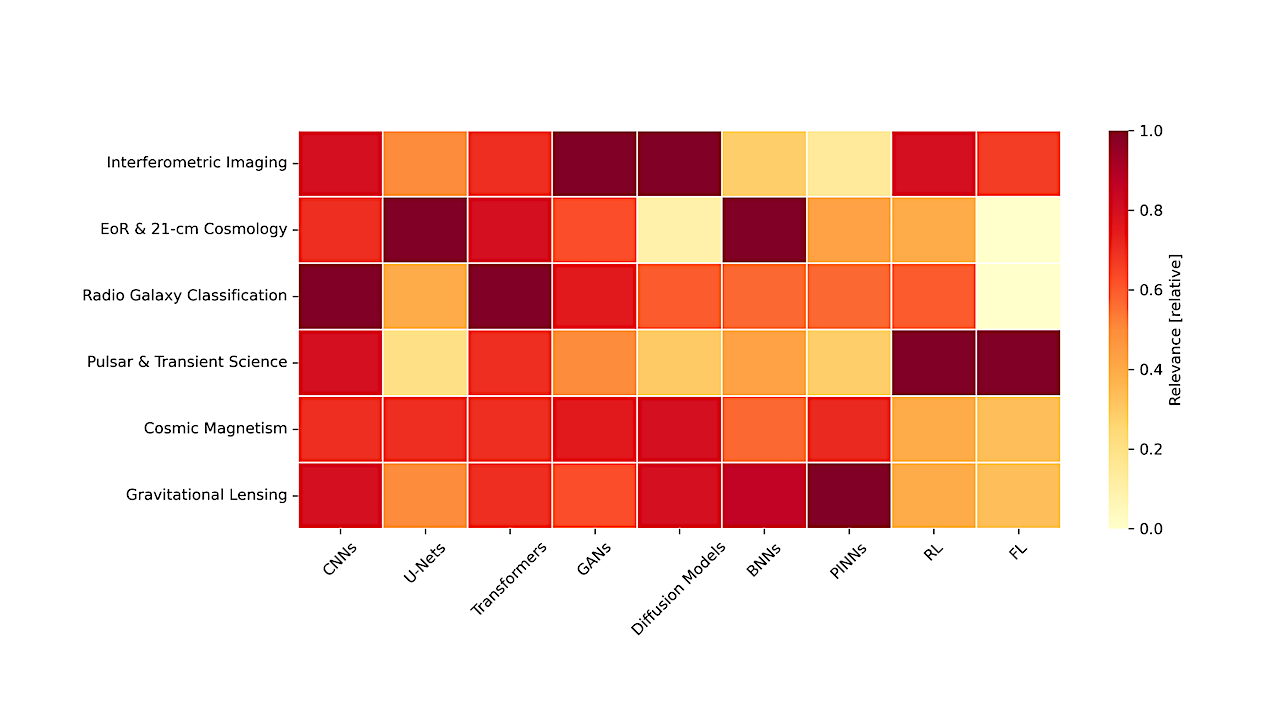
This section of the article details the multifaceted applications of various AI models tailored for the SKA project, spanning both real-time operations and scientific discovery. Deep learning models are explored for their capability to enable automated source detection, mitigate radio-frequency interference (RFI), perform anomaly detection, and facilitate robust parameter inference. Furthermore, generative AI approaches are discussed for their potential to significantly accelerate sky simulations, improve calibration processes, and enhance imaging techniques. These diverse applications demonstrate AI's comprehensive integration into the operational and analytical framework of SKA.
Advanced AI Techniques and Ethical Considerations
The discussion extends to more advanced AI methodologies, highlighting the potential of reinforcement learning to implement dynamic scheduling and achieve autonomous system control within the expansive SKA infrastructure. Additionally, federated learning is introduced as a promising approach to effectively manage and process the inherently distributed nature of SKA data, ensuring privacy and efficiency across numerous locations. Crucially, the article emphasizes that beyond mere computational performance, the necessity of explainability, robust uncertainty quantification, and the incorporation of physics-informed inductive biases are paramount. These ethical and methodological considerations are essential to ensure the scientific integrity and trustworthiness of AI-driven discoveries in astronomy.
AI as a Catalyst for Unlocking Cosmic Mysteries
Concluding the analysis, the article firmly positions AI not merely as an automation tool designed to cope with the sheer scale and complexity of SKA data. Instead, it is presented as a transformative catalyst for profound scientific discovery. By strategically mapping SKAO's core challenges—data volume, inherent complexity, and the need for interpretability—onto cutting-edge AI methodologies, including deep learning, self-supervised frameworks, and probabilistic models, AI is expected to unlock new frontiers. This will lead to groundbreaking insights in cosmology, galaxy evolution, and time-domain astrophysics, fundamentally redefining humanity’s approach to observing, modeling, and ultimately comprehending the vast and intricate Universe.