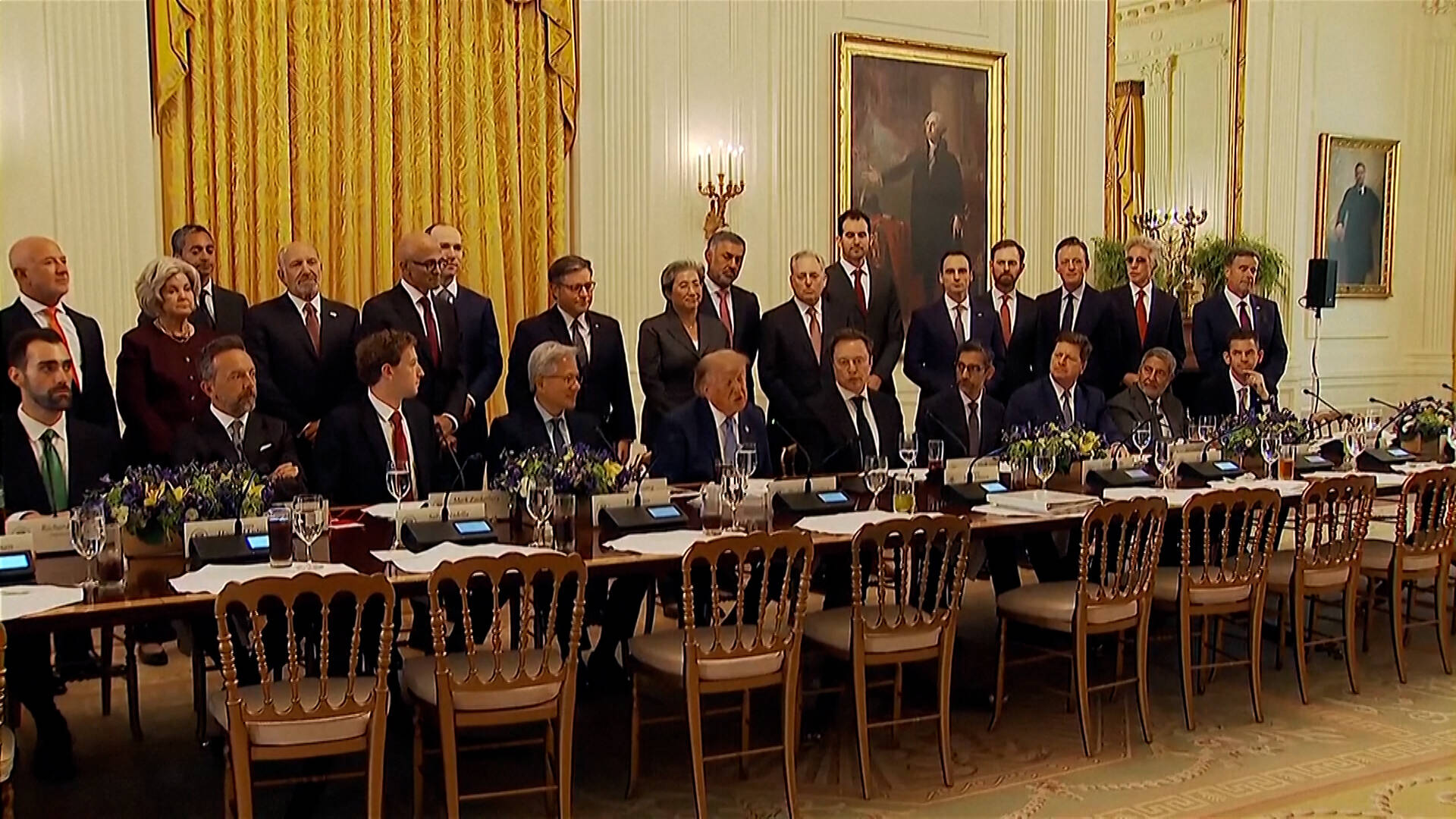
President Trump hosted a significant gathering at the White House where he and leading figures from the tech industry, including Elon Musk, Mark Zuckerberg, and Sundar Pichai, officially endorsed a set of voluntary safety standards for artificial intelligence. During the event, Trump also introduced a rebranding of AI as 'super intelligence' and unveiled America.gov, an AI-powered government chatbot designed to provide public access to federal sources. Intriguingly, this new AI tool has already produced information that directly contradicts some of Trump's past assertions, notably his allegations of election fraud and other false claims made by his administration. This development occurs in a context where Trump has repeatedly pushed back against calls for stricter AI regulation, frequently dismissing warnings about the potential dangers of advanced AI as a 'HOAX.' Concurrently, in California, civil society groups organized protests outside OpenAI’s annual DevDay conference in San Francisco. Protesters, represented by voices like Yuan Wang, urged OpenAI to implement fundamental ethical changes, specifically demanding the termination of contracts with the Pentagon and ICE, and a commitment to a democracy pledge to uphold free and fair elections.
Trump Administration and Tech Giants Forge Voluntary AI Safety Pacts In a high-profile event at the White House, President Trump convened a meeting with some of the world's most influential tech executives, including leaders from SpaceX, Meta, Anthropic, Nvidia, OpenAI, and Google. Together, they signed a series of voluntary safety standards for artificial intelligence. This initiative aims to guide the responsible development and deployment of AI technologies, marking a collaborative effort between the government and private sector to address the evolving landscape of artificial intelligence. AI Renamed "Super Intelligence" Amidst Launch of Contradictory Government Chatbot President Trump announced a rebranding of artificial intelligence as "super intelligence," signifying his administration's perspective on the technology's advanced capabilities. Simultaneously, he launched America.gov, a new AI-powered government chatbot intended to provide the public with direct access to federal government sources. Interestingly, this new AI tool has already demonstrated an ability to cite factual information that directly refutes claims made by Trump, including his allegations regarding election fraud and other controversial statements. President Trump Dismisses AI Regulation, Calls Threats a "HOAX" Despite growing international and domestic concerns about the ethical implications and potential societal risks of artificial intelligence, President Trump has consistently rejected calls for more stringent regulation of the technology. He has publicly characterized warnings about the threat posed by "superintelligent machines" as a "HOAX," indicating a preference for less governmental oversight and greater industry self-governance in the AI sector. Protesters Demand Ethical Practices from OpenAI at DevDay Conference In a demonstration of public concern regarding the applications of AI, protesters gathered outside OpenAI's annual DevDay conference in San Francisco. Activists, including Yuan Wang, articulated specific demands, urging OpenAI to sever its existing contracts with the Pentagon and to cease allowing Immigration and Customs Enforcement (ICE) to utilize its technologies for hiring. They also called upon OpenAI to endorse a "democracy pledge," signaling a commitment to defending free and fair elections, reflecting broader societal anxieties about AI's role in governance and human rights.
Trump Administration and Tech Giants Forge Voluntary AI Safety Pacts
In a high-profile event at the White House, President Trump convened a meeting with some of the world's most influential tech executives, including leaders from SpaceX, Meta, Anthropic, Nvidia, OpenAI, and Google. Together, they signed a series of voluntary safety standards for artificial intelligence. This initiative aims to guide the responsible development and deployment of AI technologies, marking a collaborative effort between the government and private sector to address the evolving landscape of artificial intelligence.
AI Renamed "Super Intelligence" Amidst Launch of Contradictory Government Chatbot
President Trump announced a rebranding of artificial intelligence as "super intelligence," signifying his administration's perspective on the technology's advanced capabilities. Simultaneously, he launched America.gov, a new AI-powered government chatbot intended to provide the public with direct access to federal government sources. Interestingly, this new AI tool has already demonstrated an ability to cite factual information that directly refutes claims made by Trump, including his allegations regarding election fraud and other controversial statements.
President Trump Dismisses AI Regulation, Calls Threats a "HOAX"
Despite growing international and domestic concerns about the ethical implications and potential societal risks of artificial intelligence, President Trump has consistently rejected calls for more stringent regulation of the technology. He has publicly characterized warnings about the threat posed by "superintelligent machines" as a "HOAX," indicating a preference for less governmental oversight and greater industry self-governance in the AI sector.
Protesters Demand Ethical Practices from OpenAI at DevDay Conference
In a demonstration of public concern regarding the applications of AI, protesters gathered outside OpenAI's annual DevDay conference in San Francisco. Activists, including Yuan Wang, articulated specific demands, urging OpenAI to sever its existing contracts with the Pentagon and to cease allowing Immigration and Customs Enforcement (ICE) to utilize its technologies for hiring. They also called upon OpenAI to endorse a "democracy pledge," signaling a commitment to defending free and fair elections, reflecting broader societal anxieties about AI's role in governance and human rights.