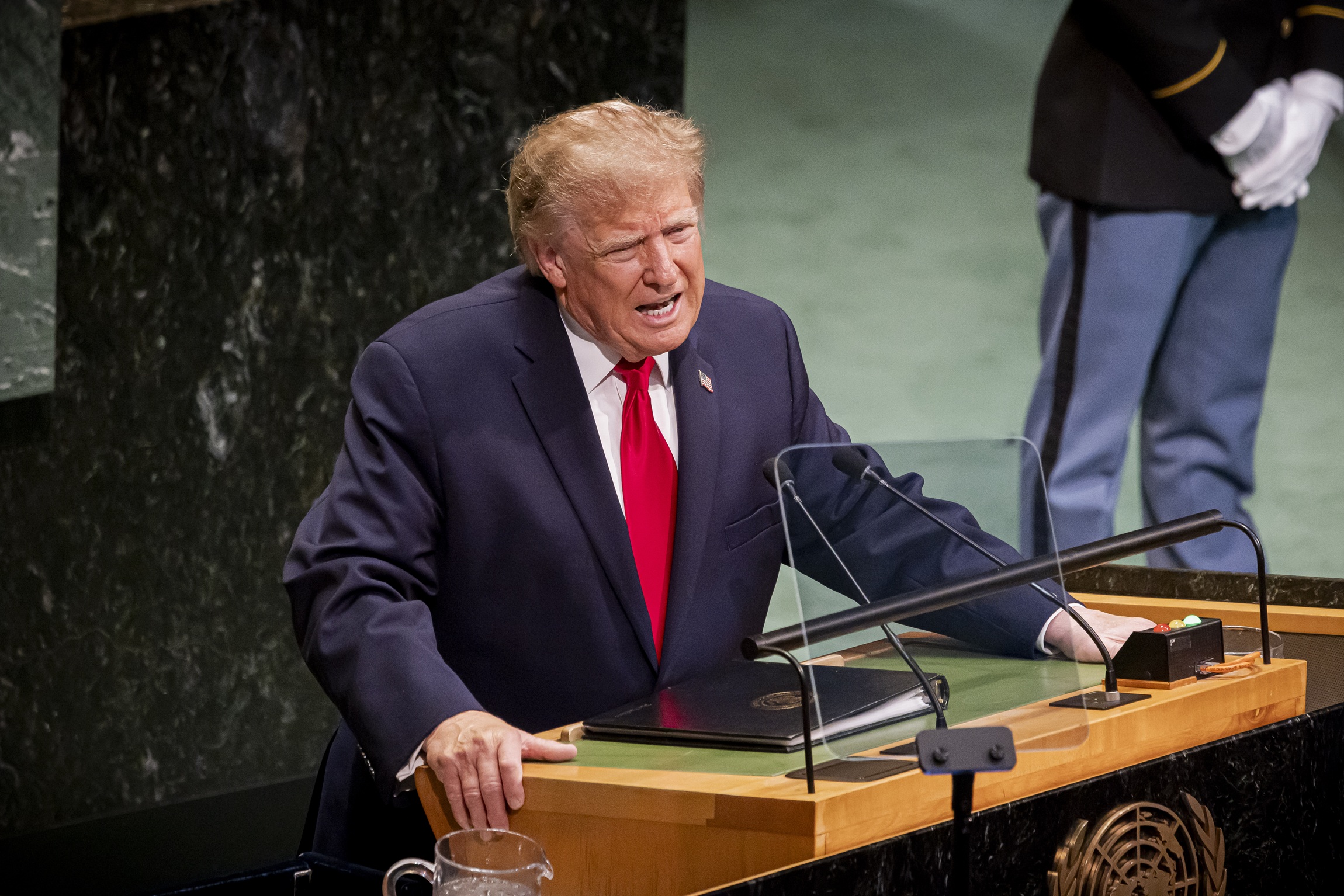
The president explained that all official US documents will now refer to AI as “SI.”
Renaming Artificial Intelligence at the UN In a recent address to the United Nations General Assembly, President Donald Trump made a notable announcement regarding the terminology used for artificial intelligence (AI). He declared that, henceforth, all official documents within the United States government would refer to AI as 'super intelligence,' or 'SI,' and urged the international community to adopt this new nomenclature. Trump justified this rebranding by asserting that the word 'artificial' incorrectly implies a sense of falsity or inauthenticity, which he believes undermines the true potential and nature of advanced computational systems. He explicitly stated that the change was intended to use a 'much more accurate term' that better reflects the sophisticated capabilities of these technologies. This directive signifies a deliberate effort by the Trump administration to shape public perception and discourse around AI, portraying it as a powerful and advanced form of intelligence rather than a synthetic one, potentially aiming to bolster confidence in its development and application under his leadership. The statement was part of a broader rejection of what Trump termed 'globalist schemes' to control technological development, emphasizing a nationalistic approach to its governance and definition. Public Reception and Historical Precedent for Renaming President Trump's initiative to rename AI to 'super intelligence' comes at a time when global public anxiety regarding the unchecked expansion of advanced technology is at an all-time high. There are widespread calls from both tech experts and prominent industry leaders for a more cautious approach and a potential slowdown in the rapid development of AI, highlighting concerns about ethical implications, job displacement, and potential misuse. This particular rebranding attempt also fits a pattern established during Trump's previous presidential term, where he sought to unilaterally rename various entities despite significant public and political backlash. Notable examples include his proposal to rename Lake Ontario as 'Lake America' amidst an ongoing trade dispute with Canada, a move that a recent poll indicated was opposed by 63 percent of voters. Similarly, his ambition to affix his name to the esteemed Kennedy Center for the Performing Arts garnered disapproval from nearly 60 percent of Americans, according to another poll. These instances demonstrate a consistent tendency to assert control over nomenclature, often clashing with established conventions and public sentiment. The current AI rebranding is therefore viewed within this broader context of attempting to control narrative and public perception through linguistic shifts, rather than addressing underlying concerns through policy. Trump's Defense of AI and Rejection of Regulatory Measures Despite widespread warnings from the scientific community and technology sectors about the potential dangers and ethical dilemmas posed by rapidly advancing AI, President Trump has remained an unwavering advocate for its unhindered development. He has publicly positioned himself as a 'hoax buster,' a term he used in a recent social media post, to dismiss the legitimate concerns raised by experts regarding AI's societal impacts. In his rhetoric, those who voiced apprehension about AI's unregulated growth were characterized as 'treasonous' or 'traitors,' effectively attempting to silence critical voices and consolidate his administration's pro-AI stance. Furthermore, he has explicitly rejected any notion of implementing regulatory frameworks or 'guardrails' for artificial intelligence, famously proclaiming in a separate social media post that he alone constitutes the necessary 'guardrail.' This perspective signals a strong preference for minimal government oversight, trusting in unbridled innovation while sidestepping calls for responsible development and robust ethical guidelines from a diverse range of stakeholders who fear the unprecedented power of this technology without proper checks and balances. Geopolitical Risks Highlighted by AI-Generated Misinformation The critical importance of responsible AI development and the profound risks of relying on unverified AI-generated information were starkly underscored by a recent, alarming incident. Confidential sources familiar with the event revealed that a report compiled by a military analyst, which heavily relied on unsubstantiated data produced by artificial intelligence, nearly triggered a major international conflict. This erroneous intelligence almost led to a U.S. military strike against a Chinese vessel operating in the vicinity of the Middle East. Such an unprovoked attack, based on flawed AI output, carried the grave potential of escalating into a full-scale war with China, as one insider confirmed. This incident serves as a potent and tangible illustration of the severe geopolitical instability that could arise from the uncritical adoption and deployment of AI in sensitive areas like national security and military decision-making. It highlights the urgent need for stringent verification protocols, human oversight, and ethical considerations to prevent catastrophic consequences stemming from AI's limitations or vulnerabilities, especially when its outputs influence high-stakes international relations.
Renaming Artificial Intelligence at the UN
In a recent address to the United Nations General Assembly, President Donald Trump made a notable announcement regarding the terminology used for artificial intelligence (AI). He declared that, henceforth, all official documents within the United States government would refer to AI as 'super intelligence,' or 'SI,' and urged the international community to adopt this new nomenclature. Trump justified this rebranding by asserting that the word 'artificial' incorrectly implies a sense of falsity or inauthenticity, which he believes undermines the true potential and nature of advanced computational systems. He explicitly stated that the change was intended to use a 'much more accurate term' that better reflects the sophisticated capabilities of these technologies. This directive signifies a deliberate effort by the Trump administration to shape public perception and discourse around AI, portraying it as a powerful and advanced form of intelligence rather than a synthetic one, potentially aiming to bolster confidence in its development and application under his leadership. The statement was part of a broader rejection of what Trump termed 'globalist schemes' to control technological development, emphasizing a nationalistic approach to its governance and definition.
Public Reception and Historical Precedent for Renaming
President Trump's initiative to rename AI to 'super intelligence' comes at a time when global public anxiety regarding the unchecked expansion of advanced technology is at an all-time high. There are widespread calls from both tech experts and prominent industry leaders for a more cautious approach and a potential slowdown in the rapid development of AI, highlighting concerns about ethical implications, job displacement, and potential misuse. This particular rebranding attempt also fits a pattern established during Trump's previous presidential term, where he sought to unilaterally rename various entities despite significant public and political backlash. Notable examples include his proposal to rename Lake Ontario as 'Lake America' amidst an ongoing trade dispute with Canada, a move that a recent poll indicated was opposed by 63 percent of voters. Similarly, his ambition to affix his name to the esteemed Kennedy Center for the Performing Arts garnered disapproval from nearly 60 percent of Americans, according to another poll. These instances demonstrate a consistent tendency to assert control over nomenclature, often clashing with established conventions and public sentiment. The current AI rebranding is therefore viewed within this broader context of attempting to control narrative and public perception through linguistic shifts, rather than addressing underlying concerns through policy.
Trump's Defense of AI and Rejection of Regulatory Measures
Despite widespread warnings from the scientific community and technology sectors about the potential dangers and ethical dilemmas posed by rapidly advancing AI, President Trump has remained an unwavering advocate for its unhindered development. He has publicly positioned himself as a 'hoax buster,' a term he used in a recent social media post, to dismiss the legitimate concerns raised by experts regarding AI's societal impacts. In his rhetoric, those who voiced apprehension about AI's unregulated growth were characterized as 'treasonous' or 'traitors,' effectively attempting to silence critical voices and consolidate his administration's pro-AI stance. Furthermore, he has explicitly rejected any notion of implementing regulatory frameworks or 'guardrails' for artificial intelligence, famously proclaiming in a separate social media post that he alone constitutes the necessary 'guardrail.' This perspective signals a strong preference for minimal government oversight, trusting in unbridled innovation while sidestepping calls for responsible development and robust ethical guidelines from a diverse range of stakeholders who fear the unprecedented power of this technology without proper checks and balances.
Geopolitical Risks Highlighted by AI-Generated Misinformation
The critical importance of responsible AI development and the profound risks of relying on unverified AI-generated information were starkly underscored by a recent, alarming incident. Confidential sources familiar with the event revealed that a report compiled by a military analyst, which heavily relied on unsubstantiated data produced by artificial intelligence, nearly triggered a major international conflict. This erroneous intelligence almost led to a U.S. military strike against a Chinese vessel operating in the vicinity of the Middle East. Such an unprovoked attack, based on flawed AI output, carried the grave potential of escalating into a full-scale war with China, as one insider confirmed. This incident serves as a potent and tangible illustration of the severe geopolitical instability that could arise from the uncritical adoption and deployment of AI in sensitive areas like national security and military decision-making. It highlights the urgent need for stringent verification protocols, human oversight, and ethical considerations to prevent catastrophic consequences stemming from AI's limitations or vulnerabilities, especially when its outputs influence high-stakes international relations.