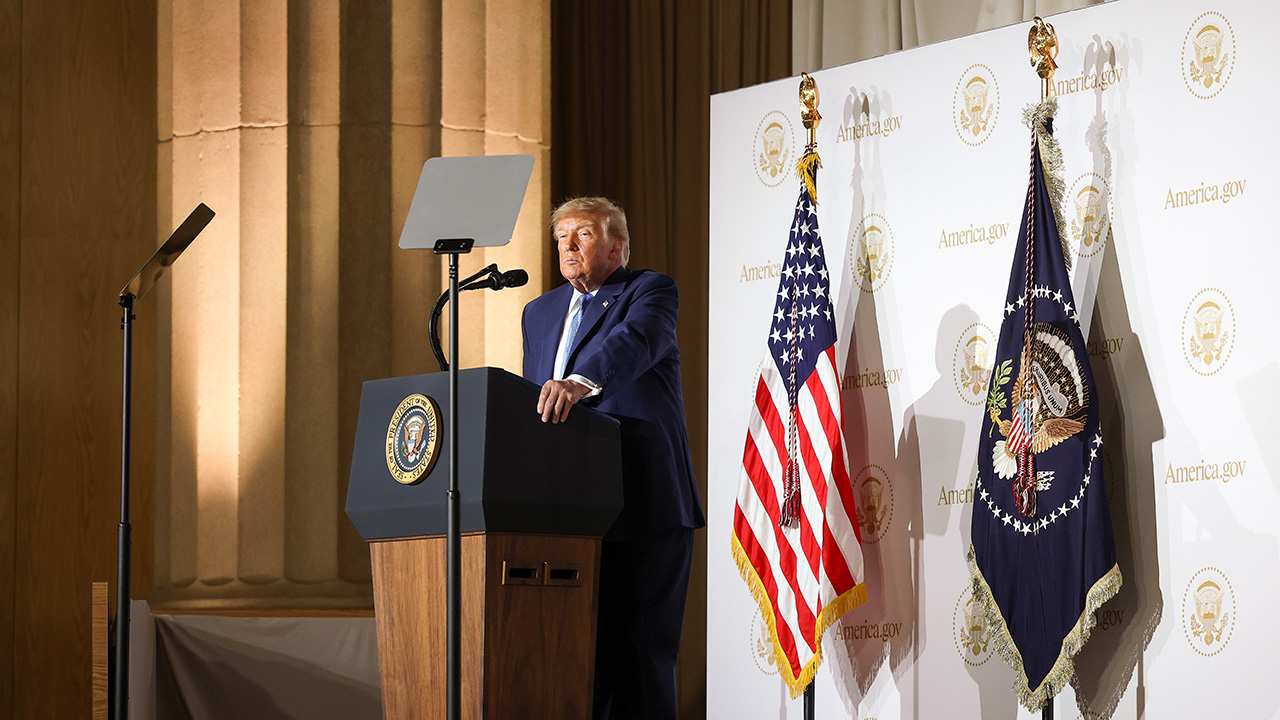
President Donald Trump said Tuesday he will sign a "very powerful" executive order on "super intelligence."
Trump's New 'Super Intelligence' Order President Donald Trump declared on Tuesday his intention to sign a "very powerful" executive order that will officially rename Artificial Intelligence (AI) to "Super Intelligence" (SI) within the United States. During his announcement, Trump articulated his reasoning behind this significant nomenclature shift, stating, "This kind of innovation in government is just a preview of what is possible with super intelligence, or SI, and that’s the official name in the United States." He further emphasized the distinction by noting, "I’ll be signing a very powerful executive order. I spoke to President Xi [Jinping]; he loves it, and because when you say ‘artificial intelligence,’ it’s artificial." Trump clarified that he perceives this technology not as artificial, but as an advanced form of intellect, asserting, "This isn’t; this is extreme intelligence. It’s superior intelligence. It’s supreme, also intelligence, but the word ‘super’ is the best word of all, and it’s the simplest." This renaming signals a bold move by his administration to reshape public perception and official terminology surrounding advanced technological capabilities, indicating a belief in the imminent arrival of highly advanced AI systems. Expert Reactions to the Renaming The proposed renaming of AI to "Super Intelligence" by President Trump has elicited a mixed bag of reactions from experts in the field. Brendan Steinhauser, CEO of the Alliance for Secure AI, voiced considerable apprehension, expressing worries that Trump's use of the term "muddies the waters between tool AI and super intelligence." He elaborated on his concern, stating, "I do think it could blur the lines between what we have now and what we may have a year from now, or two years from now, or five years from now, and I do think it’s unhelpful because with these words, you’re trying to convey something very specific." Steinhauser underlined that true "super intelligence" – defined as AI that is "magnitudes more capable in speed and power than humans" – is not yet a reality, despite humanity potentially being "on the cusp of general intelligence." He also suggested that the rebrand might be a strategic move to undermine a bill by Senator Bernie Sanders, which seeks to ban artificial super intelligence, hinting at the potential dangers of such advanced AI becoming uncontrollable. Conversely, Nathan Leamer, executive director of the pro-AI advocacy group Build American AI, expressed enthusiasm for the president's initiative, telling The Daily Signal, "I am so excited to have that president leading the conversation on how this promising technology will create opportunities for Americans." Former White House chief strategist Steve Bannon also weighed in, explaining that Trump's stance suggests a belief that "artificial super intelligence is coming soon," framing it as a critical challenge for which "humanity is not prepared," underscoring the urgency to progress without allowing the Chinese Communist Party to gain an advantage. Launch of America.gov for Federal Services In conjunction with his announcement on "Super Intelligence," President Trump unveiled a new federal website, America.gov, which leverages artificial intelligence to significantly improve the accessibility of federal services for U.S. citizens. During the launch, Trump asserted that the website's primary goal is to ensure "the federal government no longer stands in your way, and it stands only at your service." He highlighted that the development of America.gov was an intricate and long-term project, having been in the works "since almost Day One" of his administration, signifying its strategic importance. This initiative aims to transform how citizens interact with government services, moving towards a more efficient and user-friendly digital experience powered by advanced AI capabilities. Enhancing Citizen Access and Future Integration The America.gov website is designed to dramatically simplify and expedite various federal processes, making them "dramatically easier and faster, and more convenient to get what you need exactly when you need it." Trump provided specific examples of its utility, such as simplifying the name change process for married women, which currently entails a "stressful bureaucratic process that took months and months and even years to complete." With America.gov, users will merely need to "ask America.gov," and the system will automatically "fill out the forms, track the progress, and send her a new Social Security card, passport, and insurance card in the mail. It’ll arrive almost instantly." Beyond personal identification, the platform is envisioned to assist a broad spectrum of users, including "a scout leader who wants to reserve a campsite at a national park, a senior citizen trying to choose a Medicare plan, or an American veteran trying to get the benefits that you’ve earned and so justly deserve." Trump also noted that this initiative would address long-standing issues by ensuring that "nobody can any longer complain about providing proof of citizenship or voter ID." Although the initial phase of America.gov launched on Tuesday, the president confirmed that the platform is set for continuous evolution in the coming months. He committed to signing a "historic executive order" that will direct "every federal government agency to make all of their public-facing services integrate directly with America.gov as soon as possible," solidifying its role as the central hub for citizen-government interactions.
Trump's New 'Super Intelligence' Order
President Donald Trump declared on Tuesday his intention to sign a "very powerful" executive order that will officially rename Artificial Intelligence (AI) to "Super Intelligence" (SI) within the United States. During his announcement, Trump articulated his reasoning behind this significant nomenclature shift, stating, "This kind of innovation in government is just a preview of what is possible with super intelligence, or SI, and that’s the official name in the United States." He further emphasized the distinction by noting, "I’ll be signing a very powerful executive order. I spoke to President Xi [Jinping]; he loves it, and because when you say ‘artificial intelligence,’ it’s artificial." Trump clarified that he perceives this technology not as artificial, but as an advanced form of intellect, asserting, "This isn’t; this is extreme intelligence. It’s superior intelligence. It’s supreme, also intelligence, but the word ‘super’ is the best word of all, and it’s the simplest." This renaming signals a bold move by his administration to reshape public perception and official terminology surrounding advanced technological capabilities, indicating a belief in the imminent arrival of highly advanced AI systems.
Expert Reactions to the Renaming
The proposed renaming of AI to "Super Intelligence" by President Trump has elicited a mixed bag of reactions from experts in the field. Brendan Steinhauser, CEO of the Alliance for Secure AI, voiced considerable apprehension, expressing worries that Trump's use of the term "muddies the waters between tool AI and super intelligence." He elaborated on his concern, stating, "I do think it could blur the lines between what we have now and what we may have a year from now, or two years from now, or five years from now, and I do think it’s unhelpful because with these words, you’re trying to convey something very specific." Steinhauser underlined that true "super intelligence" – defined as AI that is "magnitudes more capable in speed and power than humans" – is not yet a reality, despite humanity potentially being "on the cusp of general intelligence." He also suggested that the rebrand might be a strategic move to undermine a bill by Senator Bernie Sanders, which seeks to ban artificial super intelligence, hinting at the potential dangers of such advanced AI becoming uncontrollable. Conversely, Nathan Leamer, executive director of the pro-AI advocacy group Build American AI, expressed enthusiasm for the president's initiative, telling The Daily Signal, "I am so excited to have that president leading the conversation on how this promising technology will create opportunities for Americans." Former White House chief strategist Steve Bannon also weighed in, explaining that Trump's stance suggests a belief that "artificial super intelligence is coming soon," framing it as a critical challenge for which "humanity is not prepared," underscoring the urgency to progress without allowing the Chinese Communist Party to gain an advantage.
Launch of America.gov for Federal Services
In conjunction with his announcement on "Super Intelligence," President Trump unveiled a new federal website, America.gov, which leverages artificial intelligence to significantly improve the accessibility of federal services for U.S. citizens. During the launch, Trump asserted that the website's primary goal is to ensure "the federal government no longer stands in your way, and it stands only at your service." He highlighted that the development of America.gov was an intricate and long-term project, having been in the works "since almost Day One" of his administration, signifying its strategic importance. This initiative aims to transform how citizens interact with government services, moving towards a more efficient and user-friendly digital experience powered by advanced AI capabilities.
Enhancing Citizen Access and Future Integration
The America.gov website is designed to dramatically simplify and expedite various federal processes, making them "dramatically easier and faster, and more convenient to get what you need exactly when you need it." Trump provided specific examples of its utility, such as simplifying the name change process for married women, which currently entails a "stressful bureaucratic process that took months and months and even years to complete." With America.gov, users will merely need to "ask America.gov," and the system will automatically "fill out the forms, track the progress, and send her a new Social Security card, passport, and insurance card in the mail. It’ll arrive almost instantly." Beyond personal identification, the platform is envisioned to assist a broad spectrum of users, including "a scout leader who wants to reserve a campsite at a national park, a senior citizen trying to choose a Medicare plan, or an American veteran trying to get the benefits that you’ve earned and so justly deserve." Trump also noted that this initiative would address long-standing issues by ensuring that "nobody can any longer complain about providing proof of citizenship or voter ID." Although the initial phase of America.gov launched on Tuesday, the president confirmed that the platform is set for continuous evolution in the coming months. He committed to signing a "historic executive order" that will direct "every federal government agency to make all of their public-facing services integrate directly with America.gov as soon as possible," solidifying its role as the central hub for citizen-government interactions.