Quick Buzz Feed

The acceleration of artificial intelligence (AI) and its capabilities is far outpacing governments’ capacities to effectively regulate it.
The UN's independent panel on Artificial Intelligence has released its Preliminary Report, emphasizing that the rapid advancement and capabilities of AI are significantly outpacing governments' ability to effectively regulate it. This situation creates a critical disadvantage for countries, as they lack sufficient scientific evidence to inform their policy-making. The report highlights that without robust, evidence-based policies, nations will struggle to navigate the complex opportunities, risks, and societal impacts presented by AI, making global policy guidance an immediate necessity.
The preliminary report is the result of a collaborative effort by 40 leading experts from diverse disciplines and global regions, including computer scientists, economists, academics, and human rights experts. These members serve in their personal capacity, ensuring independence from governmental, corporate, or institutional influences. The report aims to provide a foundational scientific evidence base for global policy ahead of its comprehensive report in 2027. Co-chairs Yoshua Bengio and Maria Ressa clarified that the panel's role is to provide scientific evidence, not policy recommendations, to avoid politicization and maintain the highest standards of scientific integrity, thereby fostering a shared understanding of AI among UN member countries.
A central finding of the report is the significant gap between the accelerated development and adoption of AI capabilities and governments' capacity to understand and regulate them. This rapid technological evolution means that consequential decisions regarding AI are often made under conditions of great uncertainty, relying on fragmented and sometimes conflicting sources of information. The report stresses that without a strong foundation of scientific evidence, governments' ability to craft effective AI policies is severely undermined, increasing the global stakes for these critical decisions as AI's power continues to grow.
The report acknowledges AI's significant potential to advance development across vital sectors such as health, education, and food production, particularly when tailored to local contexts and user needs in the Global South. However, it also reveals striking disparities in AI adoption and usage. A large number of countries, predominantly in the Global South (118), are not engaged in major AI governance discussions, and fewer than one-third of developing countries have national AI strategies. This unequal engagement leaves the Global South disproportionately exposed to AI misuse due to limited mitigation capacities and frameworks, further compounded by linguistic unevenness in AI model training.
The report highlights a concerning concentration of AI development and computing capacity globally. Out of 500 major public and private AI compute clusters, 75% are located in the United States, 15% in China, and only 10% across the rest of the world. Furthermore, 91% of notable AI models originate from the private sector, with U.S. and Chinese institutions dominating production. This concentration of power raises significant risks of exacerbating existing inequalities between developed and developing countries, enabling a select few individuals and states to shape AI standards, and potentially affecting economic power, military capabilities, and the ability to influence public opinion worldwide.
The ease with which AI can generate and disseminate textual and visual content poses a severe challenge to our shared reality, blurring the lines between authentic and manipulated information. This capability can be exploited to create and spread deceptive content, undermining institutions of information, civic participation, and democratic processes. Additionally, the report provides demonstrable evidence that AI harms disproportionately affect minority communities. This is largely attributed to limited regulatory frameworks surrounding the training and application of AI systems, leading to biased or unjust outcomes for vulnerable populations.
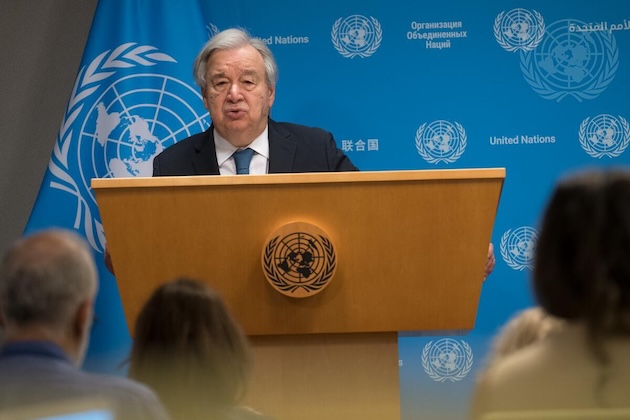
The report recognizes the uncertain but rapidly accelerating trajectory of AI, outlining two potential future scenarios: continued exponential growth that could widen existing gaps and exacerbate societal risks without sufficient oversight, or a plateau in AI capabilities that would provide other countries more time to develop their own capacities. Against this backdrop, UN Secretary-General António Guterres issued a clear call to action ahead of the Global Dialogue on AI Governance. He urged governments to act with urgency, emphasizing that delaying the establishment of shared rules will diminish their ability to influence the outcomes of AI, stressing that the scientific evidence is now available, and collective action is imperative.