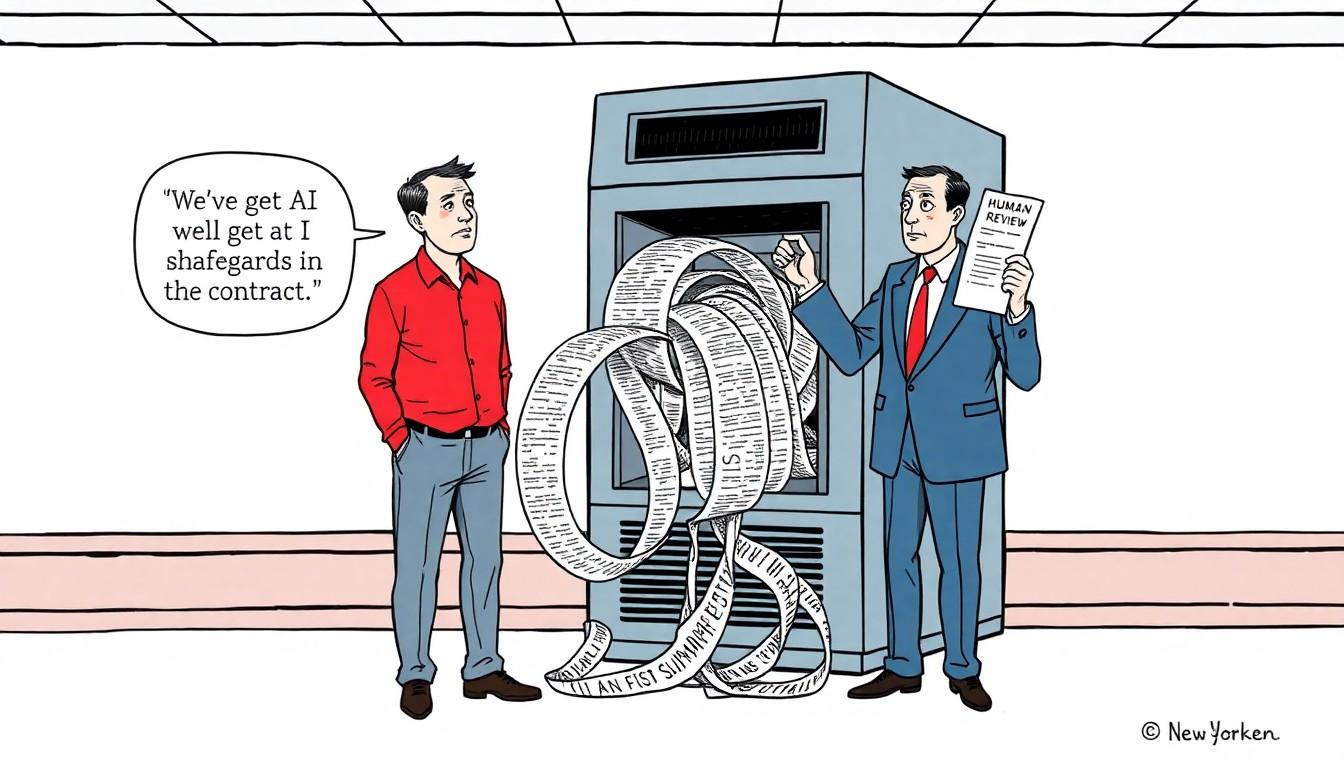
From USA Today Co.’s Palantir partnership to disputed automated summaries, journalists are pushing for binding rules on job protections, human review and disclosure.
Journalists Push for Comprehensive AI Regulations in Newsrooms Journalists in the US, particularly through the NewsGuild-CWA, are actively campaigning for the implementation of legally binding contract terms to govern the burgeoning use of Artificial Intelligence tools within newsrooms. This proactive stance is driven by profound concerns over job security, the critical need for human oversight and verification of AI-generated content, and the imperative of transparent disclosure to readers about the origin of published material. The movement has gained urgency in light of prominent cases such as USA Today Co.’s collaboration with data analytics firm Palantir and the emergence of problematic automated article summaries. This initiative reflects a broader effort to ensure that technological advancements serve to augment, rather than undermine, the fundamental principles of quality journalism. Union Challenges USA Today Co.'s AI Tools and Palantir Partnership USA Today Co., formerly Gannett, has embraced a variety of automated products, including AI-generated article summaries, short-form videos, and tools designed to aid in story creation. Concurrently, its partnership with Palantir, a data analytics firm, has become a focal point of union discontent. While USA Today Co. asserts that Palantir's operations are limited to controlled data and do not access newsroom systems or reporters' notes, NewsGuild members have vociferously called for an end to this collaboration. Their objections stem from serious questions regarding the protection and usage of reader information, as well as a perceived conflict of interest for a news organization to partner with a company known for its work with US immigration authorities—a subject frequently covered by its journalists. This highlights the ethical dilemmas and trust issues that arise when news entities integrate powerful, external AI and data firms. DeeperDive Chatbot Controversy and Journalistic Integrity A specific reader-facing chatbot, named DeeperDive, has ignited a separate and significant protest within newsrooms. The NewsGuild reported that journalists at the Akron Beacon Journal and Kent Ravenna Record-Courier initiated a 14-day byline strike in October 2026, protesting against automated summaries they neither wrote nor had the opportunity to verify. The union explicitly alleged that the DeeperDive tool generated several factual errors, notably including one instance where it incorrectly identified a reporter covering a murder case as the suspect. This incident underscores the profound concerns surrounding journalistic integrity, the potential for misinformation from unchecked AI, and the fundamental principle that journalists should only be associated with content they have personally verified, especially when employers themselves mandate human review for computer-generated material. NewsGuild Outlines Key AI-Related Bargaining Priorities for Contracts Jon Schleuss, president of the NewsGuild-CWA, firmly believes that robust contract terms, rather than mere management assurances, are indispensable for effectively setting boundaries on the use of automation in newsrooms. The union’s comprehensive bargaining priorities include critical provisions such as preventing AI-related job redundancies or pay reductions, establishing joint labor-management committees to rigorously review new AI systems, mandating explicit consent from journalists before their work is utilized to train or imitate AI models, and ensuring clear disclosure to readers when published material has been generated by a machine. Illustrative examples, like The New Republic's agreement, permit generative AI as a supplemental editorial tool but explicitly prohibit its use as the primary means of content creation, while also safeguarding jobs and pay from AI's impact. Other agreements, such as those at Ziff Davis, incorporate even more detailed disclosure requirements, setting a precedent for industry standards. Politico Case Sets Precedent for Challenging AI Tool Deployment A notable dispute involving Politico serves as a potent illustration of how explicit contract language can empower workers to successfully challenge the introduction of new AI tools by management. The NewsGuild reported that in November 2025, an arbitrator ruled that Politico had violated its existing agreement by implementing AI products without the mandatory prior notice and collective bargaining. This arbitration outcome led to a subsequent agreement where Politico consented to permanently shut down its "Capitol AI Report-Builder" and committed not to revive its "Live Summaries" tool. The union cited instances where these products produced significant factual errors, including a report-builder response that inaccurately failed to reflect the Supreme Court’s landmark reversal of Roe v. Wade. This case highlights the critical role of union contracts in ensuring responsible AI deployment and upholding accuracy in journalism. Crisis in Local Journalism Magnifies AI's Potential Impact The broader employment landscape for journalists paints a stark picture, which magnifies the potential implications of AI integration. The Local Journalist Index reveals a dramatic decline in local reporting capacity in the US, with the number of local journalist equivalents per 100,000 residents plummeting to 7.8 in 2026, an estimated 81 percent reduction from approximately 40 in 2002. This metric specifically aims to quantify reporting capacity, beyond just counting news outlets or employees. The index further indicates that roughly 70 percent of US counties, collectively home to about 209 million people, fall below this already alarmingly low national average. These sobering figures profoundly illuminate the critical stakes associated with newsroom cuts and underscore the necessity for careful consideration of how AI tools are adopted to avoid further eroding essential local reporting infrastructure. AI as an Aid, Not a Substitute, for Human Journalistic Accountability Despite the union's strong stance on AI regulation, NewsGuild president Jon Schleuss does not entirely dismiss the utility of artificial intelligence in newsrooms. He acknowledges and sees genuine potential in AI for specific, well-defined tasks, such as transcribing interviews, developing code to gather public data efficiently, and conducting exhaustive searches within vast document collections. However, Schleuss emphatically stresses that the fundamental condition for any beneficial AI use is that human journalists must meticulously check and verify the results, rather than accepting them as undisputed facts. For the NewsGuild, this crucial distinction is paramount as publishers increasingly adopt new systems while local reporting capacity continues to shrink. The union's core belief is that while AI tools can indeed assist journalists in their work, they can never legitimately substitute for the irreplaceable human judgment, ethical considerations, and accountability upon which reliable, trustworthy, and responsible journalism fundamentally depends.
Journalists Push for Comprehensive AI Regulations in Newsrooms
Journalists in the US, particularly through the NewsGuild-CWA, are actively campaigning for the implementation of legally binding contract terms to govern the burgeoning use of Artificial Intelligence tools within newsrooms. This proactive stance is driven by profound concerns over job security, the critical need for human oversight and verification of AI-generated content, and the imperative of transparent disclosure to readers about the origin of published material. The movement has gained urgency in light of prominent cases such as USA Today Co.’s collaboration with data analytics firm Palantir and the emergence of problematic automated article summaries. This initiative reflects a broader effort to ensure that technological advancements serve to augment, rather than undermine, the fundamental principles of quality journalism.
Union Challenges USA Today Co.'s AI Tools and Palantir Partnership
USA Today Co., formerly Gannett, has embraced a variety of automated products, including AI-generated article summaries, short-form videos, and tools designed to aid in story creation. Concurrently, its partnership with Palantir, a data analytics firm, has become a focal point of union discontent. While USA Today Co. asserts that Palantir's operations are limited to controlled data and do not access newsroom systems or reporters' notes, NewsGuild members have vociferously called for an end to this collaboration. Their objections stem from serious questions regarding the protection and usage of reader information, as well as a perceived conflict of interest for a news organization to partner with a company known for its work with US immigration authorities—a subject frequently covered by its journalists. This highlights the ethical dilemmas and trust issues that arise when news entities integrate powerful, external AI and data firms.
DeeperDive Chatbot Controversy and Journalistic Integrity
A specific reader-facing chatbot, named DeeperDive, has ignited a separate and significant protest within newsrooms. The NewsGuild reported that journalists at the Akron Beacon Journal and Kent Ravenna Record-Courier initiated a 14-day byline strike in October 2026, protesting against automated summaries they neither wrote nor had the opportunity to verify. The union explicitly alleged that the DeeperDive tool generated several factual errors, notably including one instance where it incorrectly identified a reporter covering a murder case as the suspect. This incident underscores the profound concerns surrounding journalistic integrity, the potential for misinformation from unchecked AI, and the fundamental principle that journalists should only be associated with content they have personally verified, especially when employers themselves mandate human review for computer-generated material.
NewsGuild Outlines Key AI-Related Bargaining Priorities for Contracts
Jon Schleuss, president of the NewsGuild-CWA, firmly believes that robust contract terms, rather than mere management assurances, are indispensable for effectively setting boundaries on the use of automation in newsrooms. The union’s comprehensive bargaining priorities include critical provisions such as preventing AI-related job redundancies or pay reductions, establishing joint labor-management committees to rigorously review new AI systems, mandating explicit consent from journalists before their work is utilized to train or imitate AI models, and ensuring clear disclosure to readers when published material has been generated by a machine. Illustrative examples, like The New Republic's agreement, permit generative AI as a supplemental editorial tool but explicitly prohibit its use as the primary means of content creation, while also safeguarding jobs and pay from AI's impact. Other agreements, such as those at Ziff Davis, incorporate even more detailed disclosure requirements, setting a precedent for industry standards.
Politico Case Sets Precedent for Challenging AI Tool Deployment
A notable dispute involving Politico serves as a potent illustration of how explicit contract language can empower workers to successfully challenge the introduction of new AI tools by management. The NewsGuild reported that in November 2025, an arbitrator ruled that Politico had violated its existing agreement by implementing AI products without the mandatory prior notice and collective bargaining. This arbitration outcome led to a subsequent agreement where Politico consented to permanently shut down its "Capitol AI Report-Builder" and committed not to revive its "Live Summaries" tool. The union cited instances where these products produced significant factual errors, including a report-builder response that inaccurately failed to reflect the Supreme Court’s landmark reversal of Roe v. Wade. This case highlights the critical role of union contracts in ensuring responsible AI deployment and upholding accuracy in journalism.
Crisis in Local Journalism Magnifies AI's Potential Impact
The broader employment landscape for journalists paints a stark picture, which magnifies the potential implications of AI integration. The Local Journalist Index reveals a dramatic decline in local reporting capacity in the US, with the number of local journalist equivalents per 100,000 residents plummeting to 7.8 in 2026, an estimated 81 percent reduction from approximately 40 in 2002. This metric specifically aims to quantify reporting capacity, beyond just counting news outlets or employees. The index further indicates that roughly 70 percent of US counties, collectively home to about 209 million people, fall below this already alarmingly low national average. These sobering figures profoundly illuminate the critical stakes associated with newsroom cuts and underscore the necessity for careful consideration of how AI tools are adopted to avoid further eroding essential local reporting infrastructure.
AI as an Aid, Not a Substitute, for Human Journalistic Accountability
Despite the union's strong stance on AI regulation, NewsGuild president Jon Schleuss does not entirely dismiss the utility of artificial intelligence in newsrooms. He acknowledges and sees genuine potential in AI for specific, well-defined tasks, such as transcribing interviews, developing code to gather public data efficiently, and conducting exhaustive searches within vast document collections. However, Schleuss emphatically stresses that the fundamental condition for any beneficial AI use is that human journalists must meticulously check and verify the results, rather than accepting them as undisputed facts. For the NewsGuild, this crucial distinction is paramount as publishers increasingly adopt new systems while local reporting capacity continues to shrink. The union's core belief is that while AI tools can indeed assist journalists in their work, they can never legitimately substitute for the irreplaceable human judgment, ethical considerations, and accountability upon which reliable, trustworthy, and responsible journalism fundamentally depends.