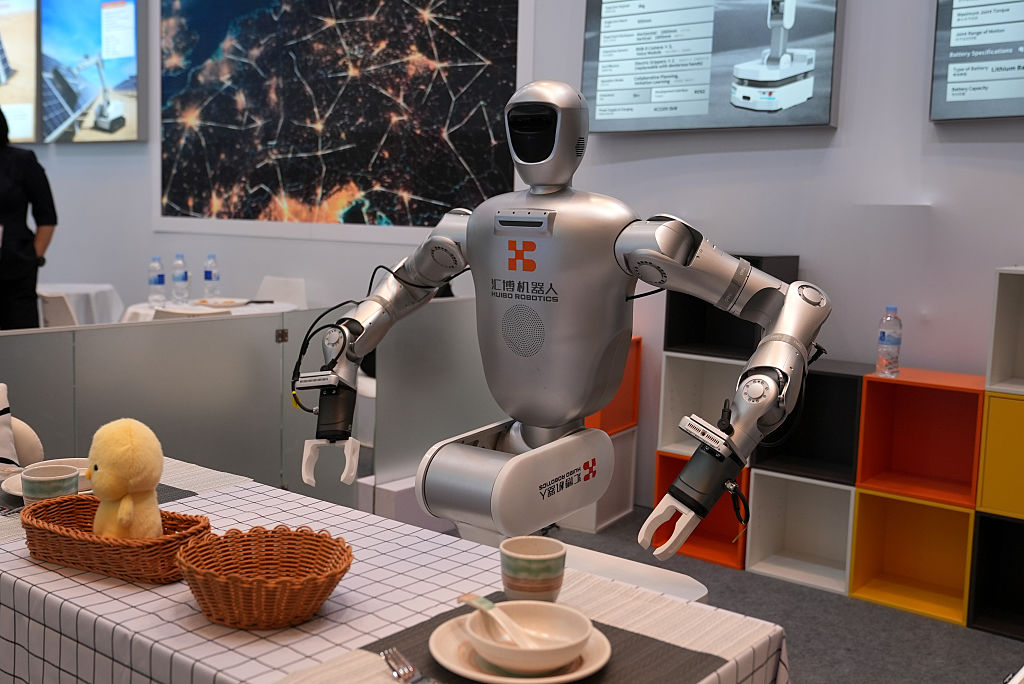
Karl Marx's profound analysis of capitalism's inherent drive to replace human labor with machines offers a crucial lens through which to understand the potential economic development following the widespread adoption of artificial intelligence. This article delves into how AI, characterized by extremely high organic composition of capital (constant capital dominating variable capital), could lead to a significant reduction in surplus value generated by labor. This reduction, in turn, suggests a tendency for the rate of profit to fall towards zero, a condition Marx theorized would eventually spell the end of capitalism. However, the author explores a nuanced perspective, suggesting that the integration of AI might not necessarily lead to the collapse of the capitalist system. Instead, it could necessitate the emergence of a dual economy: one highly automated and capital-intensive, and another thriving on human-specific labor that resists automation. This framework allows for a re-evaluation of AI's long-term impact on labor, skill development, and the overall stability of capitalist production, moving beyond simplistic predictions of either total human obsolescence or economic stagnation. It aims to reconcile Marxist economic principles with contemporary technological advancements, proposing a more complex future for labor and capital.
Marx's View on AI and the Falling Rate of Profit
From a Marxist perspective, the widespread introduction of artificial intelligence (AI) presents a significant challenge to the capitalist system, primarily through its impact on the labor theory of value and the rate of profit. AI-driven production processes are inherently capital-intensive, implying a very high organic composition of capital, where constant capital (machines, technology) dwarfs variable capital (wages for labor). According to Marx, surplus value, the source of capitalist profit, is exclusively generated by living labor. If the amount of living labor employed is drastically reduced or approaches zero, as in fully automated production, the surplus value produced will also be minimal or absent. Consequently, the rate of profit, calculated as surplus value divided by total capital (constant + variable capital), must also tend towards zero. This phenomenon aligns with Marx's "law of the tendency of the rate of profit to fall," which suggests that capitalists, in their pursuit of efficiency and cost reduction by replacing labor with machines, inadvertently erode the very source of their profits. Historically, Marxist economists like Rosa Luxemburg and Henryk Grossman explored this idea, predicting capitalism's self-destruction through increasing capital intensity. The article posits that if AI were to permeate the entire economy, this Marxist prediction of zero profits and the consequent collapse of capitalism would hold true, presenting a stark contradiction to current expectations of high profits from AI.
The Two-Sector Economy Solution
To reconcile Marx's theory with the contemporary expectation of continued capitalist profitability amidst AI integration, the article proposes a "two-sector" economic model. This model envisions an economy divided into two distinct parts. The first sector comprises highly automated, capital-intensive industries, where AI plays a dominant role, as initially described. Crucially, the existence of this sector is balanced by a second, equally vital sector characterized by a low organic composition of capital – meaning it is significantly more labor-intensive. This labor-intensive sector would focus on providing goods and services that either require unique human interaction and skill or are simply valued more highly when performed by humans. Examples include caring professions, nursing, high-level culinary arts, creative writing, sports, and personalized education. While AI might perform basic versions of some of these tasks, the demand for superior, human-delivered services would increase, creating substantial variable capital and thus generating considerable surplus value. In a capitalist system, commodity prices eventually adjust to equalize profit rates across sectors, meaning the immense capital invested in the AI sector would still yield high profits, proportional to its scale, by drawing on the surplus value generated in the labor-intensive sector. This interdependence prevents the profit rate in the automated sector from collapsing, ensuring overall economic equilibrium and capitalist viability. The survival of capitalism, therefore, hinges on this dual development, where AI-driven efficiency in one area fuels demand for human-centric services in another.
AI's Impact on Labor Skills and Future of Work
The introduction of artificial intelligence prompts significant questions about the future of labor skills. Initially, it might seem that AI would lead to a widespread de-skilling of the workforce, as machines take over tasks traditionally requiring human expertise in areas like computing, software development, writing, and even complex mathematics. This perspective suggests a "dumbing down" of a portion of the labor force whose skills become redundant. However, the article argues for a more nuanced and potentially optimistic outcome: the creation of new, highly sophisticated skills. To remain competitive and valuable in an AI-dominated landscape, human labor will be compelled to develop capabilities superior to those produced by AI. This dynamic will drive the emergence of occupations that demand advanced human creativity, emotional intelligence, critical thinking, and interpersonal skills – attributes that machines currently struggle to replicate or where human performance is inherently preferred. Therefore, while some parts of the labor force may indeed experience de-skilling, another segment will likely become far more skilled and specialized. Their competition will be less with other humans and more with advanced machines. The underlying belief is in human adaptability, suggesting that humans will always find a niche for tasks that machines cannot do, or where the human touch is uniquely appreciated and valued, such as in artistic performances (e.g., human ice skaters versus AI-generated ones). This dual process implies a bifurcation of the labor market rather than a uniform shift towards de-skilling or full automation, ultimately preserving a significant role for skilled human labor.