Quick Buzz Feed

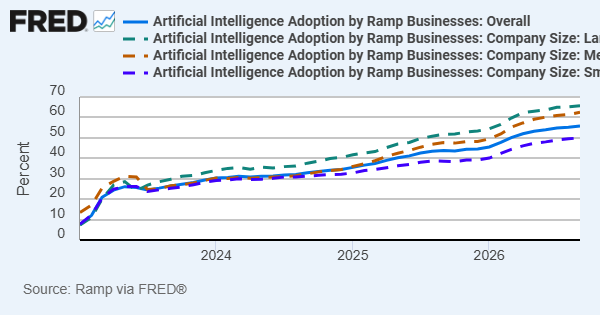
As of September 2026, more than half of all businesses paid for an artificial intelligence (AI) product or service. Adoption rates jumped after ChatGPT's public launch in late 2022 and have risen steadily since.
According to the Ramp AI Index, over half of all businesses were paying for an artificial intelligence (AI) product or service by September 2026. This adoption significantly increased following ChatGPT's public release in late 2022 and has continued to rise consistently.
The Ramp AI Index calculates AI adoption rates by analyzing corporate spending on services from AI companies. This method allows for estimating adoption across various segments, including overall businesses, different providers, industries, and company sizes. FRED recently integrated 14 new data series based on this source.
AI adoption has grown across businesses of all sizes, with larger and medium-sized companies showing the fastest spread, while small businesses, though growing steadily, are lagging. Industry type plays a significant role; the information sector (including software and publishing) consistently leads in adoption since 2023, closely followed by finance and insurance. Other industries such as manufacturing, retail trade, healthcare, construction, and accommodation and food services show lower adoption rates. In terms of providers, OpenAI experienced a surge after early 2023 but has since leveled off. Anthropic has seen steady growth since 2024, accelerating sharply in early 2026 to become the most widely adopted provider, while xAI remains a smaller player.
The data series from the Ramp AI Index do not account for employees using free AI tools (like Google's Gemini), AI features embedded in other software, or the intensity of tool usage, which is typically measured by spending on tokens. Further details on how accurately the Ramp index reflects business practices across the US can be found in the notes accompanying the FRED graphs.