Quick Buzz Feed

Explore how artificial intelligence displacement will reorganize the future of medical specialties, from radiology to psychiatry, and what it means for doctors.
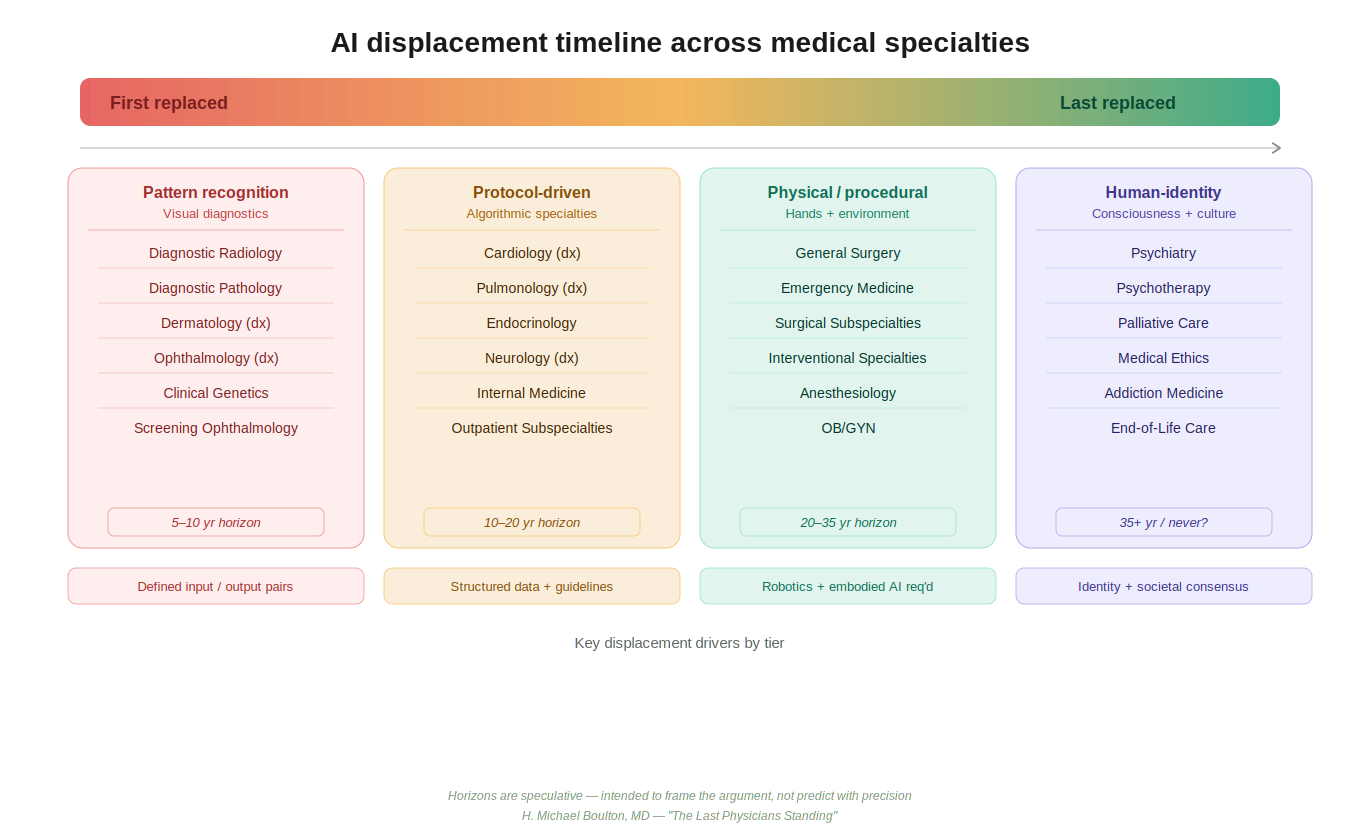
This section proposes a taxonomy to predict AI displacement in medical specialties, categorizing them into four tiers based on the nature of their cognitive tasks: pattern recognition, protocol-guided, physical intervention in dynamic environments, and human-identity specialties.
Tier 1 specialties like diagnostic radiology and pathology face existential threats from AI due to their reliance on pattern recognition. While AI will initially augment these roles, expanding access and efficiency, its superior performance will eventually lead to significant workforce displacement, making human review a potential source of error.
Tier 2 specialties such as cardiology and endocrinology, which apply evidence-based guidelines to structured data, are also vulnerable to AI, though at a slower pace. AI will enhance specialist reach and chronic disease management, but physicians' roles may eventually be reduced to supervising AI outputs as deep thinking neural networks manage routine cases.
Tier 3 specialties like emergency medicine and surgery are structurally protected by their need for physical intervention in chaotic, unpredictable environments. While AI will augment these roles by improving efficiency and warning systems, full displacement is decades away, requiring advanced robotics and artificial general intelligence to overcome environmental variance and the need for human improvisation.
Tier 4 specialties, including psychiatry, palliative care, and addiction medicine, are most resistant to AI displacement due to philosophical and cultural reasons. These fields engage with human suffering, identity, and therapeutic relationships, aspects society consistently expects to be handled by other human beings, making their full replacement unlikely despite technical advancements in AI.
The near-term future involves AI amplifying physician capabilities across all tiers, while the long-term forecasts significant disruption in Tier 1 and 2, and eventual challenges to Tier 3. The article urges the medical profession to proactively engage with these changes, invest in durable skills, and address the critical undersupply in human-centric specialties like psychiatry.