Quick Buzz Feed

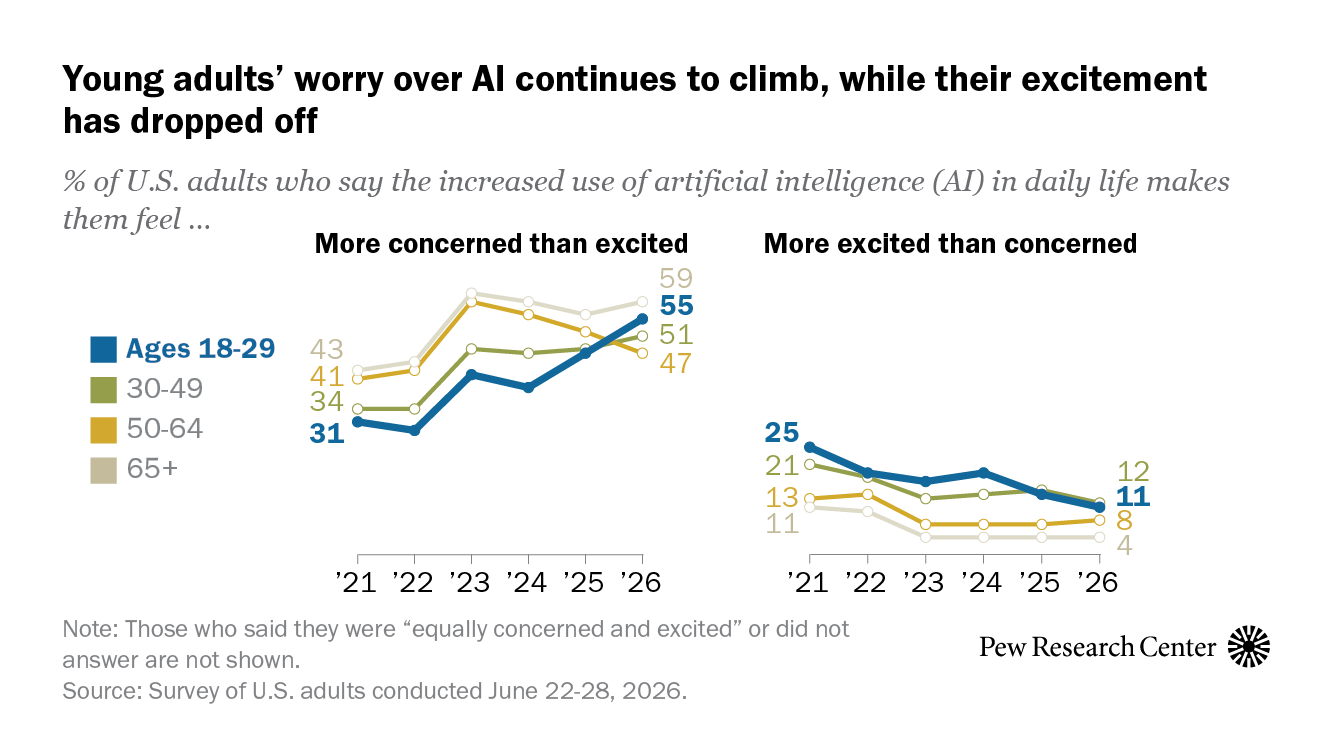
About half of Americans say they're more concerned than excited about AI, and young adults' concern is rising.
A Pew Research Center survey from June 2026 indicates a significant rise in public concern about artificial intelligence, with 52% of Americans now more concerned than excited, compared to 37% in 2021. This skepticism is particularly pronounced among young adults (under 30), where 55% express more concern, reflecting a consistent increase in wariness across all age groups and a decline in excitement since 2021. Young adults' rising concern has garnered attention in recent months.
The survey reveals a growing apprehension about AI's impact on employment, with 71% of U.S. adults believing AI will lead to fewer jobs over the next two decades, an increase from 64% in 2024. Only a small fraction (5%) anticipate more jobs due to AI, while others are unsure. Notably, 73% of adults under 30 now expect job losses, placing their concern on par with those aged 30 to 64. Worry over job loss has been a consistent theme in AI research among workers and teenagers, with experts divided on whether AI is a threat or a creator of jobs. Beyond employment, young adults are also more likely to perceive AI negatively for society and personal aspects like connection and creativity, even as they use AI chatbots.
This analysis is based on a Pew Research Center survey conducted from June 22-28, 2026, among 3,488 U.S. adults who are members of the American Trends Panel. The research aims to inform the public, journalists, and policymakers on evolving attitudes towards AI and its economic and societal impacts, building on previous studies concerning how people feel about AI, what they think it will do to jobs, and how their views and experiences differ by age. The methodology and questionnaire are publicly available.